
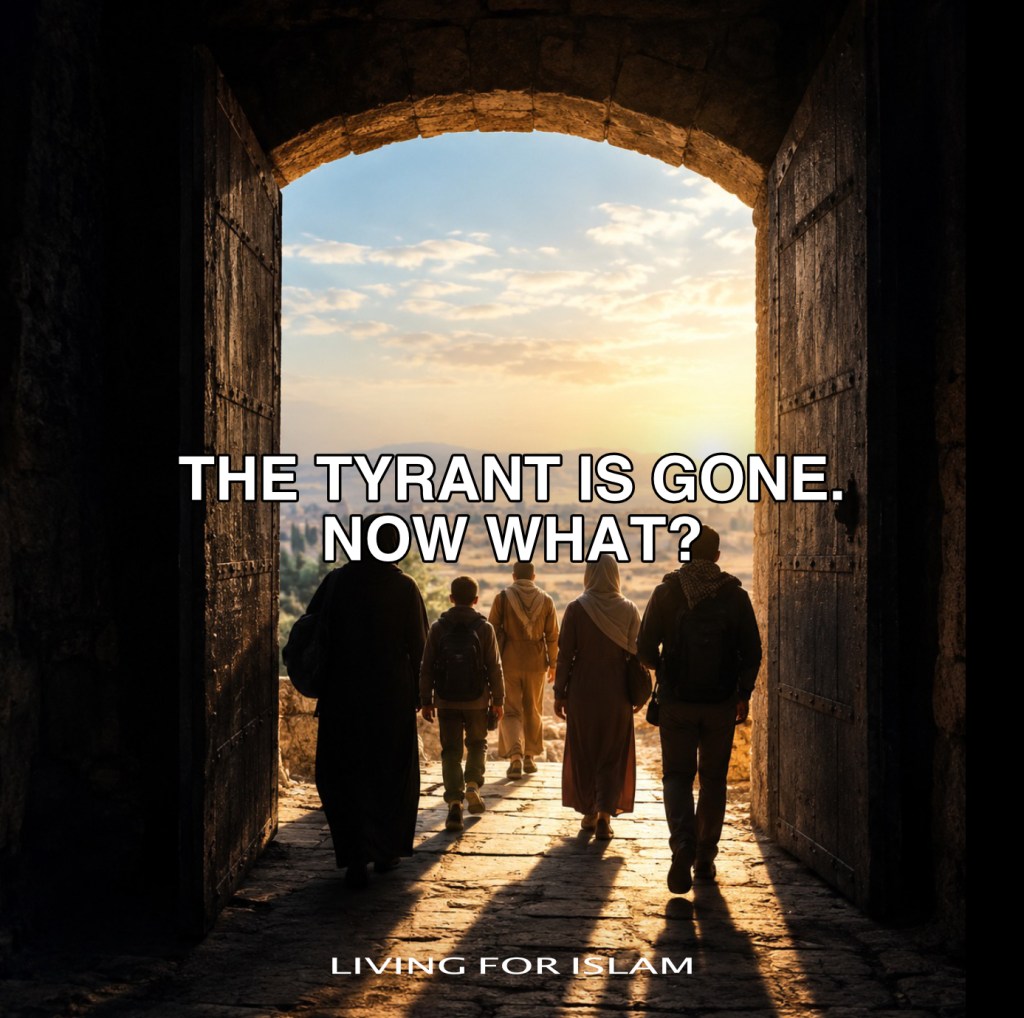
WHAT HAPPENS TO a people after the tyrant is gone?
It is easy to imagine that liberation is the end of the struggle. The tyrant falls. The prisons open. Fear begins to lift. People celebrate in the streets. A chapter of oppression that seemed as though it would never end is finally closed.
But the Qur’an gives us a different way of thinking about what comes next.
After Pharaoh had drowned and Banī Isrā’īl had been delivered from his rule, Allah reminds us of the mission given to Mūsā (as):
وَلَقَدْ أَرْسَلْنَا مُوسَىٰ بِآيَاتِنَا أَنْ أَخْرِجْ قَوْمَكَ مِنَ الظُّلُمَاتِ إِلَى النُّورِ وَذَكِّرْهُم بِأَيَّامِ اللَّهِ ۚ إِنَّ فِي ذَٰلِكَ لَآيَاتٍ لِّكُلِّ صَبَّارٍ شَكُورٍ
And We certainly sent Moses with Our signs: ‘Bring your people out of the darknesses into the light, and remind them of the Days of Allah.’ Surely in that are signs for everyone who is steadfast, grateful. (Ibrāhīm 5)
There is something easy to miss here. This came after Pharoah’s drowning, when Banī Isrā’īl have already escaped Egypt.
So what are the darknesses from which Mūsā (as) is being told to bring them out?
This is where the āyah becomes especially relevant to peoples who have recently experienced the removal of long-standing rulers, such as in Syria and Bangladesh
For the people who had lived through those periods, the removal of a long-standing ruler was an enormous historical rupture. Such moments should not be diminished. They are moments to remember and give thanks for. Moments in which people can look back and recognise that what once seemed immovable was, in fact, temporary.
But the Qur’anic question goes deeper. The darkness is not always outside us. Sometimes it is within us.
Tyrants can control a people for years. They can create fear, corruption and dependence and shape how people think about authority and what they believe they have to tolerate.
And when they finally fall, those habits do not necessarily disappear.
A people can be politically free while still carrying the mentality of oppression. They can have freedom but remain afraid. They can reject the old ruler but retain the corruption and political tribalism that flourished under him. They can change the people in power without changing their own expectations of power. The expectation that politics is simply a struggle to capture power rather than a responsibility to establish justice may remain, as can the desire for revenge.
This is why the Qur’an speaks of aẓ-ẓulumāti, the darknesses, in the plural. There is more than one darkness to leave behind. This is what makes the story of Banī Isrā’īl so instructive.
Pharaoh had been defeated. Yet their journey was far from over.
The people still had to break their attachment to what they had known and become a people capable of living differently. They still had to learn trust and patience.
The external tyrant had been removed. The internal transformation had only begun. Removing the ruler does not automatically remove the darknesses that tyranny has left behind.
That is why the Qur’an’s language is so important. Mūsā (as) is not simply told to remove Pharaoh. He is told to bring his people from the darknesses into the light.
The liberation of the body is one thing. The liberation of the mind and heart is another. And that second liberation can take much longer.
This is why Allah continues: wa dhakkirhum bi-ayyāmillāh, and remind them of the Days of Allah. Remember. Because human beings forget.
A people can experience years of oppression, pray for an opening, finally receive it, and then quickly begin to treat that opening as though it was inevitable.
Allah teaches something different. He asks us to remember the moments when Allah changed the course of your history. To remember the suffering, the opportunity and protection that He gave. To remember the doors that appeared when there seemed to be no way through. These are the Days of Allah.
Because remembering changes how we understand what has happened. It prevents liberation from becoming merely a story of what the people achieved by themselves. It reminds us that Allah is the One who gave that liberation.
Once a people recognise that as a favour from Allah, another question follows: What will we do with it?
The next āyah gives us the answer.
وَإِذْ قَالَ مُوسَىٰ لِقَوْمِهِ ٱذْكُرُوا۟ نِعْمَةَ ٱللَّهِ عَلَيْكُمْ إِذْ أَنجَىٰكُم مِّنْ ءَالِ فِرْعَوْنَ يَسُومُونَكُمْ سُوٓءَ ٱلْعَذَابِ وَيُذَبِّحُونَ أَبْنَآءَكُمْ وَيَسْتَحْيُونَ نِسَآءَكُمْ ۚ وَفِى ذَٰلِكُم بَلَآءٌ مِّن رَّبِّكُمْ عَظِيمٌ
When Musa said to his people, “Remember Allah’s favour upon you when He rescued you from the people of Pharaoh, who afflicted you with dreadful torment, slaughtering your sons and keeping your women. That was a severe test from your Lord.” (Ibrāhīm 6)
Again: Remember. But now the object becomes more specific. Remember Allah’s favour.
Do not simply remember the suffering you experienced before. But remember what Allah has given you since. The chance to live without fear, to establish justice, to rebuild and to raise a generation differently. These are blessings which demand a response.
That response is shukr, gratitude.
Allah says:
وَإِذْ تَأَذَّنَ رَبُّكُمْ لَئِن شَكَرْتُمْ لَأَزِيدَنَّكُمْ ۖ وَلَئِن كَفَرْتُمْ إِنَّ عَذَابِى لَشَدِيدٌ
And (remember) when your Lord proclaimed, “If you are grateful, I will certainly give you more. But if you are ungrateful, surely My punishment is severe.” (Ibrāhīm 7)
This is where the journey after liberation becomes so important.
Shukr is not simply saying alhamdulillah for the fall of a tyrant. Shukr means using the blessing Allah has given you in a way that pleases Him.
If freedom is a blessing, use it responsibly. If safety is a blessing, create safety for others. If the opportunity for justice is a blessing, establish justice. If Allah has opened the door to rebuilding, do not waste the opportunity.
The greatest danger after liberation is assuming that because the old darkness has gone, the light has already arrived. It has not. There is a journey between the two. And that journey requires ṣabr as well as shukr.
Allah ends the first āyah by describing those who recognise the signs in these events: likulli ṣabbārin shakūr, for everyone who is steadfast, grateful.
A liberated people need both.
Ṣabr, because rebuilding a society is difficult. Old habits do not disappear overnight. Institutions do not become trustworthy overnight. Generations shaped by fear do not suddenly become confident and responsible.
And shukr, because the opportunity itself is a gift from Allah and can easily be squandered.
For Syria and Bangladesh, and for every people that have experienced the removal of a tyrant, the moment of liberation therefore presents a profound question. Who are we going to become?
Will the old darknesses simply find new forms? Will corruption simply find new faces? Will fear be replaced by another form of domination? Will people continue to look for salvation in personalities rather than building a society rooted in justice and responsibility? Will they use this opening to become a different kind of people? The kind that Allah wants them to be?
That is the real journey and one that requires another kind of struggle. From the darknesses into the light. Remember the Days of Allah. Remember His favour. Be steadfast. Be grateful.
And then perhaps we begin to understand the promise: La-in shakartum la-azīdannakum, if you are grateful, I will surely increase you.
|QUR’ANIC REFLECTION · SURAH IBRAHIM 5-7|

