
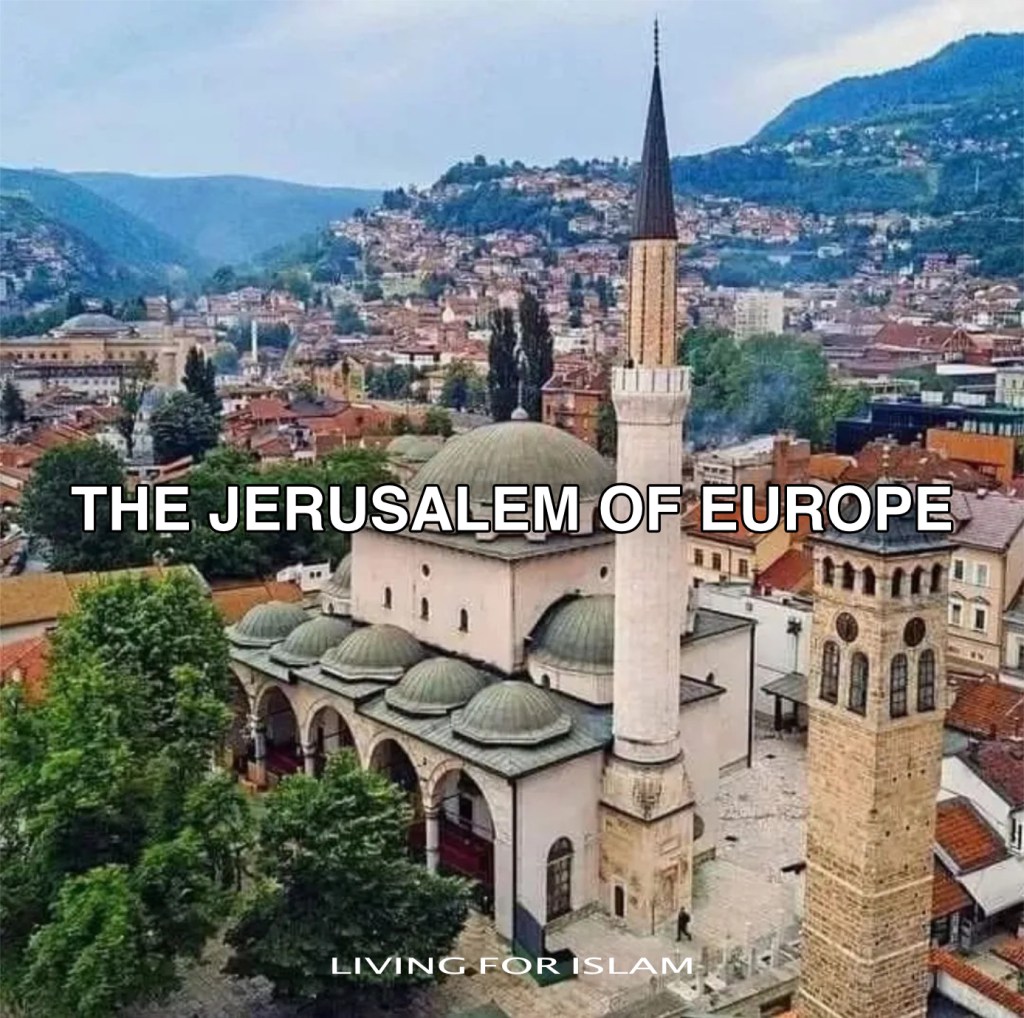
THEY CALL SARAJEVO the Jerusalem of Europe.
I understood why when I walked through the old city. A mosque. A church. A synagogue. Not separated by miles, but by metres.
The Gazi Husrev-beg Masjid stands at the heart of the old Ottoman city. A short walk away are Orthodox and Catholic churches, and nearby is the historic synagogue.
Three faiths. Three histories. Three communities. And yet they occupy the same small corner of the city.
For a visitor, it might simply seem like an interesting example of religious diversity. But as I stood there, I found myself asking a deeper question: What made it possible for people of different faiths to live alongside one another like that?
The answer is Islam.
Islam does not pretend that people will all believe the same thing. Nor does it say that religious difference must disappear before society can have peace.
Allah says:
لَّا يَنْهَىٰكُمُ ٱللَّهُ عَنِ ٱلَّذِينَ لَمْ يُقَـٰتِلُوكُمْ فِى ٱلدِّينِ وَلَمْ يُخْرِجُوكُم مِّن دِيَـٰرِكُمْ أَن تَبَرُّوهُمْ وَتُقْسِطُوٓا۟ إِلَيْهِمْ ۚ إِنَّ ٱللَّهَ يُحِبُّ ٱلْمُقْسِطِينَ
Allah does not forbid you from dealing kindly and fairly with those who have neither fought nor driven you out of your homes. Surely Allah loves those who are fair. (al-Mumtaḥanah 8)
Notice the words Allah uses. Not merely leave them alone. An tabarrūhum, to deal with them with goodness. And wa tuqsiṭū ilayhim, to deal with them justly.
And the Prophet ﷺ placed the protection of non-Muslims under Muslim authority among matters of such seriousness that he said: “Whoever kills a Muʿāhid will not smell the fragrance of Paradise.” (Bukhari)
This is not simply an abstract teaching about tolerance. It is a conception of society in which people of different faiths have rights, responsibilities and a recognised place within the political order.
Perhaps that is why Sarajevo’s streets are so striking.
The masjid, the church and the synagogue are not simply three buildings belonging to different religions. They are reminders of different communities living within the same city.
And Sarajevo is not the only place where this history can be seen.
When ʿUmar ibn al-Khaṭṭāb (ra) entered Jerusalem in the seventh century, the city became part of the Muslim world. Yet its Christian inhabitants were not required to abandon their churches or their faith.
The accounts of ʿUmar’s (ra) assurance to the people of Jerusalem describe protection for their lives, their property, their churches and their religion. There is an especially beautiful detail in the traditional account. The Christian patriarch invited ʿUmar to pray inside the Church of the Holy Sepulchre. He declined. He did not want his prayer inside the church to become a pretext for Muslims in a later generation to claim the building as a masjid.
Think about that. A Muslim ruler standing inside one of Christianity’s holiest places, possessing the political power to take it, and deliberately choosing not to create a precedent that might endanger the Christians’ possession of it.
Centuries later, when Ṣalāḥ al-Dīn recaptured Jerusalem from the Crusaders in 1187, the same principle appeared again. His advisers debated what should happen to the Church of the Holy Sepulchre. The majority argued that it should not be destroyed or closed to Christian pilgrims, referring specifically to the protection granted under ʿUmar. The church was preserved.
This does not mean Muslim history was perfect. Muslim rulers and Muslim societies sometimes fell short of Islamic principles, and there were periods of injustice and persecution. But principles matter. Across the eight centuries of Muslim rule, Jerusalem experienced long periods of relative stability, while Christian and Jewish communities continued to live and worship there. Muslim rulers and jurists repeatedly understood their role as being custodians of the city, protecting its sacred places and the rights of its different religious communities.
Islam did not require religious difference to disappear before people could live together. It gave that difference a place within an ordered society. And perhaps this is a concept the world needs to recover today.
We live at a time when hatred and intolerance towards people because of their religion or identity remain painfully visible across the world. Difference is too often treated as a threat rather than something that can exist within a just society.
Islam offers something more substantial than the vague idea of tolerance. It offers justice, rights and responsibilities, and a framework in which people can remain different without having to live as enemies.
And perhaps that is what struck me most in Sarajevo. Simply walking through the old city and finding a masjid, a church and a synagogue almost next door to one another, told me something about Islamic governance.
These were not simply symbols of religious diversity. But a reminder that coexistence requires more than tolerance. It requires justice. It requires rights. It requires responsibilities. And it requires an order capable of protecting people who do not share your faith.
Perhaps that is one reason Sarajevo has been called the Jerusalem of Europe. And perhaps, for a Muslim, there is something deeper to see in that name.

