

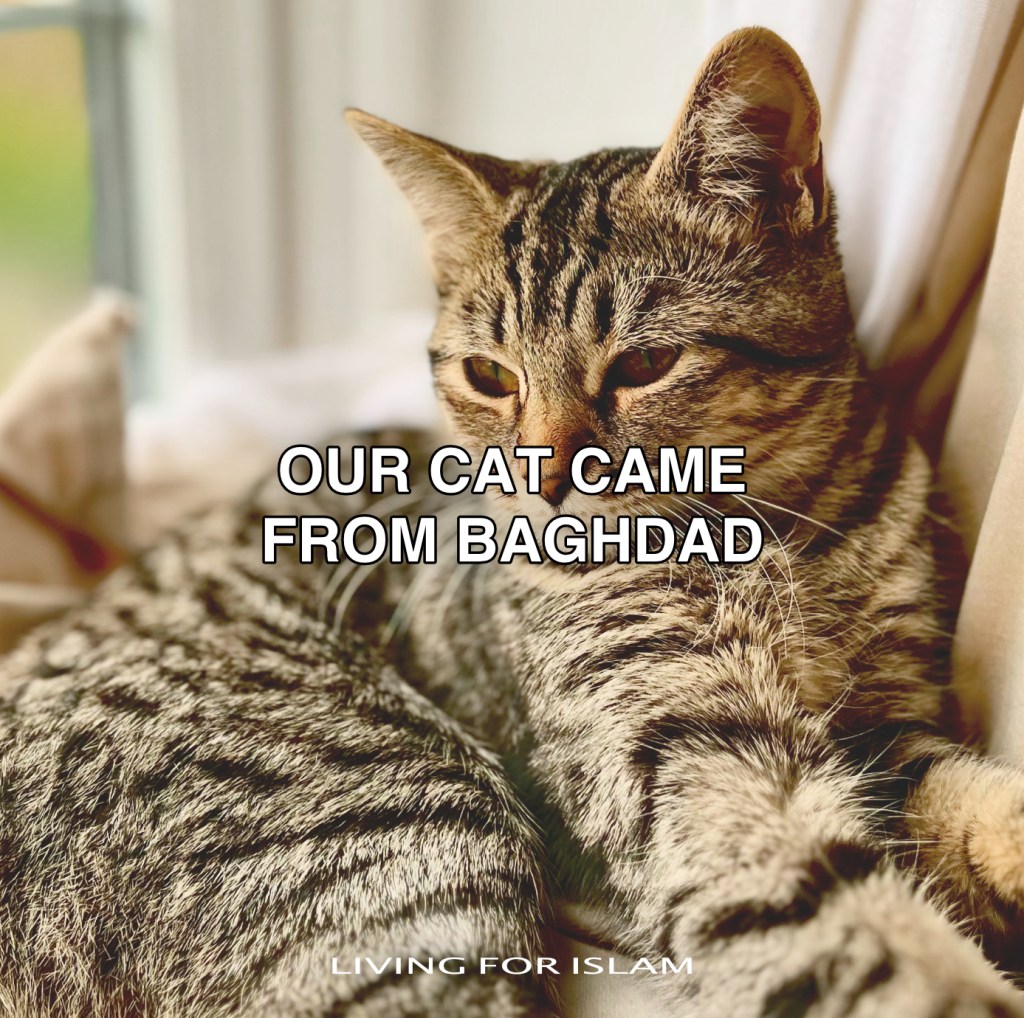
WE ADOPTED A cat this week. A nine-month-old domestic shorthair with dark stripes running along her sleek brown-grey coat, in a pattern known as a mackerel, or fishbone, tabby.
She has started to explore her new home, walking softly across the floor with her tail held high one moment, disappearing under the bed or settling on the windowsill the next. Those stripes make her look like a tiny tiger, rippling across her coat as she moves.
I have long been familiar with the word “tabby”. But I wasn’t aware of where it came from.
So I was pleasantly surprised to discover that the word has its origins in Baghdad. And not originally as a word for a cat. It began with a fabric.
In medieval Baghdad there was a district known as al-’Attābiyya, associated with the production of a silk taffeta called ’attābī, prized for its irregular, wavy watered finish. The fabric became known far beyond Baghdad, and its name travelled with it.
The textile moved through the wider Islamic world and into Mediterranean trade. Baghdad, as the capital of the Abbasid khilafah, sat at the centre of trade routes stretching from Muslim Spain to Central Asia. Goods travelled along these routes, but so did ideas, techniques and words.
In Muslim Spain, ‘attābī cloth was produced in Almería, one of the great centres of silk manufacture in al-Andalus.
Eventually, the word crossed into European languages. It became attabi in Spanish, tabì, in Italian, tabyn in Dutch, tabis in French and tabby in English.
For centuries, then, tabby meant cloth rather than cat, a fashionable textile used for clothing and furnishings. Only later did the name attach itself to cats whose rippling, watered coats recalled the appearance of the fabric.
What I find fascinating is that the most ordinary words can hide traces of a once-great Islamic civilisation. Arabic words entered European languages through diplomacy, trade, scholarship, agriculture, science and everyday life. Think of the words “sugar,” “cotton,” and “mattress,” words we use without a thought for the Arabic language and civilisation behind them.
Language can preserve traces of encounters between civilisations long after we have forgotten the encounters themselves. And tabby is one of those traces.
A word that began with a textile associated with a neighbourhood of Baghdad travelled through the Islamic world, across the Mediterranean and into European languages. And this week, after centuries of travelling, it arrived at our door as a small striped kitten padding cautiously across the floor.
Now she is part of our family. A little piece of Baghdad history has somehow found its way into our home. And our tiny tiger is here to stay.

