
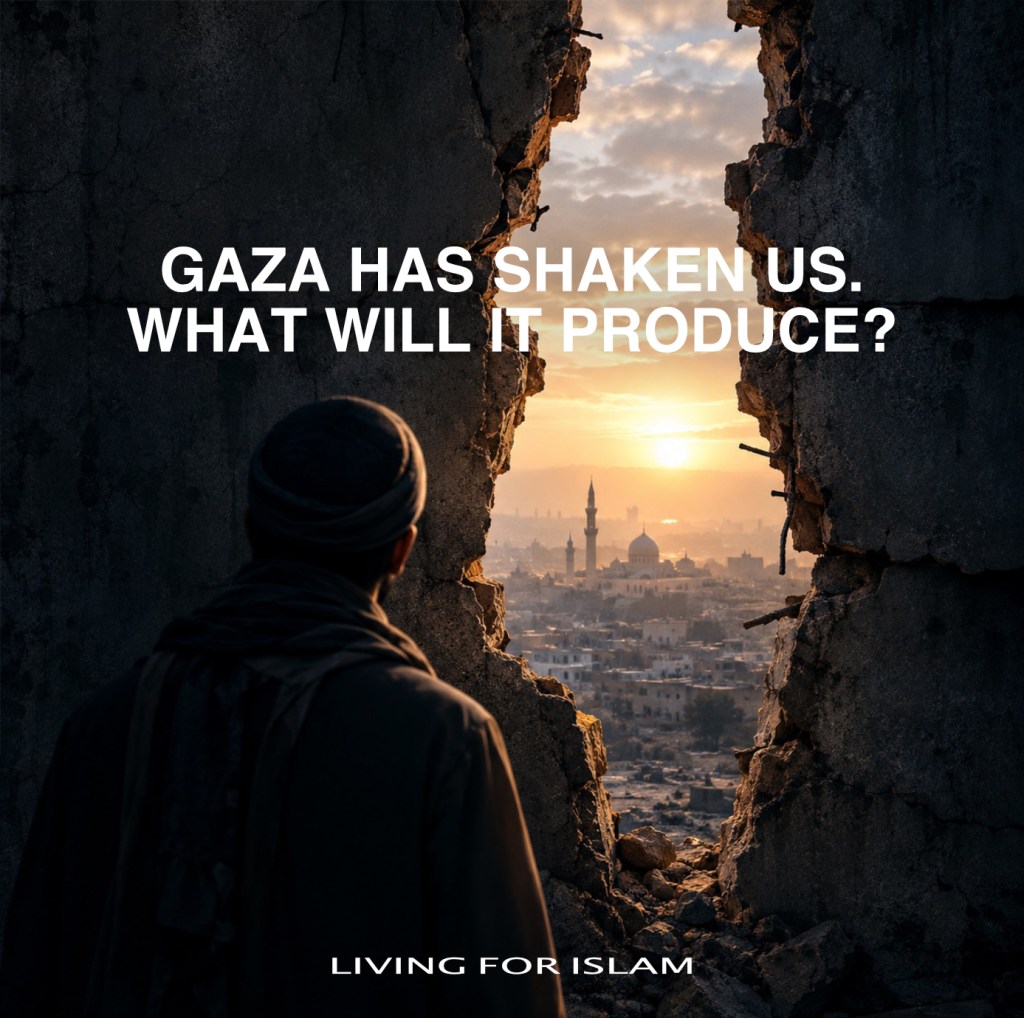
SOME EVENTS ARE so overwhelming that they shake something inside us.
Gaza has been one of those events.
For many Muslims, what has happened over the past three years has not simply produced grief and anger. It has unsettled assumptions that once seemed secure. Assumptions about international law, human rights, Western governments, the institutions of the international order, the Muslim world and its governments, the media, and perhaps even our own understanding of what it means to belong to an Ummah.
The Qur’an gives us a remarkable way of thinking about what happens when believers are shaken.
During the Battle of Al-Ahzab, the Muslims in Madinah faced an overwhelming coalition surrounding the city. The danger and fear were real. Allah captures what they experienced.
هُنَالِكَ ابْتُلِيَ الْمُؤْمِنُونَ وَزُلْزِلُوا زِلْزَالًا شَدِيدًا
“There the believers were tested and shaken with a severe shaking.” (al-Ahzab 11)
The word zulzilū comes from the same root as an earthquake. Something stable is violently shaken. What appeared firm is disturbed.
Gaza has done something similar. It has forced many to reexamine what they believed in and how they viewed the world. But Allah shows us something even more important. The same shaking does not produce the same response in everyone.
Immediately afterwards, Allah describes what the hypocrites and those in whose hearts is a disease said:
مَا وَعَدَنَا اللَّهُ وَرَسُولُهُ إِلَّا غُرُورًا
“Allah and His Messenger promised us nothing but delusion.” (al-Ahzab 12)
The crisis became, for them, evidence against the truth of Allah’s promise.
But later Allah shows us another response:
وَلَمَّا رَأَى الْمُؤْمِنُونَ الْأَحْزَابَ قَالُوا هَٰذَا مَا وَعَدَنَا اللَّهُ وَرَسُولُهُ وَمَا زَادَهُمْ إِلَّا إِيمَانًا وَتَسْلِيمًا
And when the believers saw the confederates, they said, “This is what Allah and His Messenger promised us,” and it only increased them in iman and submission. (al-Ahzab 22)
The armies, the danger, the threat of complete annihilation was no less real. In fact, Allah deliberately says ra’a, they saw. They looked directly at the reality in front of them. Yet they interpreted what they saw through revelation.
The same reality of war produced two very different conclusions. For some, the shaking led to doubt. For others, it led to an increase in imān and taslīm (submission).
That gives us an important question about Gaza.
It is not simply: Has the shaking awakened us? Millions of people have been awakened in some sense. They have seen things they had never seen before. They have had to question assumptions they once held. They have become angry at injustice. They have protested, donated, boycotted, written to politicians, contacted representatives, raised awareness and tried to use whatever influence they possess.
All of these things have a place. It matters to raise awareness and speak against injustice. Relieving suffering matters. But waking up is not the goal.
The Qur’anic believers did not merely become more aware of what was happening around them. Their seeing led to an increase in conviction and then submission.
So we have to ask: What is our awakening producing? Is it simply anger? Is it despair and cynicism about the world? Is it an endless search for another individual action we can take? Or is the shaking taking us back to Islam with more conviction and making us ask what Allah actually requires from us in this situation?
What does Islam say we should do?
This is where the discussion becomes uncomfortable.
When we see oppression, we often ask: “What can I do?”
But because our political imagination tends to reduce political responsibility to what the individual citizen can do, the answers naturally become individual ones. Donate. Protest. Boycott. Write to your MP. Raise awareness. Contact organisations. Share information.
But after three years, we should also be willing to ask a deeper question. Have we confused the means available to an individual with the response required of an Ummah?
Islam certainly teaches us to feel the suffering of other Muslims. The Prophet ﷺ described the believers as one body: when one limb suffers, the whole body responds with sleeplessness and fever. (Bukhari) But Islam does not leave our response at compassion.
Allah also says:
وَمَا لَكُمْ لَا تُقَاتِلُونَ فِي سَبِيلِ اللَّهِ وَالْمُسْتَضْعَفِينَ مِنَ الرِّجَالِ وَالنِّسَاءِ وَالْوِلْدَانِ
“And what is wrong with you that you do not fight in the cause of Allah and for the oppressed among men, women and children…” (an-Nisa 75)
And then He gives us the cry of the oppressed:
رَبَّنَا أَخْرِجْنَا مِنْ هَٰذِهِ الْقَرْيَةِ الظَّالِمِ أَهْلُهَا وَاجْعَل لَّنَا مِن لَّدُنكَ وَلِيًّا وَاجْعَل لَّنَا مِن لَّدُنكَ نَصِيرًا
“Our Lord, take us out of this city whose people are oppressors, and appoint for us from Yourself a protector and appoint for us from Yourself a helper.” (an-Nisa 75)
Notice the language. The oppressed ask for a walī and a naṣīr. A protector and a helper.
There is a recognition here that oppressed people may not possess the capacity to remove oppression themselves. They need others who have the ability to help them.
And Allah speaks explicitly about this relationship elsewhere.
وَإِنِ ٱسْتَنصَرُوكُمْ فِى ٱلدِّينِ فَعَلَيْكُمُ ٱلنَّصْرُ
“And if they seek your help in religion, then it is upon you to help them.” (al-Anfal 72)
Fa-‘alaykumu-nnaṣr, then upon you is the help. This is more than a feeling. It is a conception of collective responsibility.
Individuals have varying abilities. A Muslim without authority, an army, political power, or means to change the situation cannot be expected to act as those with such power do.
Islam does not place responsibility beyond capacity. But individual inability does not make collective responsibility disappear. Those who possess the capacity have responsibilities corresponding to that capacity. And those who do not possess that capacity can still use their voice to call upon those who do possess the capacity to fulfil their responsibility.
We have become accustomed to asking, “What can I do?” But perhaps we also need to ask, “What does Islam require, and who has the capacity to fulfil it?”
Where is our imagination?
Perhaps one reason this question is so rarely asked is that we have gradually become accustomed to thinking that political action must take place within the framework that already exists.
We know how to organise demonstrations. We are encouraged to lobby politicians and petition governments. We are taught how to campaign for sanctions and to appeal to international institutions.
But why should these tools only be used to demand solutions within the existing political framework?
If we believe Islam has its own conception of how the Ummah should respond to oppression, why shouldn’t Muslims also raise awareness of that Islamic conception? Why shouldn’t we discuss it and educate people about it? Why shouldn’t we remind Muslims of the Qur’anic concepts of wilāyah, naṣr, collective responsibility and preparation of power? And why shouldn’t we call upon those who possess authority and capacity to consider and fulfil the responsibilities Islam places upon them?
If we can protest and lobby to raise awareness about a particular political response, we can also use those same capacities to raise awareness about the Islamic response. If we can organise people around a demand, we can educate them about an Islamic demand. If we can ask those in positions of authority to act, we can also ask them to consider what their authority means in the sight of Allah.
The issue is not that Muslims should stop caring about the practical things they can do. The issue is whether those individual actions have become a substitute for thinking about the collective responsibility of the Ummah.
If we never discuss an Islamic response, how can we expect Muslims to demand one?
And those who possess authority cannot be called to fulfil a responsibility that the Ummah itself has stopped discussing.
We need more than reaction
The Qur’an does not describe an Ummah that simply waits for oppression to happen and then searches for ways to react.
Allah says:
وَأَعِدُّوا۟ لَهُم مَّا ٱسْتَطَعْتُم مِّن قُوَّةٍ
“And prepare against them whatever power you are able.” (al-Anfal 60)
Preparation is different from reaction. It asks what kind of capacity an Ummah needs before the crisis arrives. That includes political, economic, military and intellectual capacity, as well as the institutions, leadership and unity needed to protect those who are oppressed.
These are not questions that can be answered by asking an individual Muslim to donate another £20 or attend another demonstration. They are questions about the condition and capacity of the Ummah itself. And perhaps this is one of the things Gaza has exposed.
We have become very good at asking the individual Muslim to do something. But we have not been nearly as willing to ask what kind of Ummah we need to become.
What will the shaking produce?
Gaza has shaken us. The question is what we do with that shaking. The believers at al-Ahzab did not simply become more aware of the danger around them. What they saw increased them in imān and taslīm. Perhaps our test is similar. Will this shaking leave us with anger and despair, or will it drive us back to the Qur’an, to understand what Allah requires from us, from those who possess authority, and from the Ummah as a whole?
The shaking has happened. What will it produce?
|QUR’ANIC REFLECTION · SURAH AL-AHZAB 11-22|

