

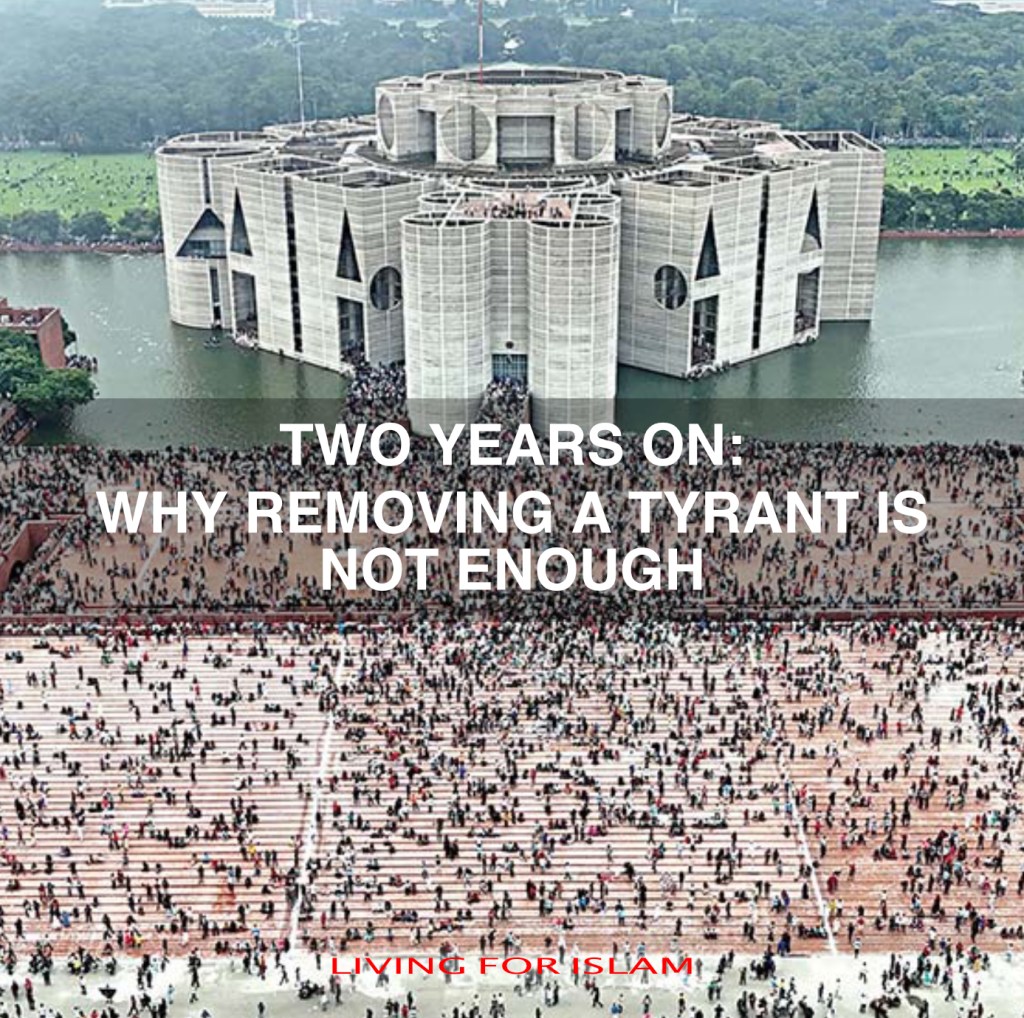
TWO YEARS AGO today, Bangladesh witnessed a moment few believed possible. After fifteen years of increasingly authoritarian rule, Sheikh Hasina fled the country following a month-long uprising led largely by students and young people.
The price was immense. Hundreds lost their lives. Thousands were injured. Families continue to carry wounds that will never fully heal.
Yet two years later, many Bangladeshis also feel that the hopes of that uprising remain only partially fulfilled. Removing a ruler proved easier than rebuilding a just society.
One of the remarkable features of the Qur’an is that it rarely presents evil as the work of one extraordinary individual. Instead, it exposes the structures that allow oppression to flourish.
This is particularly evident in Surah al-Qaṣaṣ.
At first glance, the surah appears to tell several different stories: the birth of Mūsā (as), his confrontation with Pharaoh, and later the account of Qārūn. Yet these are not disconnected narratives. Read together, they reveal something profound.
Surah al-Qaṣaṣ does not merely tell us how tyrants behave. It teaches us how tyranny functions.
The opening verses establish this theme.
Allah first describes Pharaoh’s oppression:
إِنَّ فِرْعَوْنَ عَلَا فِى ٱلْأَرْضِ وَجَعَلَ أَهْلَهَا شِيَعًۭا يَسْتَضْعِفُ طَآئِفَةًۭ مِّنْهُمْ يُذَبِّحُ أَبْنَآءَهُمْ وَيَسْتَحْىِۦ نِسَآءَهُمْ ۚ إِنَّهُۥ كَانَ مِنَ ٱلْمُفْسِدِينَ
Indeed, Pharaoh exalted himself in the land and divided its people into factions. He oppressed one group among them, slaughtering their sons and sparing their women. Indeed, he was among the corrupters. (al Qasas 4)
Everything about these verses suggests that Pharaoh is in complete control. He legislates. He divides society. He decides who lives and who dies. History appears to be unfolding according to his will.
Then the narrative is interrupted.
Allah says:
وَنُرِيدُ أَن نَّمُنَّ عَلَى الَّذِينَ اسْتُضْعِفُوا فِي الْأَرْضِ
“But We intended to show favour to those who had been oppressed in the land…” (al Qasas 5)
The contrast is startling. Pharaoh has a plan. Allah has a plan.
The Qur’an does not argue with Pharaoh’s apparent power. It simply introduces a higher will.
The choice of words is remarkable. While Pharaoh busies himself making plans, Allah says, Wa nurīdu, we intended. Even as the tyrant believes he is directing history, Allah reveals that history has always been unfolding according to His decree.
Pharaoh orders the killing of newborn boys. Allah decrees that the very child Pharaoh fears will be raised in his own palace. Every attempt Pharaoh makes to secure his rule becomes part of the means by which Allah brings about its collapse.
This is one of the Qur’an’s recurring themes. Human beings possess intention and agency, but every human plan exists within the greater reality of Allah’s decree.
Tyranny is Never a One-Person Project
Allah then says:
وَنُمَكِّنَ لَهُمْ فِي الْأَرْضِ وَنُرِيَ فِرْعَوْنَ وَهَامَانَ وَجُنُودَهُمَا مِنْهُمْ مَا كَانُوا يَحْذَرُونَ
“And We intended to establish them securely in the land, and to show Pharaoh, Haman and their soldiers, through them, that which they had been fearing.” (al Qasas 6)
One question naturally arises: Why does Allah mention Pharaoh, Haman and the soldiers? Why not simply say: “to show Pharaoh”?
The answer reveals a deep insight into the nature of oppression.
A tyrant cannot oppress alone. Political authority requires institutions. Institutions require enforcement.
Allah therefore exposes and dismantles not only a dictator, but an entire system.
The wording of the ayah is particularly subtle. Allah says: wa junūdahumā, their soldiers. The dual pronoun (–humā) refers to both Pharaoh and Haman.
Allah does not say: “Pharaoh’s soldiers.” Nor does he say: “Haman’s soldiers.” He says: their soldiers.
This tiny grammatical choice carries enormous meaning.
The machinery of oppression belongs to them both. Pharaoh represents political authority. Haman represents the administrative machinery that advises, organises, legitimises and sustains that authority. The soldiers serve both. Oppression is therefore portrayed as a shared enterprise rather than the actions of one individual.
Allah broadens accountability: The ruler is accountable. The bureaucrat is accountable. The enforcers are accountable.
Later in the surah another figure appears. Qārūn.
At first glance, his story seems disconnected from Pharaoh. In reality, it completes the picture.
Unlike Pharaoh, Qārūn possesses no throne. Unlike Haman, he holds no office. Unlike the soldiers, he commands no army. His influence comes through wealth.
He emerged from among the oppressed themselves. Yet his immense wealth aligned him with the structures of oppression.
The Four Pillars of Tyranny
Read as a whole, Surah al-Qaṣaṣ presents four enduring archetypes:
- Pharoah — the ruler who concentrates political power.
- Haman — the bureaucrat who organizes and legitimizes it.
- The soldiers — those who enforce it through coercion.
- Qārūn — the wealthy elite whose economic interests become tied to the existing order.
Together they form the architecture of oppression. Political authority commands. Bureaucracy administers. Force enforces. Wealth profits. Each pillar reinforces the others.
The Illusion of Permanence
To those living under oppressive systems, these pillars often appear immovable.
Political authority seems permanent. Institutions appear too entrenched to change. Military power appears overwhelming. Great wealth seems untouchable.
But Surah al-Qaṣaṣ reveals that every pillar rests upon an illusion. Pharoah believed political power made him untouchable. Haman trusted the institutions he had helped build. The soldiers relied upon their strength. Qārūn trusted his wealth.
Each placed confidence in something temporary. Yet every pillar collapses. Pharaoh is drowned. Haman falls with the regime he served. The soldiers are overwhelmed despite their force. Qārūn is swallowed by the earth together with the wealth in which he placed his confidence.
Political power is fragile. Institutions are fragile. Military power is fragile. Wealth is fragile.
When separated from justice and accountability before Allah, none possesses permanence.
When One Pillar Falls but the Structure Remains
One of the most important lessons from Surah al-Qaṣaṣ is that the fall of a ruler is not necessarily the same as the transformation of a society.
The Qur’an does not only ask: “Who is Pharaoh?”
It asks: “What allowed Pharaoh to function?”
Who organised his rule? Who enforced his commands? Who benefited from the system? Who became invested in preserving it?
This is why Allah mentions Pharaoh, Haman and the soldiers together.
The removal of one person does not automatically remove the structures, incentives and relationships that sustained that person.
Bangladesh’s experience over the past two years illustrates this Qur’anic principle.
A ruler departed almost overnight. Yet institutions shaped over many years do not disappear with one resignation. Networks of patronage, habits of governance, bureaucratic culture and entrenched interests continue long after a palace has been emptied.
The Qur’anic lesson is that genuine transformation requires more than replacing individuals. It requires justice, accountability and the rebuilding of the entire system so that oppression cannot simply reproduce itself under different names.
Even after Pharaoh drowned, Mūsā (as) and Banī Isrā’īl still had a journey ahead of them. Liberation from a tyrant was only the beginning.
Building a society rooted in justice, accountability and obedience to Allah was the greater challenge.
Two years on, Bangladesh reminds us that this remains true today. The fall of a tyrant can happen in a single day. The building of a just society takes far longer.
The Qur’an distinguishes between escaping oppression and establishing justice.
Every generation that seeks liberation must remember the difference.


One thought on “Two Years On: Why Removing a Tyrant is Not Enough”