
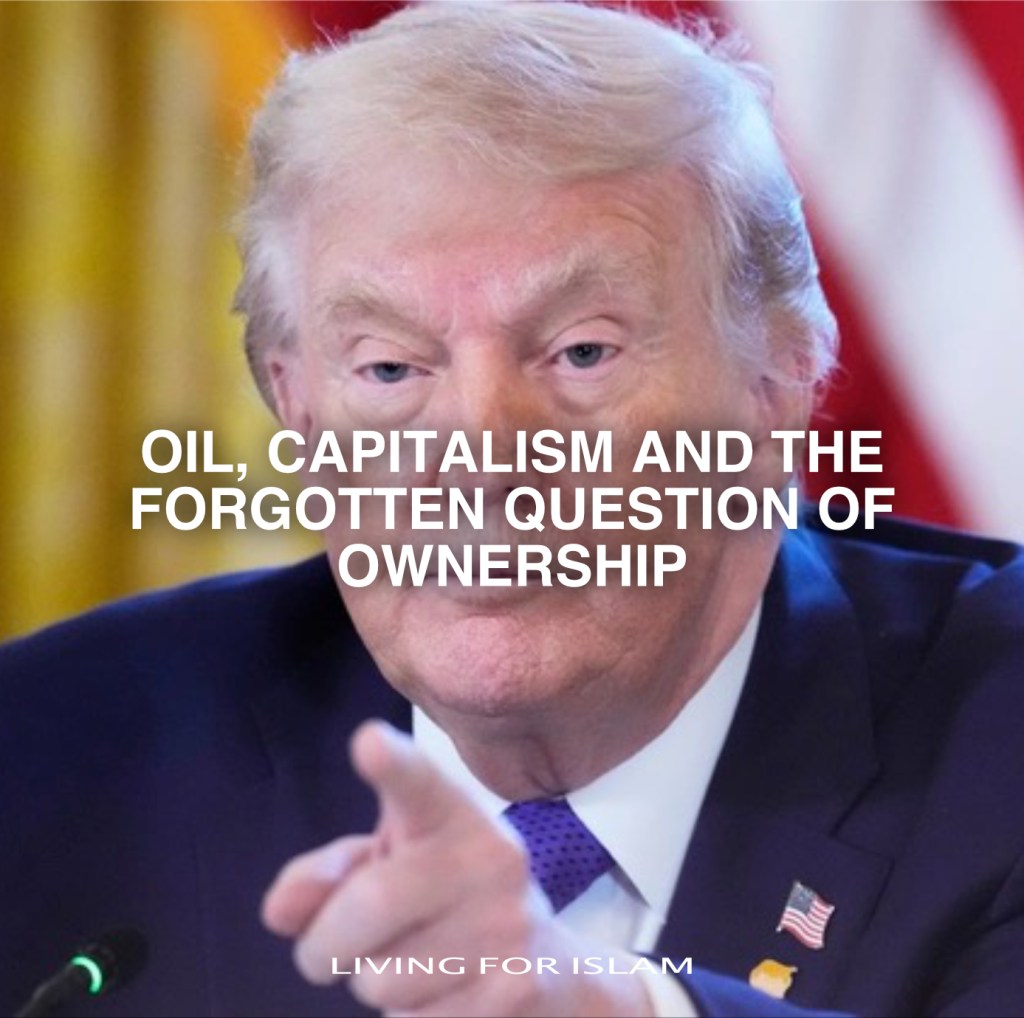
WHEN DONALD TRUMP accused oil companies of ‘making too much money’ from his war on Iran, he highlighted a contradiction at the heart of modern capitalism.
With fuel prices rising and households struggling with the cost of living, Trump argued that companies such as ExxonMobil and Chevron should lower prices and show greater responsibility towards ordinary people.
But this raises a deeper question:
Are these companies actually doing something unusual, or are they simply doing what the capitalist system was designed to encourage?
A corporation exists to generate returns for its owners and shareholders. Its primary obligation is not to provide affordable energy as a social service, but to maximise profit within the law.
When global events disrupt supply, prices rise. When prices rise, companies producing scarce resources earn greater profits.
That is not a failure of capitalism. It is capitalism working according to its own principles.
The Political Contradiction
So why do politicians criticise companies for doing exactly what the market rewards them for doing? Because economics and politics operate according to different incentives.
A free market system encourages companies to pursue profit. But elected politicians are judged by the experiences of ordinary people. When families struggle to afford fuel, heat their homes or pay higher prices for goods and services, they do not blame economic theory. They blame those in government.
Politicians therefore find themselves in a difficult position.
They defend the free market when it creates investment, growth and wealth. But when the same market produces painful consequences for the public, they call upon companies to act differently.
They ask corporations to put social responsibility above profit.
Yet from the perspective of capitalism, why should they?
Oil companies are not charities; they aim to maximize profits, not sacrifice them for political reasons. The issue is not that they go against capitalism, but rather that they are acting in line with its principles.
Islam Begins With a Different Question
Islam approaches this issue from a different starting point.
Rather than asking: How do we control private companies after they have gained enormous profits from essential resources?
Islam asks: Should essential resources have become private property in the first place?
The Messenger of Allah ﷺ said: “The Muslims are partners in three things: water, pasture and fire.” (Abu Dawud)
This narration establishes an important principle: some resources are not ordinary commodities. They are resources upon which society depends and therefore cannot simply become the exclusive possession of individuals.
The classical scholars discussed the scope and application of this principle. However, many understood from this and related texts that resources essential to public life should remain available for the benefit of the community.
Another important narration concerns Abyad ibn Hammal (ra). The Prophet ﷺ granted him a salt mine, but after being informed that it was not an ordinary mine and was instead a vast resource from which the wider community could benefit, the Prophet ﷺ retracted the grant. (ibn Majah)
Scholars have used this narration as evidence that resources of a public nature cannot be privately controlled in a way that deprives society of their benefit.
The principle is clear: Not everything that exists in the earth is automatically suitable for private ownership.
Oil in the Modern World
In the past, people depended on water sources, grazing land and fire for survival. Today, energy has become one of the foundations of civilisation.
Oil and gas power transport, industry, electricity generation and economic activity across the world. They are not simply ordinary goods. They are resources upon which entire nations depend.
This raises an important question for Muslims: If the Prophet ﷺ established that certain essential resources belong collectively to the people, should modern energy resources be treated differently simply because technology has changed?
The Islamic principle is not based on the form of the resource, but on its nature and its relationship to society.
Public Ownership is not State Ownership
An important distinction must be made.
The Islamic concept of public ownership does not mean that everything belongs to the government, like in communism.
Islam recognises private ownership. Individuals may own businesses, homes, farms and wealth acquired through lawful means.
However, Islam also recognises that some resources belong to the ummah as a whole. The ruler does not own these resources. The ruler is a trustee responsible for managing them according to the Shariah and ensuring that their benefits reach the people. The ruler’s authority over public resources is therefore a responsibility, not ownership.
The Consequences for the Ummah
This question of ownership has enormous consequences.
The Muslim world contains some of the largest energy reserves on earth. Yet many Muslim societies continue to experience poverty, unemployment and economic dependency.
The issue is not simply whether resources exist. The issue is who controls them, how they are managed and who benefits from them.
When public wealth becomes concentrated in the hands of governments, ruling elites or narrow interests, or foreign multinationals, the wealth of the ummah becomes separated from the needs of the ummah.
Islamic public ownership challenges this by treating natural resources as a trust belonging to the Ummah.
The purpose is not merely to replace private corporations with government corporations. The purpose is to ensure that wealth serves the people.
Allah says:
كَىْ لَا يَكُونَ دُولَةًۢ بَيْنَ ٱلْأَغْنِيَآءِ مِنكُمْ
“…so that it does not circulate solely among the rich among you.” (al-Hashr 7)
This verse expresses a broader Islamic concern: that wealth should not become permanently concentrated among a small group while the wider society is excluded from its benefits.
A Different Economic Vision
The modern debate usually asks: Should markets be freer? Should governments regulate more? Should corporations pay more taxes?
Islam begins with a different question: Who has the right to own the resources in the first place?
Capitalism begins with private ownership and then attempts to manage its consequences. Islam begins by defining the limits of ownership according to revelation.
If oil and other essential resources are public property, then the question of private companies making extraordinary profits from public resources is transformed completely.
The issue is no longer whether corporations should voluntarily give up profits. The issue is that those profits should never have belonged to private interests in the first place.
The debate over oil prices therefore reveals something deeper than a disagreement over fuel costs. It reveals two different visions of economics.
One vision sees natural resources as opportunities for investment and profit. The other sees certain resources as trusts from Allah, belonging to the ummah and to be managed for the benefit of the Ummah.
The question Muslims must ask is not only how to regulate the markets around us. It is whether we have forgotten the Islamic principles of ownership that were revealed to us by Allah to organise our affairs..

