

ONE OF THE delights of reading the Qur’an is noticing how its stories speak to one another. While reflecting on the account of Sulaymān (as) and the Queen of Sheba in Sūrah al-Naml, I found myself thinking about another famous scene from the Qur’an: the magicians in Pharaoh’s court.
At first, they seem to have little in common. One is a queen ruling a prosperous kingdom. The others are magicians assembled to defeat Prophet Mūsā (as). Yet both narratives end in sincere submission to Allah.
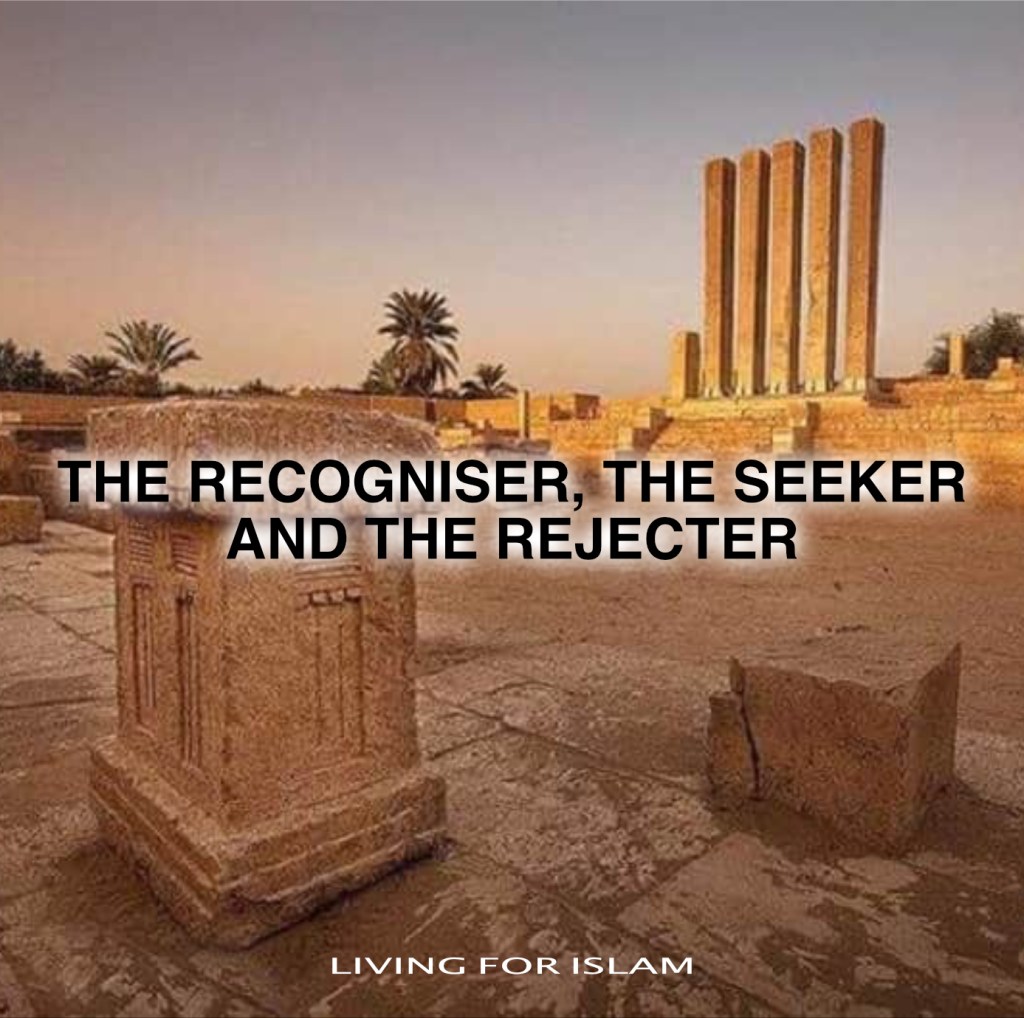
As I reflected on these passages, another pair of figures came to mind: Pharaoh himself and, centuries later, Abū Jahl. Both were presented with overwhelming evidence, yet both refused to submit. It struck me that the Qur’an presents three distinct responses when Allah’s signs become clear: the recogniser, the seeker, and the rejecter.
The Recogniser
When Mūsā stands before Pharaoh, the greatest magicians in Egypt are gathered to expose him as an imposter. They come seeking wealth and honour. Allah says:
وَجَآءَ ٱلسَّحَرَةُ فِرْعَوْنَ قَالُوٓا۟ إِنَّ لَنَا لَأَجْرًا إِن كُنَّا نَحْنُ ٱلْغَـٰلِبِينَ
قَالَ نَعَمْ وَإِنَّكُمْ لَمِنَ ٱلْمُقَرَّبِينَ
They said, ‘O Pharaoh, will there surely be a reward for us if we are the victors?’ He said, ‘Yes, and indeed, you will be among those brought near.’ (al A’raf 113–114)
Then Mūsā casts down his staff. It swallows everything they had fabricated. The Qur’an records their response with remarkable brevity:
فَأُلْقِىَ ٱلسَّحَرَةُ سُجَّدًۭا قَالُوٓا۟ ءَامَنَّا بِرَبِّ هَـٰرُونَ وَمُوسَىٰ
“So the magicians fell down in prostration. They said, ‘We have believed in the Lord of Hārūn and Mūsā.’” (Ta Ha 70)
There is no debate, no hesitation, no consultation. Why? Because they recognise what they are seeing. These are experts in illusion. They know every trick they themselves are capable of performing. The miracle before them is something else entirely. Their expertise becomes the very means by which Allah guides them.
Within moments they move from serving Pharaoh to worshipping Allah. Even the threat of execution cannot make them retreat.
Some people recognise the truth the moment they encounter it.
The Seeker
The Queen of Sheba’s journey is very different. The hoopoe informs Sulaymān (as):
إِنِّى وَجَدتُّ ٱمْرَأَةًۭ تَمْلِكُهُمْ وَأُوتِيَتْ مِن كُلِّ شَىْءٍۢ وَلَهَا عَرْشٌ عَظِيمٌۭ
“Indeed, I found a woman ruling over them, and she has been given of everything, and she has a magnificent throne.” (an-Naml 23)
Before mentioning her disbelief, the Qur’an acknowledges her strengths. She is capable. She governs a stable kingdom. She consults her advisers. Her error is not incompetence, it is that she and her people worship the sun instead of Allah.
Sulaymān’s (as) response is itself a lesson. He does not begin with force. He begins with an invitation:
إِنَّهُۥ مِن سُلَيْمَـٰنَ وَإِنَّهُۥ بِسْمِ ٱللَّهِ ٱلرَّحْمَـٰنِ ٱلرَّحِيمِ
أَلَّا تَعْلُوا۟ عَلَىَّ وَأْتُونِى مُسْلِمِينَ
“Indeed, it is from Sulaymān, and indeed it reads: ‘In the Name of Allah, the Most Merciful, the Especially Merciful. Do not exalt yourselves against me, but come to me in submission.’” (an-Naml 30–31)
Reading this reminded me of the Prophet ﷺ after the Treaty of Ḥudaybiyyah, when he sent letters to neighbouring rulers inviting them to Islam. The invitation preceded any confrontation. Before people can accept the truth, they must first hear it.
The Queen does not reject the message. Neither does she embrace it immediately. She reflects. She consults:
قَالَتْ يَـٰٓأَيُّهَا ٱلْمَلَؤُا۟ أَفْتُونِى فِىٓ أَمْرِى مَا كُنتُ قَاطِعَةً أَمْرًا حَتَّىٰ تَشْهَدُونِ
“She said, ‘O eminent ones, advise me in my affair. I would not decide a matter until you are present.’” (an-Naml 32)
She understands the devastation of war:
قَالَتْ إِنَّ ٱلْمُلُوكَ إِذَا دَخَلُوا۟ قَرْيَةً أَفْسَدُوهَا وَجَعَلُوٓا۟ أَعِزَّةَ أَهْلِهَآ أَذِلَّةًۭ ۖ وَكَذَٰلِكَ يَفْعَلُونَ
She reasoned, “Indeed, when kings enter a city, they ruin it and render the honoured of its people humbled.” (an-Naml 34)
She sends gifts. She observes. She watches. She learns. She witnesses her throne brought before her. She walks into Sulaymān’s (as) palace and mistakes its glass floor for water. Each event becomes another invitation to reconsider her assumptions. The Qur’an portrays guidance as a journey. Not every heart arrives by the same road. Some recognise the truth in a single moment. Others are guided through a series of conversations, reflections and experiences that slowly remove every barrier. Allah guides each soul according to His wisdom.
Finally she says:
رَبِّ إِنِّى ظَلَمْتُ نَفْسِى وَأَسْلَمْتُ مَعَ سُلَيْمَـٰنَ لِلَّهِ رَبِّ ٱلْعَـٰلَمِينَ
“My Lord, indeed I have wronged myself, and I submit with Sulaymān to Allah, Lord of the worlds.” (an-Naml 44)
She is the seeker. She does not arrive at iman in a single moment, but through a sincere willingness to follow the evidence wherever it leads.
The Rejecter
Then there are those who recognise the truth but refuse to surrender to it. Pharaoh sees exactly what the magicians see. The evidence is identical. The difference is not intellectual. It is moral. Allah says:
وَجَحَدُوا۟ بِهَا وَٱسْتَيْقَنَتْهَآ أَنفُسُهُمْ ظُلْمًۭا وَعُلُوًّۭا
And they rejected them, while their [inner] selves were convinced thereof, out of injustice and haughtiness. (an-Naml 14)
This may be one of the most searching verses in the Qur’an. It tells us that a person can be inwardly convinced while outwardly refusing to submit. Knowledge alone is not enough. The obstacle is pride.
The same pattern appears during the lifetime of the Prophet ﷺ. The leaders of Quraysh knew Muhammad ﷺ as al-Amīn long before revelation. They heard the Qur’an in their own language and recognised that it was unlike anything they had ever encountered.
Among them was Abū Jahl. The books of sīrah report that he acknowledged the Prophet’s ﷺ truthfulness while refusing to follow him because accepting Muhammad ﷺ would mean accepting the leadership of Banū Hāshim over Banū Makhzūm. Arrogance, rivalry and attachment to status and wealth can become barriers to iman.
Pharaoh and Abū Jahl remind us that the greatest obstacle to guidance is often not a lack of evidence but an unwillingness to humble oneself before Allah.
“I submit with Sulaymān”
The Queen’s final declaration contains one of the most beautiful expressions of da’wah in the Qur’an:
رَبِّ إِنِّى ظَلَمْتُ نَفْسِى وَأَسْلَمْتُ مَعَ سُلَيْمَـٰنَ لِلَّهِ رَبِّ ٱلْعَـٰلَمِينَ
My Lord, indeed I have wronged myself, and I submit with Sulaymān to Allah, Lord of the worlds. (an-Naml 44)
She does not submit to Sulaymān (as). She submits with Sulaymān (as). Those two words deserve reflection.
Sulaymān (as) was a prophet and a king, yet his success was never measured by people attaching themselves to him. His mission was to bring people with him to Allah. This is the essence of every prophet’s call. The sincere dā’ī is never inviting people to himself, his scholarship, his movement or his personality. He simply says, in effect: “Come with me to Allah.”
The destination is not the caller. The destination is Allah.
That subtle wording transforms the entire story. The Queen is not celebrating her inclusion in Sulaymān’s kingdom. She is celebrating her inclusion among those who worship the Lord of the worlds.
Three responses, one question
The Qur’an leaves every one of us with the same question. When Allah places His signs before me, what kind of heart will I bring to them? The heart of the magicians that recognises? The heart of the Queen that seeks? Or the heart of Pharaoh that knows yet refuses?
Every believer should ask Allah for the first. Every seeker should pray for the second. And every one of us should fear the third.
The Qur’an here also leaves us with hope.
In Sūrah al-Naml, after recounting so many who turned away, Allah also tells us of the Queen of Sheba, who accepted. Not everyone comes to iman in the same way. Some recognise immediately. Some seek patiently. But every sincere journey ends in the same place: “I submit with Sulaymān to Allah, Lord of the worlds.”
That surely is the true goal of da’wah: not gathering followers for ourselves, but walking together towards Allah, until others can say those same beautiful words, “I submit with you to Allah, Lord of the worlds.”

