

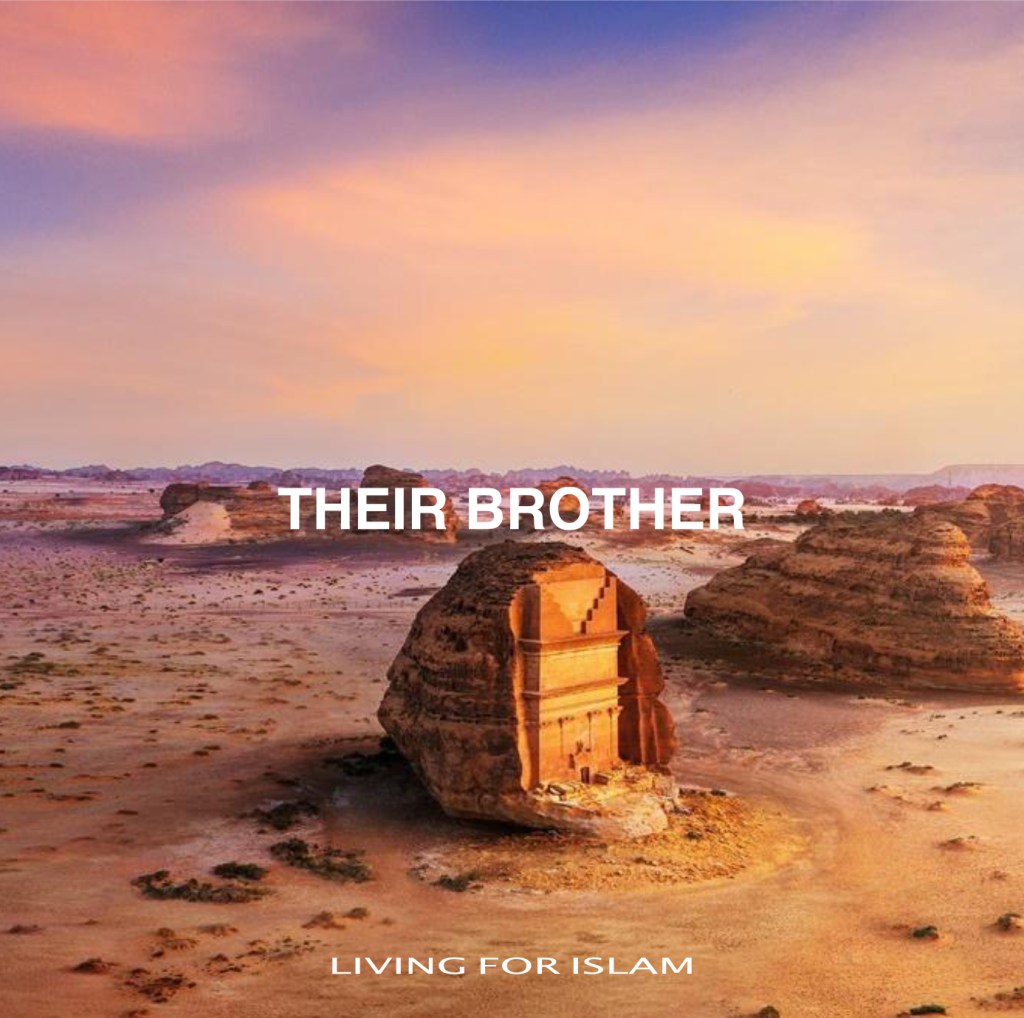
THE QUR’AN HAS a remarkable way of teaching profound lessons through seemingly ordinary words. One such example appears in the story of Prophet Ṣāliḥ (as).
Allah says:
وَلَقَدْ أَرْسَلْنَآ إِلَىٰ ثَمُودَ أَخَاهُمْ صَـٰلِحًا أَنِ ٱعْبُدُوا۟ ٱللَّهَ فَإِذَا هُمْ فَرِيقَانِ يَخْتَصِمُونَ
Indeed, We sent to Thamūd their brother Ṣāliḥ, saying, ‘Worship Allah.’ Then at once they became two factions disputing. (an-Naml 45)
At first glance, the word akhāhum, “their brother”, appears simply to describe Ṣāliḥ’s relationship to Thamūd. He was one of them. He belonged to their people.
But the Qur’an does not include words merely for information. Its descriptions are deliberate. Why, then, does Allah introduce Ṣāliḥ as their brother?
One of Their Own
The classical scholars explain that Ṣāliḥ was described as their brother because he was from among them. He shared their ancestry, their language and their society. They knew him, and he knew them.
He was not a stranger who had suddenly appeared among them. He had lived among them. They knew his character. They knew his history. They knew the man before they heard the message.
This is a recurring Qur’anic pattern. Hūd (as) is described as the brother of ʿĀd. Ṣāliḥ (as) as the brother of Thamūd. Shuʿayb (as) as the brother of Madyan. The messengers were sent from within their own communities.
That mattered because the people could not simply dismiss the messenger as someone who did not understand them or their circumstances. His life was already known to them. The messenger was not an outsider imposing himself upon a people he did not know. He was their brother.
There is another layer worth reflecting upon.
When we hear the word brother, we do not hear it merely as a description of biological relationship. Especially as Muslims, the word carries a deeper emotional sense. Brotherhood suggests closeness. Concern. Loyalty. A genuine desire for another person’s wellbeing.
He was one of them, calling them to something beyond what they had become.
But Not Like Them
Ṣāliḥ was of Thamūd. But he was not like Thamūd in everything.
He belonged to them, but he did not belong to their falsehood. He knew their society, but he did not surrender to its beliefs. He was close to them, but he was not absorbed by them.
This is an important distinction.
Sometimes we imagine that standing firmly for Islam requires distance from society. At other times, we assume that meaningful engagement requires becoming indistinguishable from those around us.
The prophets demonstrate something different. They were deeply embedded in their societies without being absorbed by them. They knew their people. They lived among them. They understood their circumstances. And yet they called them away from what was wrong.
Ṣāliḥ (as) did not compromise tawḥīd in order to preserve his relationship with Thamūd. His closeness to them did not weaken his message. His message gave direction to his closeness.
“Worship Allah”
The message itself could hardly be simpler: an iʿbudū Allāha, worship Allah.
No demand for wealth. No claim to tribal superiority. No personal ambition. Just worship Allah.
And then comes the suddenness of the response: fa-idhā hum farīqāni yakhtaṣimūn, then at once they became two factions disputing.
The word fa-idhā creates a sense of sudden transition. Ṣāliḥ calls them to worship Allah, and almost immediately the community is divided.
The contrast is striking. The message is one. The response becomes two factions. The messenger comes as their brother. Yet his call creates a division between those who accept the truth and those who reject it.
The Qur’an is showing us something important about revelation. Truth can unite people upon what is right, but it can also expose divisions that were already hidden beneath the surface.
A Lesson for Da’wah Today
One of the challenges facing Muslims today is not simply how to communicate Islam, but how to remain genuinely connected to the people we hope to reach.
Sometimes people know our arguments before they know our character. They hear our positions before they experience our concern. They encounter us as critics before they encounter us as neighbours.
The Qur’anic model gives us something different.
The prophets knew their people. They spoke their language. They understood their circumstances. They lived among them. They shared their society. And they called them to Allah.
Their closeness did not require compromise. Their distinctiveness did not require isolation. They were able to be among their people without becoming captive to their people.
That balance is particularly important for Muslims living as minorities. We should not imagine that preserving our Islamic identity requires withdrawing from society. Nor should we imagine that engaging society requires diluting Islam.
The prophetic model is neither isolation nor assimilation. It is faithful presence. Know the people around you. Understand them. Serve them. Build relationships with them. Be someone whose character makes your commitment to Islam visible before you ever begin speaking about Islam.
And when you speak, do not be afraid to say what Ṣāliḥ said: Worship Allah.
Becoming “Brothers” First
Perhaps this is the challenge hidden within the word akh. Before people accept our reminders, they should experience our concern. Before they hear our lectures, they should know our sincerity. Before they see us as teachers, they should recognise us as neighbours, colleagues, friends and brothers.
Communities are rarely transformed by voices shouting from a distance. They are transformed by people who care enough to walk beside them. Perhaps that is why Allah chose such a simple word. Not preacher, reformer or scholar. But their brother.
In that single expression, the Qur’an reminds us that daʿwah is not simply about having the truth to convey. It is also about how we carry that truth to the people around us.
The messengers were close enough to know their people, and committed enough to call them to something greater.
That is the balance worth recovering.
|QUR’ANIC REFLECTION · SURAH AN NAML 45|

