
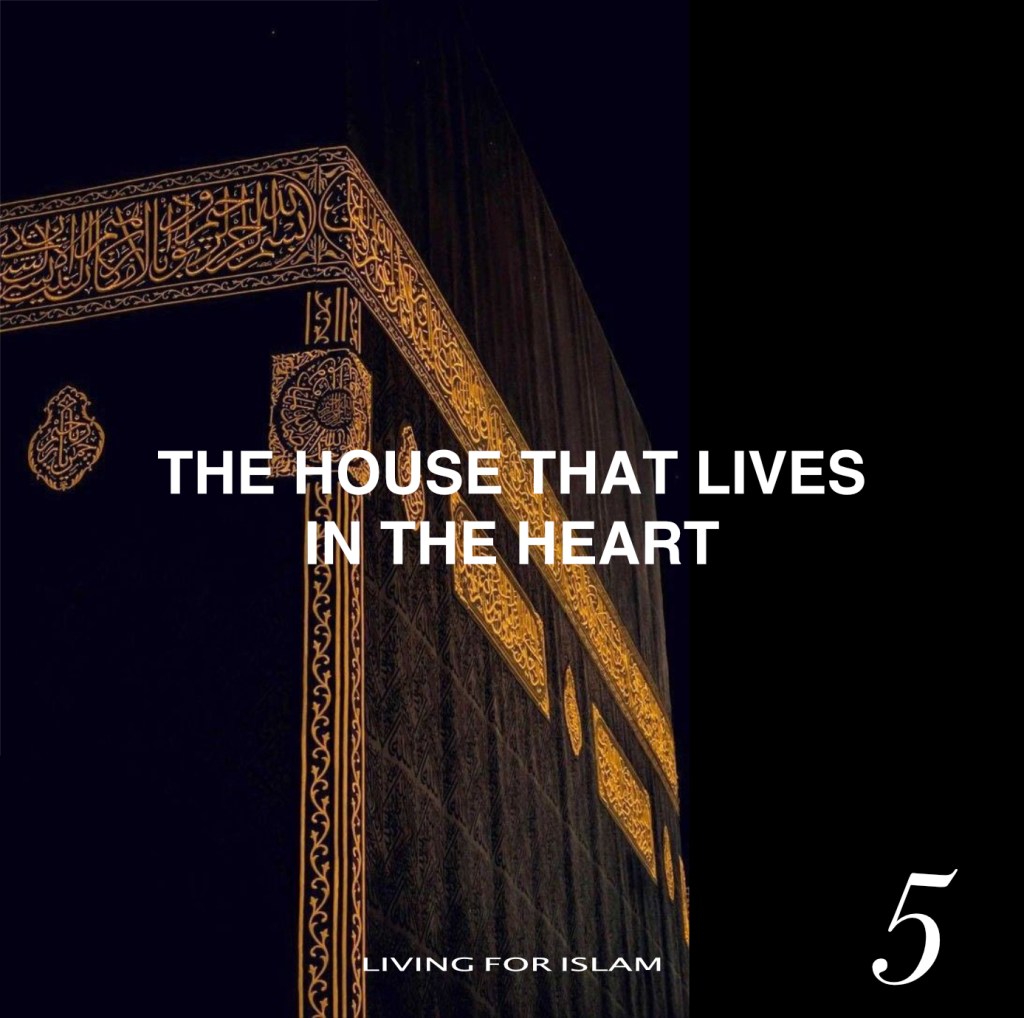
THERE ARE CERTAIN images every Muslim grows up with. For many of us, the most powerful of all is the sight of the Ka’bah.
Long before we ever travel to Makkah, we already know it intimately. We see it in our homes, in masajid, in taraweeh broadcast from Makkah during Ramadhan, in Hajj documentaries, on prayer mats, calendars, and television screens across the Muslim world. Five times a day, wherever we are on earth, we turn towards it in prayer.
In that sense, the Kaʿbah may be the single greatest unifying symbol in the Muslim world.
A Muslim in London, Lagos, Medellín, San Diego, or Kuala Lumpur may speak different languages, belong to different cultures, and live entirely different lives; yet all stand facing the same sacred point every day. The Kaʿbah creates a shared geographical anchor for nearly two billion people.
The Qur’an describes it as:
إِنَّ أَوَّلَ بَيْتٍۢ وُضِعَ لِلنَّاسِ لَلَّذِى بِبَكَّةَ مُبَارَكًۭا وَهُدًۭى لِّلْعَـٰلَمِينَ
“Indeed, the first House established for mankind was that at Bakkah, blessed and a guidance for the worlds. (ale Imran 96)
Bakkah is an ancient name for Makkah. This verse frames the Kaʿbah not merely as a sacred place for Arabs or Muslims, but as the original centre of monotheism for humanity.
Over time, its original foundations were obscured, but Allah honoured Ibrāhīm (as) and his son Ismāʿīl (as) with rebuilding it as a sanctuary dedicated to the worship of Allah alone.
Allah says:
وَإِذْ يَرْفَعُ إِبْرَٰهِـۧمُ ٱلْقَوَاعِدَ مِنَ ٱلْبَيْتِ وَإِسْمَـٰعِيلُ
And (remember) when Ibrahim raised the foundation of the House with Ismail (al Baqarah 127)
Originally, early Muslims prayed toward Jerusalem. Later, the Qur’an records the command changing the direction toward the Kaʿbah:
فَوَلِّ وَجْهَكَ شَطْرَ ٱلْمَسْجِدِ ٱلْحَرَامِ ۚ وَحَيْثُ مَا كُنتُمْ فَوَلُّوا۟ وُجُوهَكُمْ شَطْرَهُۥ
So turn your face towards the Sacred Mosque (in Makkah), wherever you are, turn your faces towards it. (al Baqarah 144)
Since then, Muslims have stood out as an a distinct ummah, and across every continent have prayed facing this single point. Rich and poor, kings and labourers, scholars and laypeople, old and young, men and women, all turn toward the same structure every single day.
That is why seeing it for the first time is so overwhelming.
It is not merely the sight of a building. It is the physical encounter with something that has already lived in your consciousness your entire life.
The First Sight
I still remember my first Hajj vividly.
I landed in Jeddah at 5am in the days before modern airport efficiency and streamlined pilgrim services. Those who travelled in that era will remember the chaos well, endless passport queues, exhausted pilgrims sleeping on luggage, overcrowded buses crawling slowly toward Makkah. What should have been a short 2 hour journey became an all-day ordeal. I did not arrive in Makkah until around 6pm, physically drained and mentally exhausted. By the time I finally entered Masjid al-Haram for Maghrib prayer, it was close to 7pm.
I was led through the crowds by a guide. And then I saw it.
Every hardship disappeared instantly.
Nothing, and I mean nothing, prepares you for that first sight. My heart stopped. Tears came to my eyes. The Kaʿbah was more beautiful than words can describe. It was also far larger than I had ever imagined from photographs or television. Cameras flatten it somehow. They cannot capture its presence, nor the strange gravity it exerts on the eye and the heart.
This was before the era of the towering Abraj Al Bait Towers. In those days, the Kaʿbah stood visually at the centre of everything. Nothing overlooked it. Nothing competed with it.
The old Ottoman arcades surrounding the sanctuary possessed a quiet elegance, their low, sweeping colonnades guiding the eye naturally inward toward the House itself. There was a serenity to the visual experience that remains etched permanently in my memory.
The Kaʿbah Is Not Worshipped
One of the biggest misunderstandings among non-Muslims is the idea that Muslims worship the Kaʿbah itself.
We do not.
The Kaʿbah is sacred because Allah made it sacred. It is the focal point of worship, not the object of worship.
This distinction was beautifully expressed by Umar ibn al-Khattab (ra) when he kissed the Black Stone during pilgrimage: “I know that you are only a stone. You neither benefit nor harm. Had I not seen the Messenger of Allah ﷺ kiss you, I would not have kissed you.”
The Kaʿbah symbolises unity, submission to God, and continuity with the faith of Ibrahim (as).
It is where the eye is directed so that the heart may be directed beyond it.
Watching Makkah Change
Years later, I hesitated to take my wife and children for Umrah.
The reason may sound strange to some, but many older pilgrims will understand immediately. Since 2011, Makkah had become a construction site, cranes filling the skyline, temporary bridges, barriers and diversions everywhere. I didn’t want my children’s first impression, an impression that lasts your entire life, to be one of scaffolding and disruption.
Of course, the expansions were necessary. Millions more Muslims now perform Hajj and Umrah than in previous generations, and accommodating them safely requires enormous engineering works. No serious observer can deny that.
But I, like many others, also feel that something precious was lost in the process. Historic neighbourhoods disappeared. Architectural layers connected to centuries of Islamic civilisation were removed. Places that linked pilgrims emotionally to the lived history of Makkah vanished beneath hotels, shopping complexes and modern towers.
The criticism is not simply nostalgia. It is about the spiritual language of architecture. Traditional sacred spaces tend to direct attention toward transcendence and contemplation. Older parts of Makkah once possessed that atmosphere, the visual experience drew the eye inward, toward the sanctuary itself.
Today, many pilgrims feel the surrounding environment resembles a luxury commercial district more than the setting of Islam’s holiest sanctuary. It creates an uncomfortable contrast between the simplicity at the spiritual centre and the hyper-commercialisation surrounding it.
Expansion was necessary. But necessity does not automatically settle questions of aesthetics, heritage or spiritual atmosphere. It could have been done differently. It could have preserved more of the historical and cultural memory that connected us to the generations before us. That loss remains deeply painful for many visitors.
“It’s the Kaʿbah!”
Yet the Kaʿbah has a way of reminding us what endures and what does not.
Despite my reservations, we eventually went as a family.
I still remember my children’s faces when they saw the Kaʿbah for the first time.
Wide-eyed. Stunned. Completely captivated.
“It’s the Kaʿbah!”
Not a building. Not a monument. Not a tourist attraction. The Kaʿbah. There was love in their faces immediately, the kind of recognition that only comes from something already deeply embedded in the heart long before the eyes ever see it.
At that moment, I understood something important. Every generation encounters a different Makkah. Some remember the older Ottoman arcades. Others remember the years of construction. Younger Muslims today may know only the modern skyline of towers surrounding the sanctuary.
But despite all the physical changes, the emotional and spiritual power of the Kaʿbah remains astonishingly constant.
Children still stop in awe. Pilgrims still cry at first sight. The heart still recognizes it instantly.
And perhaps that is part of what Allah meant when He described it as:
جَعَلْنَا ٱلْبَيْتَ مَثَابَةًۭ لِّلنَّاسِ
We made the Sacred House a place of return for mankind.” (al Baqarah 125)
The word mathābah means a place people constantly return to. The scholars say this is why hearts never get tired of Hajj and ‘Umrah.
For millions of Muslims across centuries, the Kaʿbah is not merely visited.
It is a home the heart was always meant to return to.

