
THE BUS FROM Jeddah to Makkah was packed with pilgrims from a dozen countries, dressed in the same two white cloths.
On my second Hajj, I was handed the microphone to lead the talbiyah for the journey into Makkah. One voice began it, others joined, and within moments the bus was one sound. It didn’t matter which corner of the world we had started our journey in and what language we spoke, we were all now saying the same thing.
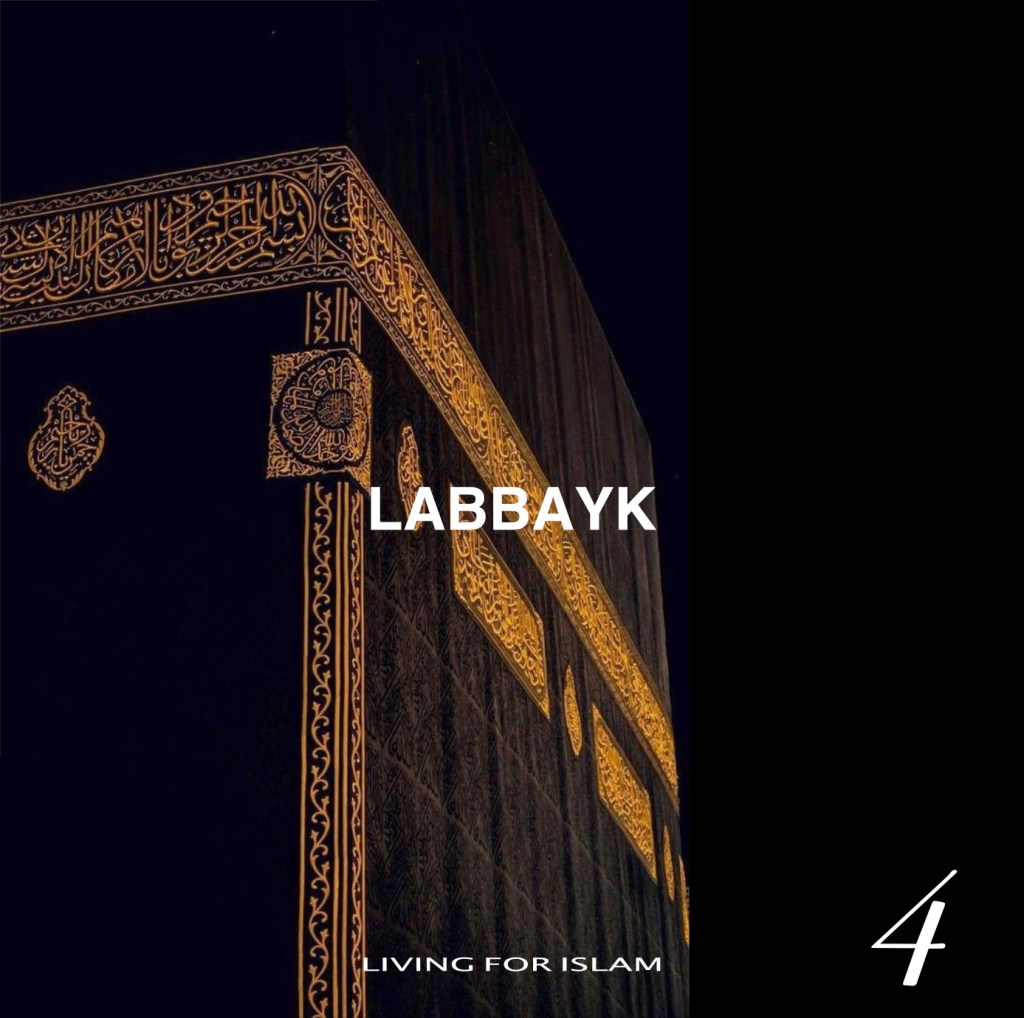
Labbayka Allāhumma labbayk.
You get lost in it. The layers of meaning wash over you until you are no longer a person on a bus. You are a voice in an ancient procession, answering a call issued thousands of years ago.
What These Words Actually Means
The talbiyah, the central invocation of Hajj and Umrah, pivots on a single Arabic word: labbayk. No English translation captures it fully. Classical scholars gave it several interlocking meanings: I am here in obedience. I answer Your call repeatedly. I am devoted entirely to You. The labbayk said twice, signals not just compliance but eagerness, persistence, totality. “I keep answering You” is closer than “Here I am.”
The full declaration is:
لَبَّيْكَ اللَّهُمَّ لَبَّيْكَ، لَبَّيْكَ لَا شَرِيكَ لَكَ لَبَّيْكَ، إِنَّ الْحَمْدَ وَالنِّعْمَةَ لَكَ وَالْمُلْكَ، لَا شَرِيكَ لَكَ
Labbayka Allāhumma labbayk, labbayka lā sharīka laka labbayk, innal-ḥamda wan-ni’mata laka wal-mulk, lā sharīka lak.
Here I am, O Allah, here I am. Here I am, You have no partner, here I am. Truly all praise, favour, and sovereignty belong to You. You have no partner.
What strikes me every time I recite it is what is absent: there are no personal requests. No mention of self. No asking for anything. In a world where almost all human speech revolves around desire or self-assertion, the talbiyah is entirely Allah-centred. Pure response. Pure surrender.
A Call Across Time
The talbiyah reaches back to Ibrahim (as). After he and his son Ismail (as) built the Ka’bah, Allah commanded him to proclaim the Hajj to humanity.
Ibrahim (as) asked: “O Allah, how can my voice reach all of humanity?” The answer: “Call. It is for Us to convey it.” And the classical scholars note that not only those then living, but every soul yet to be born who was destined to make Hajj, responded, Labbayk, across time.
The Messenger ﷺ insisted the talbiyah be recited aloud. Jibril (as) commanded him to tell the companions to raise their voices, because it is one of the defining outward symbols of Hajj. It is not a private prayer. It is a proclamation. And a hadith tells us that when a pilgrim recites it, the rocks and trees and earth to the east and west recite it alongside him.
On that bus, with Makkah drawing close and those voices filling the air, I believed it entirely.
The Corruption: One Word That Changed Everything
The pre-Islamic Arabs did not abandon Ibrahim’s (as) pilgrimage. They kept the Ka’bah, the tawaf, the sacrifice, the talbiyah itself. But over centuries, the pilgrimage became entangled with tribal politics and polytheism, and the talbiyahwas altered. The key figure in this corruption was Amr ibn Luhayy, a Makkah chieftain who introduced idol worship to Arabia, installing some 360 idols in and around the Ka’bah.
He had a problem. The talbiyah said lā sharīka lak, You have no partner. But now there were 360 partners. So he added one word illā, “except” and the pagan talbiyah became: “Here I am, O Allah, here I am. You have no partner, except a partner that belongs to You; You own him and all that he possesses.”
Read that carefully. They did not remove the monotheistic formula. They added to it and qualified it. Allah remained supreme, the partners were merely His, subordinate intermediaries, sacred mediators between man and Allah. The Qur’an records the polytheists’ own justifications:
وَٱلَّذِينَ ٱتَّخَذُوا۟ مِن دُونِهِۦٓ أَوْلِيَآءَ مَا نَعْبُدُهُمْ إِلَّا لِيُقَرِّبُونَآ إِلَى ٱللَّهِ
We only worship them so that they may bring us closer to Allah. (az-Zumar 3)
This was sophisticated idol worship and that is precisely what made it so dangerous. Outright rejection of Allah is easy to identify. A hierarchy that keeps Allah at the top while inserting layers of intermediaries between the soul and the divine is far harder to see and far harder to dismantle.
And of course there was a political and economic dimension too. The Ka’bah housing idols from multiple tribes made Makkah indispensable to the entire Arabian peninsula. Every tribe with an idol in the Ka’bah had a stake in the system. The Quraysh, as custodians, held religious and economic leverage over everyone. Pure monotheism threatened not just their theology but their entire social order.
The Restoration
When the Messenger ﷺ led the Farewell Pilgrimage, after he had opened Makkah and removed the idols 2 years earlier, his recitation of the talbiyah was a declaration as much as a prayer: Labbayka lā sharīka laka labbayk.
No illā. No “except.” No qualification. The Ka’bah was cleared of its idols. The tribal religious hierarchies were abolished. The politics and economics aligned to a single source. And the words Ibrahim (as) had first proclaimed was restored, intact, unqualified, clean.
Islam did not present itself as a new religion. It presented itself as the original religion, restored. The Qur’an calls Ibrahim (as) a Hanif, a pure monotheist. The talbiyah, in its restored form, is the audible proof of that claim. It was there at the beginning, corrupted, and given back to us without the escape clause.
The Idols Have Returned
As I recited the talbiyah across those miles and looked out at the passing desert, a thought occurred to me. Here I am declaring my surrender to Allah. But what about the land around me. Does it declare the talbiyah as it did when the Prophet ﷺ recited his? Or have the idols quietly returned?
The idols of our age have different names. Nationalism. Materialism. Secularism. Amongst others. And like the pre-Islamic idols, they rarely announce themselves as rivals to Allah. They present themselves as neutral, practical, inevitable. You can be religious and nationalist. You can pray and organise your entire life around wealth. Religion for moments of need; the market and the nation for everything else.
But lā sharīka lak does not negotiate. When a nation demands that its interests override Allah’s commands, it is making the same claim Hubal made from inside the Ka’bah. When materialism tells you that your worth is your wealth, it is making the same promise that al-Lat made, that something other than Allah determines your standing and your security. These are the modern idols that have invaded our lands and, more dangerously, our minds. They do not require temples. They live in our assumptions, our education, our daily habits.
I think about this every time I remember that bus. Two million pilgrims say lā sharīka lak in ihram, and then go home to lives quietly governed by other sovereigns. The shell of Ibrahim’s (as) religion, preserved. The core, negotiated away.
What the Talbiyah Asks
The accepted Hajj is the one whose effect persists, the pilgrim returns different, not merely moved. The labbayk said at the miqat is meant to restructure every subsequent choice.
Leading that talbiyah that morning toward Makkah, I began to understand something. There can be no space for a false self that manages comfortable dual loyalties, that keeps one foot in the sacred and one in the ordinary, that says labbayk in ihram and illā, “except”, every other day of the week.
The Prophet ﷺ cleansed the Ka’bah. He restored the word. He handed it to us intact, without the qualification, without the exception, without the escape clause.
Labbayka lā sharīka laka labbayk.
Here I am. You have no partner. Here I am.
The question is whether we are willing to carry what he restored off the bus, into our lives, our communities, and our vision of the world.

