
NOTHING QUITE PREPARES you for tawaf.
You have seen images. You think you know what to expect. Then you arrive at the mataf and see it, a vast human sea, swirling endlessly around the Ka’bah, and whatever you thought you knew just disappears.
Whether on the mataf immediately around the Ka’bah or on the upper floors, you find yourself sometimes weaving through the people, sometimes simply surrendering, absorbed into that enormous tide of believers moving tirelessly around the Sacred House.
The area near the Black Stone is always the bottleneck. People entering and leaving the flow. Others slowing to kiss the Stone, touch it, or raise their hand towards it: Bismillah, Allahu Akbar. The temperature there feels noticeably warmer, a testament to the sheer density of bodies of every size, colour, language, and age, gathered in one place, drawn by one thing.
Round and round. Anticlockwise. Seven times.
Why that direction? Why seven, a number that keeps recurring in the deen? Only Allah knows. The Prophet ﷺ did it, and that suffices.
The Bead and the String
There is something about that state of moving in tawaf that reminds me of the reality of life.
Human beings are always in a state of motion. We move from childhood, through education to work, to marriage, to parenthood, to old age. Through grief and joy, ease and hardship, and everything in between.
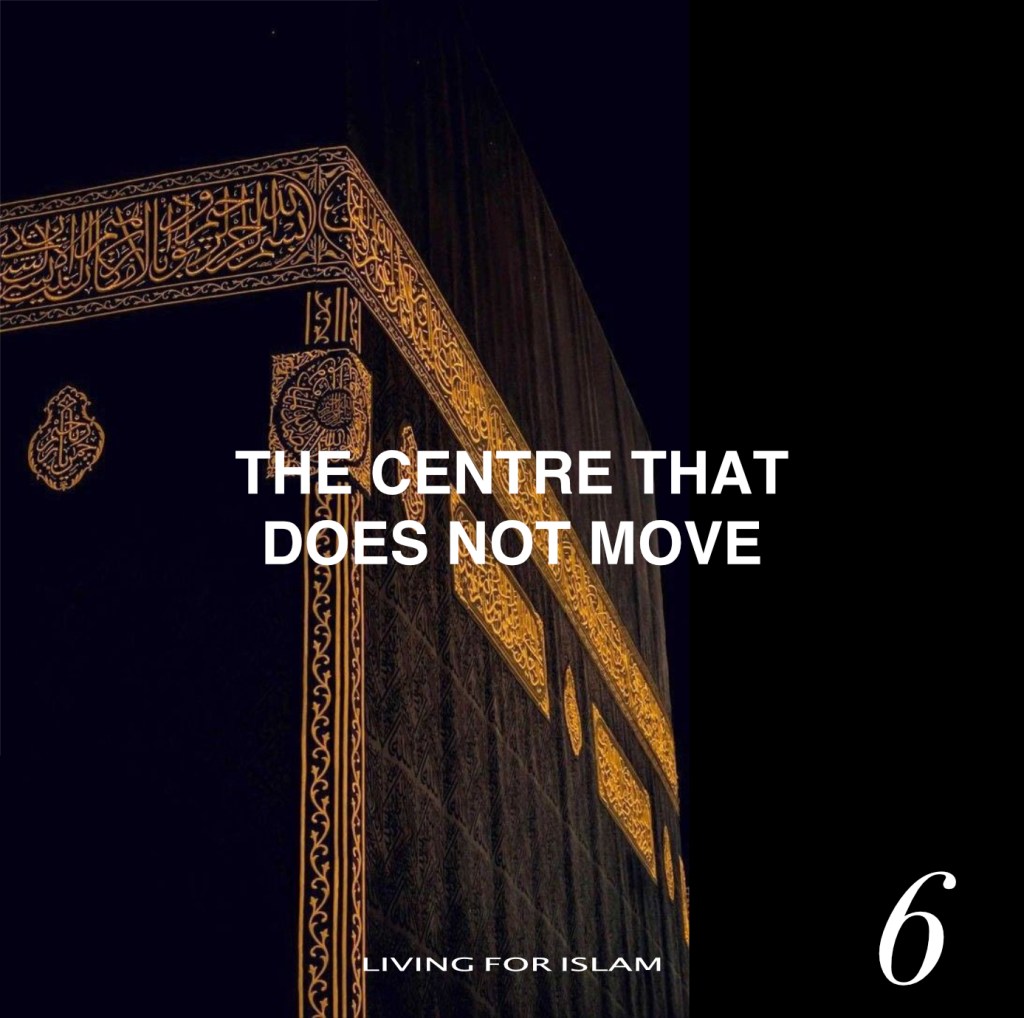
And tawaf shows us that no matter the radius of our orbit or the distance we cover, there is a centre that does not move.
Movement is inevitable. But tawaf reminds us that what we keep at the centre either gives stability and meaning through that movement, or it leads to instability and hardship.
I remember as a boy tying a bead to a string and spinning it around my finger. You could feel the pull of it through your hand, the force of the connection holding the motion together. Tawaf feels something like that. The believer moving around, pulled at from every direction by the demands and distractions of this world, yet held in place despite all that motion by a centripetal force drawing him always back towards Allah.
But what happens if the string breaks? What if the connection to Allah is lost?
The bead flies off, uncontrolled, disconnected, scattered. Perhaps free. But lost, and eventually crashing.
That is the condition of the human being separated from his Lord.
Only when Allah is the centre does motion make any sense. Only then can there be stability within movement. Only then can there be peace.
What the Prophet ﷺ Said Mid-Tawaf
We can become lost in tawaf in our thoughts and dua, thinking about ourselves, our sins, what we want to ask Allah. It is easy to let the experience remain a private transaction between the self and its Lord.
But the Prophet ﷺ taught us something else.
Mid-tawaf, circling this very House, he stopped before the Ka’bah and addressed it directly:
“How pure and good you are, and how pure and good is your fragrance. How great are you and how great is your sanctity. But by Him in Whose Hand is the soul of Muhammad, the sanctity of the believer is greater with Allah than your sanctity.”
He did not say this from a pulpit. He said it here, in the very act of tawaf, as if to ensure we could never separate the two. Islam has never been a purely personal belief. It has always been a complete whole, with the condition of the ummah inseparable from the act of worship itself.
The Four Corners
That reality is written into the very geography of the tawaf. As you circle the Ka’bah, you pass its four corners: the Rukn al-Iraqi, the Rukn al-Shami, the Rukn al-Yamani, and the Rukn al-Aswad, the corner of the Black Stone.
It is impossible not to think about what those names carry. Iraq. Syria and Palestine. Yemen. And beyond them, Kashmir, Sudan, the Rohingya, the Uyghurs, Afghanistan. The believers who turn toward this House are bleeding across the world.
And the ummah knows it. In every country, in every community, ordinary Muslims carry the weight of their brothers and sisters. They make dua. They weep. They give what they can. They speak and protest. The failure is not theirs.
It is the failure of those who hold power, who have substituted the maintenance of symbols for the defence of lives. Who preside over the sacred whilst abandoning the sanctity of the believer.
The Quraysh themselves demonstrated this exact pattern. They maintained the Sacred Masjid with great pride, providing water for pilgrims, tending to the Ka’bah, whilst resisting the deeper demands of faith. Allah addressed them directly:
أَجَعَلْتُمْ سِقَايَةَ ٱلْحَآجِّ وَعِمَارَةَ ٱلْمَسْجِدِ ٱلْحَرَامِ كَمَنْ ءَامَنَ بِٱللَّهِ وَٱلْيَوْمِ ٱلْـَٔاخِرِ وَجَـٰهَدَ فِى سَبِيلِ ٱللَّهِ ۚ لَا يَسْتَوُۥنَ عِندَ ٱللَّهِ
“Do you consider providing water for the pilgrims and maintaining the Sacred Mosque equal to believing in Allah and the Last Day and striving in the path of Allah? They are not equal in the sight of Allah.” (at-Tawbah 19)
This was not a rebuke of ordinary believers. It was a condemnation of a leadership class that confused custodianship of a symbol with faithfulness to what the symbol demands.
That pattern has not disappeared. Only the people it applies to.
The Centre Holds
If Allah is truly at the centre of our lives, then everything that flows from that centre carries His demand upon us. And He has told us, in this very place, through His Prophet ﷺ, what He values.
Our deen has never been one of passivity. It asks us to act, to challenge, to refuse to accept a world in which Muslim blood is cheap. The connection to the centre is precisely what gives us the purpose and the strength to do that.
Tawaf ends. The obligation does not.
The centre holds. But it holds us to something.

