

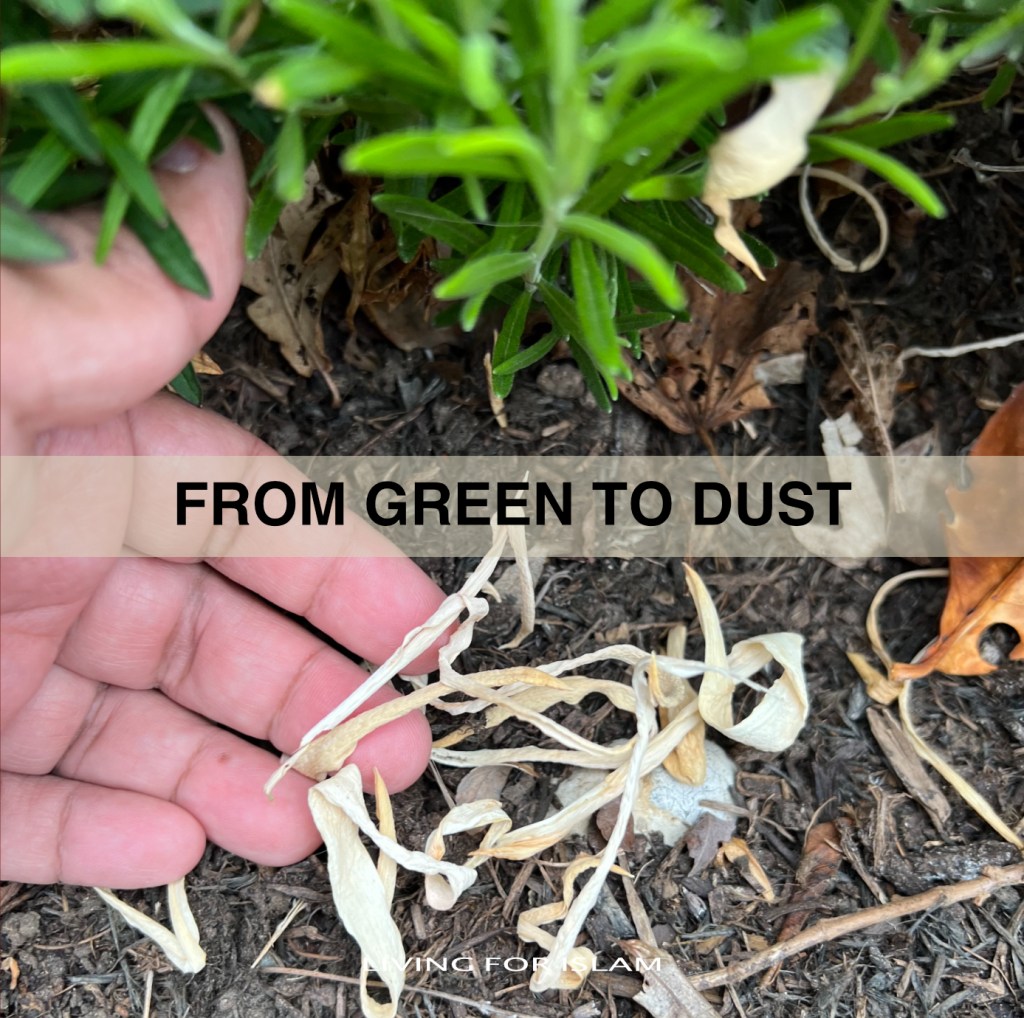
THERE IS SOMETHING deeply moving about a spring garden.
After months of cold, darkness, and bare branches, the earth suddenly begins to breathe again. Tiny green shoots push through the soil. Crocuses appear almost overnight. Hyacinths and daffodils take a little longer. Tulips come next and slowly unfold their colour toward the sky. Every morning seems to bring a new sign of life.
For those of us who love gardening, spring feels hopeful. Alive. Almost comforting.
But there is another side to spring that reveals itself.
Just as the garden reaches its beauty, the first signs of decline begin to appear. The crocuses that looked radiant only days ago start to bend and dry. Tulip petals lose their firmness and fall one by one into the soil beneath them. What felt fresh and permanent suddenly looks fragile.
Standing in the garden recently and noticing those early flowers beginning to wither, I found myself inside a parable I had read many times before.
وَٱضْرِبْ لَهُم مَّثَلَ ٱلْحَيَوٰةِ ٱلدُّنْيَا كَمَآءٍ أَنزَلْنَـٰهُ مِنَ ٱلسَّمَآءِ فَٱخْتَلَطَ بِهِۦ نَبَاتُ ٱلْأَرْضِ فَأَصْبَحَ هَشِيمًۭا تَذْرُوهُ ٱلرِّيَـٰحُ ۗ وَكَانَ ٱللَّهُ عَلَىٰ كُلِّ شَىْءٍۢ مُّقْتَدِرًا
And give them a parable of this worldly life. (It is) like the plants of the earth, thriving when sustained by the rain We send down from the sky. Then they (soon) turn into chaff scattered by the wind. And Allah is fully capable of (doing) all things. (al Kahf 45)
Allah does not compare this world to something barren or worthless. He compares it to vegetation after rain. Something that draws the eye. Something that fills the chest with a feeling almost like permanence.
That is the point.
The danger was never that dunya has no beauty. The danger is that its beauty is real enough to make us forget it will not remain.
There is a subtle sadness in the rhythm of the ayah. Rain falls. Vegetation grows. Life emerges. Then suddenly, fa-asbaha hashīman, it becomes dry and brittle.
The transition feels abrupt because that is exactly how dunya often feels. We spend so much time waiting for things to bloom that we are startled by how quickly they fade.
A career built across decades. A body that served us without complaint. People we assumed would always be there. One season these are present and full. Another season they are already beginning to change in ways we cannot reverse.
One of the most striking words in the ayah is hashīman. It does not simply mean dead. It means disintegrated, vegetation so dry and brittle that it has lost its form entirely, reduced to fragments light enough for the smallest wind to carry away.
This is not metaphor alone. This is a description of how things actually end.
For most of human history, people did not need this parable explained to them. They lived inside it. They planted and watched. They waited through drought and witnessed abundance turn to nothing in a single failed season. The rhythm of growth and collapse surrounded them constantly, not as an idea but as a physical reality they could not avoid.
That world is largely gone.
Food arrives without seasons. Environments are controlled. Decay is managed and removed before it can be properly observed. It is possible now to pass through years of life without ever watching something flourish and then fail, without ever standing before the evidence that nothing in this world holds its form.
This distance is not spiritually neutral.
The heart grows unfamiliar with the rhythm Allah built into creation. Impermanence remains something we can affirm as a doctrine while struggling to feel as a reality. We know dunya is temporary. Modern life is structured to make us experience it as stable.
The Qur’an was not revealed to people who needed to be convinced that life changes. They could already see it. Its parables assumed a closeness to the natural world that much of modern existence has quietly eroded.
Perhaps this is one reason why this ayah touches differently those who garden, or for those who pay careful attention to the natural world.
You do not merely read that vegetation grows, dries, and scatters.
You have watched the first yellowing at the edge of a leaf. You have seen strong stems become soft and hollow. You have felt the strange sadness of removing a flower that seemed vibrant only days earlier. You witness, in slow motion, how quickly beauty begins to lose its form.
The Qur’an compresses this reality into a few words.
Life stretches it out long enough for us to observe it without looking away.
Yet there is mercy in this reminder too, not only warning.
Islam does not teach us to reject beauty. The Prophet ﷺ loved beauty. He appreciated greenery, pleasant scents, and the signs of Allah in creation. The believer is not asked to become indifferent to beauty, but to see through it properly. To enjoy it without becoming deceived by it.
A flower is not less beautiful because it does not last. It may be more beautiful precisely because it does not.
And maybe that is part of what makes spring so emotional. Every blossom carries within it the certainty of decline. The moment the crocus blooms, its fading has already begun. The tulip opens even as its petals move slowly toward the earth.
This is what the garden has always been trying to say. It does not simply display life. It displays the fleeting nature of life.
And every year, without words, the earth recites the parable of dunya back to us.
The rains come. The flowers bloom. The winds scatter.
And Allah alone remains.
|QUR’ANIC REFLECTION · SURAH AL-KAHF 45|
 Living For Islam