
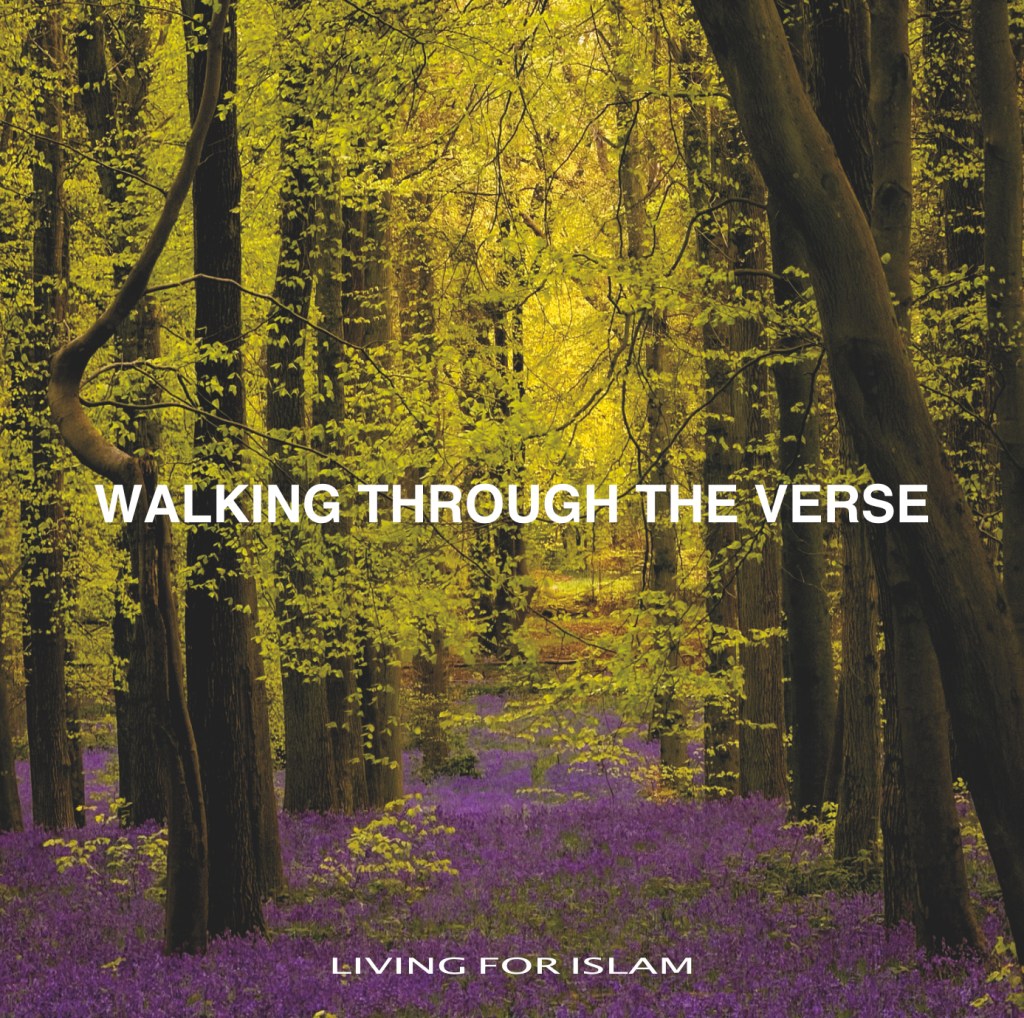
THERE IS SOMETHING that happens in certain forests across Britain at this time of year, not every forest, but those which are ancient and undisturbed. What was bare, dead soil transforms, day by day, into a sea of blue and purple stretching as far as the eye can see. The trees, still dark-branched, begin to wake. The first green pushes through the canopy above. And below, covering the forest floor in every direction, the bluebells arrive.
Every spring I seek this out. Different year, different forest, and always the same feeling when you step into it. The same stillness. The same sense of standing inside something that has been happening, repeatedly and faithfully, long before any of us arrived.
This year, walking through one of those ancient woodlands, a verse came to me that I had been sitting with that morning.
وَاللَّهُ أَنزَلَ مِنَ السَّمَاءِ مَاءً فَأَحْيَا بِهِ الْأَرْضَ بَعْدَ مَوْتِهَا
And Allah sends down rain from the sky, giving life to the earth after its death. (an-Nahl 65)
It felt like I was walking through the verse itself.
But it was the ending of that verse that had made me pause deeply earlier:
إِنَّ فِي ذَٰلِكَ لَآيَةً لِّقَوْمٍ يَسْمَعُونَ
Indeed in that is a sign for a people who listen.
Rain is something we see. The transformation of dead earth into living land is overwhelmingly visual, colour returning to what was grey and still, life erupting from what appeared finished. So why does the verse end with listening? Why yasmaʿūn and not yubsirūn, not those who see, but those who hear?
Because seeing would be stating the obvious.
Everyone sees rain. The cycle of death and revival is not subtle, not hidden, not reserved for those with specialist knowledge. It is undeniable, repeated, universal. If the verse had ended with “for a people who see,” it would have said almost nothing. Of course they see it.
So the Qur’an shifts the question entirely.
It is not asking whether you observed the sign. It is asking whether you received it, and what happened next.
This distinction matters more than it first appears.
Seeing exposes you to something. But it demands nothing from you. You can witness a thing completely, register it, even be briefly moved by it, yet remain entirely unchanged. The exposure and the response are not the same event. And the gap between them is precisely where the verse locates its challenge.
In Qur’anic usage, listening is different in kind. It implies a readiness to be addressed, a willingness to allow what you encounter to reach you, to mean something beyond itself, to make a claim on you. Seeing passes in front of you. Listening enters.
The verse is not asking: can you see what is happening?
It is asking: are you willing to hear what it means?
This is part of a larger pattern in how the Qur’an speaks.
It calls people to look
أَفَلَا يَنظُرُونَ إِلَى الْإِبِلِ كَيْفَ خُلِقَتْ
Do they not look at the camels, how they were created?
To notice the detail and mastery of creation placed directly in front of them.
It calls people to listen, as here, to receive and reflect.
And then, in one of its most searching statements, it says that it is not the eyes that go blind:
فَإِنَّهَا لَا تَعْمَى الْأَبْصَارُ وَلَٰكِن تَعْمَى الْقُلُوبُ الَّتِي فِي الصُّدُورِ
Indeed it is not the eyes that are blind but the hearts within the chests.
Seeing. Listening. The heart.
Three faculties. Three stages. And the chain can break at any point.
A person can see signs everywhere and draw nothing from them, stopping at observation, never moving to reflection. A community can hear and understand, yet remain unmoved. And sometimes something is grasped, discussed, even lamented, yet never settles into the heart deeply enough to produce anything. Never changes the course of anything.
We live in an age that sees everything. Cameras in every pocket, suffering broadcast in real time, the signs of Allah’s creation available on demand. The images from Gaza alone, the rubble, the children, the dead earth where homes once stood, have been seen by hundreds of millions of people. Seen, registered, perhaps wept over.
And yet.
The question the verse presses is not whether we saw. We saw. The question is whether we listened. Whether what entered through the eyes travelled the distance to the heart and whether the heart, on receiving it, moved.
The Sahaba understood something about this that the ummah has largely lost.
Their defining response to revelation, recorded in the Qur’an itself as their collective character, was not mere reflection, or discussion, or even emotion. It was:
سَمِعْنَا وَأَطَعْنَا
We hear and we obey.
Samiʿnā wa ataʿnā. Notice that there is no gap in that formula. No pause for deliberation, no committee, no decade of analysis. The hearing and the responding were one continuous act. To hear a command from Allah and His Messenger ﷺ, for them, was already to be in motion.
This was not merely a personal spiritual disposition. It was a civilisational reflex, the posture of a people organised around the principle that revelation is not material for contemplation alone but a call to action at every level: individual, communal, political. The ummah that emerged from that built a civilisation precisely because it did not stop at seeing, or even at feeling. It moved.
What we have now is almost the inverse. A vast collective capacity to witness and a profound inability to respond. We see more than any generation in history. We are moved, briefly, often sincerely. And then the feed moves on.
This is not primarily a failure of feeling. It is a failure of listening. The heart that truly receives a sign cannot remain unchanged by it. The heart that heard samiʿnā wa ataʿnā and meant it did not return to ordinary life the following morning as though nothing had occurred.
The bluebells will come back next spring, if Allah wills. They have been coming back, in those ancient undisturbed forests, for longer than any living memory. The earth does not deliberate about whether to respond to rain. It does not weigh the cost, or defer to next season, or produce a statement of concern and move on. It receives and it answers.
إِنَّ فِي ذَٰلِكَ لَآيَةً لِّقَوْمٍ يَسْمَعُونَ
The sign is not new. It has never stopped being given.
The question, the only question the verse is actually asking, is what kind of people are standing in front of it.
| QUR’ANIC REFLECTION · SURAH AN-NAHL 65 |

