
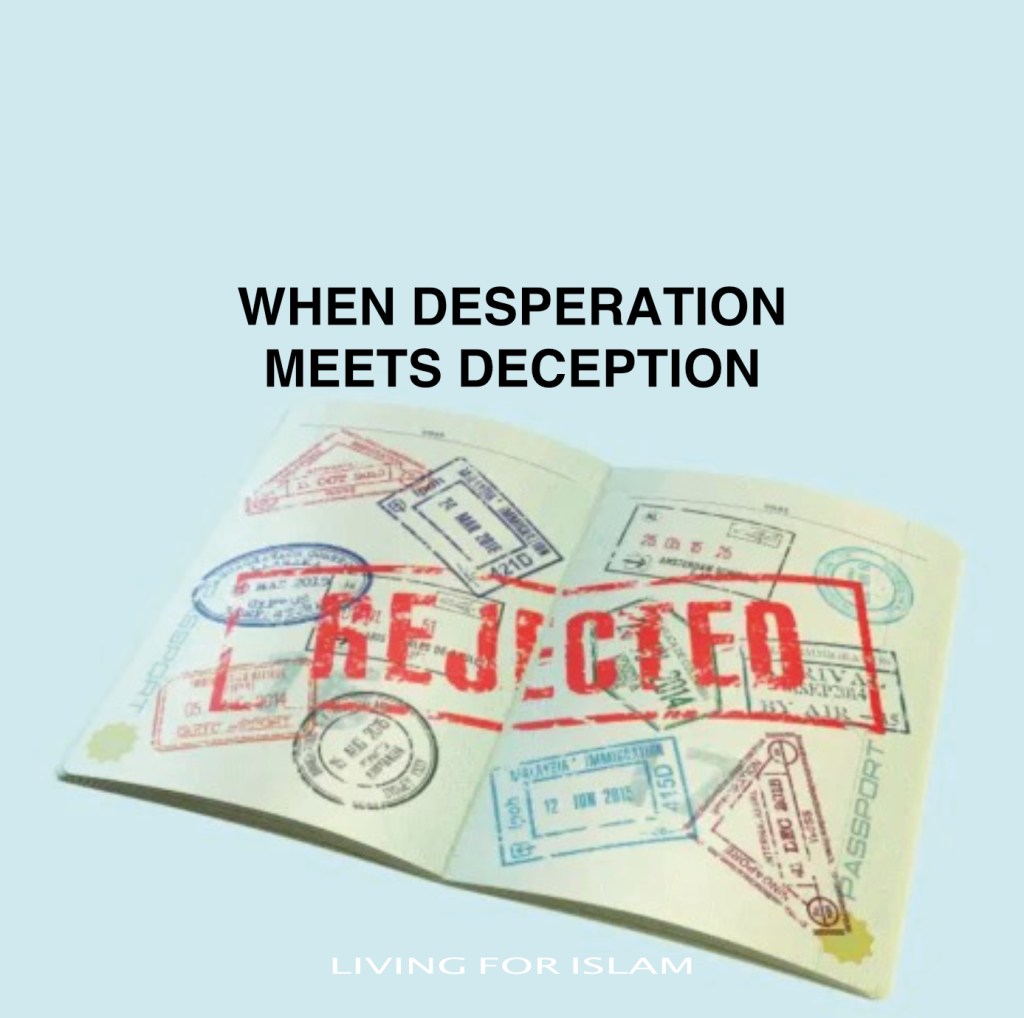
A BBC investigation has exposed what it describes as a shadow industry. Legal advisers and intermediaries are charging thousands of pounds to help migrants remain in the UK after their visas expire by constructing false asylum claims. The claims are built around protected categories: sexual orientation, religious identity, political persecution, and domestic abuse. Scripts are provided. Narratives are shaped. Evidence is created.
The reporting includes cases involving individuals from Pakistan and Bangladesh.
My reaction when I read the report wasn’t anger. It was sadness. The kind that comes when you see how someone fall into a trap.
I understand the pressures. The visa expires. Circumstances change. The uncertainty of what comes next becomes unbearable. Hardship is real. Pressure is real. The weight of a family’s expectation carried across continents is real. Many have spent their families’ savings to come legally. And in that moment, someone offers a solution.
To claim asylum on the grounds that you are an atheist, when you are not. To claim asylum on the grounds that you are gay, when you are not. To accuse your spouse of domestic violence when they have not. To sign your name to a statement that says, in effect: I have abandoned Islam, or I am what Islam forbids, and to say this not as truth, but as a transaction.
That last category deserves separate attention. The false claims about faith or sexuality wound the person making them. But the false accusation of domestic violence wounds someone else, a spouse, often left behind, carrying a lie they did not consent to and cannot easily answer. This is not only deception before the state. It is a violation of the rights of another Muslim. The shadow industry does not advertise this either.
Islam teaches us to have mercy on people in desperate situations. The Prophet ﷺ said: “Allah will not be merciful to those who are not merciful to people” (Bukhari).
But when a Muslim stands before an official of a state and declares that he has no religion as a means to an end, something has happened that cannot simply be filed under “irregular migration.” A statement has been made about one’s relationship with Allah ﷻ. A man has, in effect, uttered words that resemble disbelief. Whatever the legal outcome, this is a wound to the self that no visa can heal.
The Prophet ﷺ warned, “Truthfulness leads to righteousness, and righteousness leads to Paradise… and lying leads to wickedness, and wickedness leads to the Fire.” (Bukhari) This is not a secondary matter of manners.
Sidq, truthfulness, and amanah, trustworthiness, are among the defining characteristics of the believer. To trade them for residency status is to make a calculation whose full cost may not be visible at the time of signing.
The shadow industry that facilitates these claims knows this, of course. That is precisely why it is predatory. It finds people in their most vulnerable hour and offers them a story. It does not tell them what the story costs.
Now hold that image for a moment. The man in the interview room, signing the statement.
And place beside it another image that has become so familiar we have almost stopped seeing it. An inflatable vessel in the middle of the Channel at 3am. Men, women, children. The water is cold enough to kill. They know this. They came anyway.
These are not two separate phenomena. They are the same phenomenon. The man signing the false statement and the family on the boat are both telling us the same thing: that what they are leaving is worse than what they are risking. The man is risking his deen. The family is risking their lives. The calculus differs. The desperation is the same.
In both cases, there are industries built on that desperation. Law firms and advisers in the first. People smugglers in the second. Mirror images of each other, extracting money from people at the most broken point of their lives, offering a path whose full dangers they do not disclose.
We ask, with frustration or genuine bewilderment: why would anyone get on that boat? Why would anyone put their children on that water? Simply, because what they are fleeing, a bombed city, a disappeared husband, a country where their children have no future, is, to them, more certain than the danger of the crossing. Certainty of destruction on one side. Possibility of survival on the other. They choose the possibility.
The deaths in the Channel are not an immigration statistic. They are a verdict. They are what it looks like when human beings have been pushed to the absolute edge of what they can bear.
The question in both cases is not primarily about migration enforcement. It is about what produced these people’s conditions in the first place.
Either war was created over us, or our rulers have failed to look after us.
That sentence covers so much of the geography of Muslim suffering in the modern period. It is not rhetoric. It is a structural description.
Look at the countries producing the boat crossings. Afghanistan, a country that was invaded, occupied for two decades, and then abandoned. Syria, where a civil war was allowed and facilitated to metastasise into a catastrophe that killed hundreds of thousands and scattered millions. Somalia. Sudan. Iraq. In each case, the destruction of a Muslim land was not simply internal. It was shaped, prolonged, or exploited within a global order in which Muslim political authority is fragmented and weak.
Then consider countries such as Pakistan or Bangladesh. No bombs. No invasion. And yet, in interview rooms in Britain, Pakistanis and Bangladeshis rehearse narratives of disbelief or reinvention. Why?
Not because of war. Because of the slow pressure of systems that have, across the decades since independence, consistently failed to build a society where a young person with ability and ambition can expect a dignified life. Where opportunity is distributed by connection rather than merit. Where institutions that should serve the public have been repeatedly captured by party politics. Where a large, young, educated population looks at the horizon available to them at home and concludes, rationally, that it is not enough.
We need to be honest about what governance failure actually costs, not in macroeconomic indicators, but in human lives, in families separated, in faith compromised.
The Prophet ﷺ said: “Each of you is a shepherd, and each of you is responsible for his flock.” (Bukhari)
Responsibility is not measured by intention. It is measured by outcome. When people are scattered, on boats, in detention systems, in interview rooms signing statements against their own moral instincts, the accounting has already begun.
And a deeper question remains unresolved: what does it mean for a people to lack authority that is accountable both to Allah and to those it governs?
This absence of unified political authority is not abstract. It is lived. It is felt in Kabul and Damascus, in Dhaka, and in the Channel on a winter night. Disunited and unIslamic governance means that there is no effective authority to defend people when they are harmed, and no reliable mechanism to correct failure when it occurs.
In that vacuum, people move.
The one entrusted with authority who does not fulfil it is not merely ineffective. He has failed in an amanah before Allah. That framing should make us uncomfortable with how normalised governance failure has become.
So what do we say to the young man or woman who signed the statement?
We say: we understand how you arrived there. We understand the pressure placed upon you. We understand that you were shown a door and told it was the only one. We do not meet you with contempt.
But we also say: what you signed has a cost that was not explained to you. It is not only legal. It is personal and spiritual. Sidq is not optional in a Muslim life.
To compromise it, even under pressure, is to lose something real, though the door of tawbah, return to Allah, always remains open.
And to the family who crossed the water, if they survived: you were not wrong to seek life for your children. You were not wrong to refuse destruction as your fate. Islam does not ask people to accept oppression. But it asks that in seeking life, we do not lose ourselves, our truthfulness, our trust, our relationship with Allah, even when the horizon is dark.
And to the communities, scholars, and institutions that speak in the name of Islam: what are you waiting for?
The boats are evidence. The interview rooms are evidence. They show what happens when the amanah of governance, the responsibility to care for a people, is treated as something to be taken rather than fulfilled.
The BBC investigation is about migration. But beneath it lies a deeper question about responsibility, what we owe one another as Muslims.
That question does not have an immigration answer.
It has a civilisational answer. And we have been avoiding it for a very long time.

