

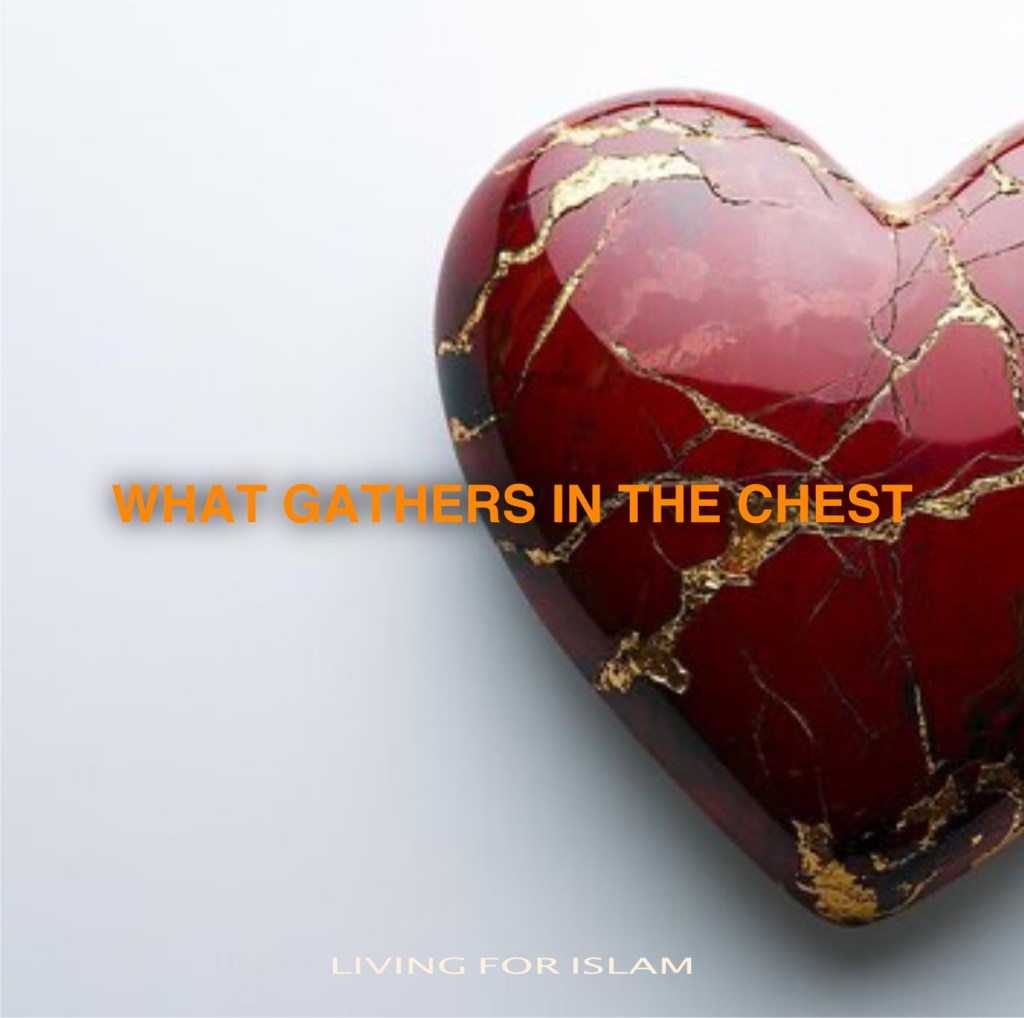
THERE ARE VERSES of the Qur’an that do not merely describe the afterlife, they reach into the present moment and do something to you. This is one of them:
وَنَزَعْنَا مَا فِى صُدُورِهِم مِّنْ غِلٍّ إِخْوَٰنًا عَلَىٰ سُرُرٍۢ مُّتَقَـٰبِلِينَ
And We will remove whatever is in their chests of resentment, [so they will be] brothers, facing each other on thrones. (al-Hijr 47)
At first glance it is a serene image: the people of Jannah, at rest, at peace, turned toward one another with nothing between them. But the verse carries within it an acknowledgement, one that anyone who has loved another person will feel immediately.
There is something that gathers in the human chest. Not always the thing we call anger. More often it is subtler than that: the weight of an old misunderstanding, a friendship that shifted without explanation, a closeness that became complicated. In Arabic this is called ghill, a word that resists easy translation because what it describes is precisely that which resists being spoken aloud.
Allah does not say that the people of Jannah were free of this. He says He will remove it. The verb used, naza’nā, carries the sense of extraction, of pulling something free from deep within, the way you might draw a thorn from beneath skin. Whatever has settled in the human interior, however long it has been there, Allah Himself will take it out.
The word used for the site of this feeling is also worth pausing over. The verse speaks of the ṣudūr, the chests, rather than simply the hearts. In Qur’anic usage, the chest is the broader interior: the place where emotions circulate, where tension lives alongside thought. The promise of Jannah, then, is not only freedom from physical pain. It is freedom from everything that has settled in that interior space. Paradise as the healing of the emotional self.
Then comes the word that follows the removal: ikhwānan, brothers. Not acquaintances. Not people who have agreed to coexist. Brotherhood, in its full sense of closeness, loyalty, and care. And the order matters. The resentment is removed first. Brotherhood is what remains when there is nothing left in the way.
The verse ends with an image that is simple in its completeness: facing one another. No one turns away. No one finds reasons to look elsewhere. The inner distance that can exist even between people sitting in the same room, that too is gone.
No one understood the weight of this verse quite like those who lived through the first great fracture among the Muslims. After the Battle of the Camel, a conflict that set companion against companion, that brought grief and shame to nearly everyone involved, Ali ibn Abi Talib (ra) led the funeral prayers for the dead on both sides. He buried Talhah ibn Ubaydullah (ra) and az-Zubayr (ra), men he had known his entire life in Islam, men he had just faced across a battlefield. Then he stood over their graves and spoke. What he said was recorded and has been passed down to us: that he hoped Allah would make him, Talhah, az-Zubayr, and Uthman among those described in this very verse, that whatever remained between their hearts would be removed, and that they would stand before one another as brothers.
He said this at a graveside. After a war. About men he had just buried.
This wasn’t for show. It was the statement of a man who understood, in the most visceral possible way, that the purification of the heart is not something we can complete in this life, and who entrusted that completion entirely to Allah.
What strikes me about this is the honesty it required. Ali (ra) did not claim his heart was already clean. He did not say the difficulty had not been real. He simply looked at the graves of his brothers and asked Allah to finish what none of them had been able to finish themselves.
That is a different kind of faith than the one that requires us to perform wholeness we do not yet have.
It allows us to say: there is something here I cannot fully resolve on my own. I ask You, O Allah, to take it from me.
For most of us, the complicated relationships in our lives are not going away. The people who have hurt us, or whom we have hurt, are often still present: at the dinner table, in the masjid, in memory. We carry what we carry, and some of it has been there long enough that we have stopped noticing its weight.
This verse does not ask us to pretend otherwise. What it offers is something more durable than pretending: a promise that our current emotional state is not our final one. That the version of us which exists now, carrying what we carry, is not the finished thing.
The removal is coming. Allah Himself will do it.
May He purify our hearts before we meet Him, and complete that purification in His presence.
| QUR’ANIC REFLECTION · SURAH AL-HIJR 47 |


One thought on “What Gathers in the Chest”