

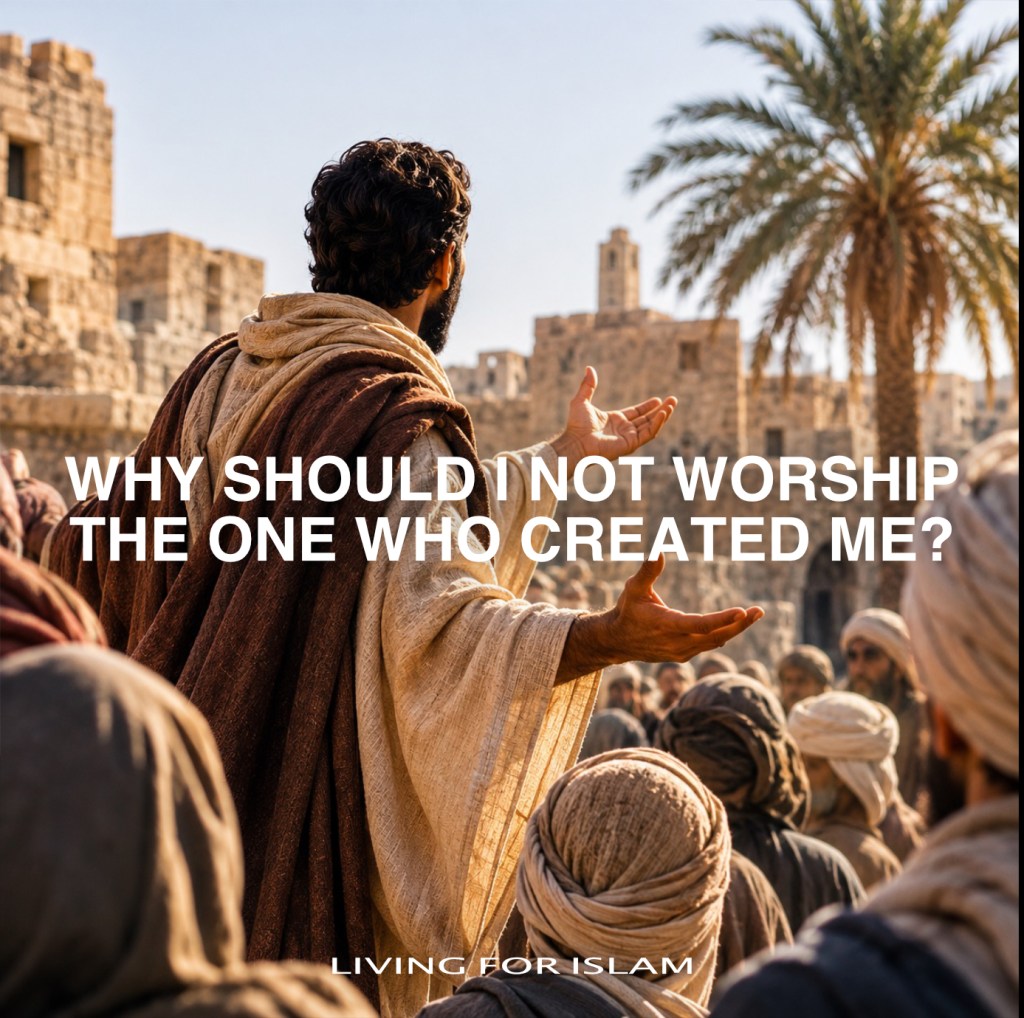
SURAH YA-SIN REVEALS the reasoning of a man whose belief in Allah shaped everything he understood about life. His words challenge not only those who worship other gods, but anyone who claims to believe in Allah while keeping His authority at a distance from the way they live.
فَمَا لِيَ لَا أَعْبُدُ الَّذِي فَطَرَنِي وَإِلَيْهِ تُرْجَعُونَ
And why should I not worship the One who created me, and to Him you will be returned? (Ya-Sin 22)
There is something extraordinary about the way this man explains his iman. He does not begin with a complicated theological argument. He asks a question that seems almost impossible to answer: Why should I not worship the One who created me?
It is a simple question, but it cuts to the heart of our relationship with Allah. If He brought us into existence, what justification could we have for refusing to worship Him? If our lives belong to Him and we will ultimately return to Him, how can we treat His guidance as something we may accept or reject according to our preferences?
In the previous verses, the man came running from the furthest part of the city to support the messengers. Now Allah allows us to hear the reasoning behind his conviction. We see a man whose belief is not merely an inherited identity or an emotional attachment. He understands why Allah deserves his worship, and that understanding shapes how he sees the world.
The depth of these verses lies not only in what he says, but in how he says it.
What is the Matter With Me That I Should not Worship?
The man declares: Fa-mā liya lā aʿbudu, so what is the matter with me that I should not worship?
The expression literally conveys the sense of “what is there for me?” or “what is the matter with me?” The question is not an expression of uncertainty. He is not genuinely wondering whether he should worship Allah. Rather, he is exposing the absence of any sound reason not to do so.
Given what he knows about his Creator, refusing to worship Him would be the irrational position. This is not faith presented as an arbitrary demand to believe without thinking. It is faith grounded in an understanding of reality.
The question also turns the focus inward. He does not begin by asking why other people refuse to worship Allah. He asks what possible justification he himself could have for not doing so.
That is a useful starting point for anyone engaged in da’wah. We can become so focused on what others need to understand that we neglect to examine our own relationship with the truth. Before asking why people do not submit to Allah’s guidance, we must ask whether we have fully understood what that submission demands of us.
The Word that Changes how we see Ourselves
The man explains why worship is the only reasonable response: Alladhī faṭaranī. The One who created me.
The word faṭarani comes from the root fa-ṭa-ra, which conveys the idea of originating or bringing something into existence. It is a powerful choice of word because it directs our attention to Allah as the One who originated us.
The man does not describe Allah merely as someone who helps him when he is in difficulty, answers his prayers or provides the things he needs. He recognises Him as the One responsible for his very existence.
Everything begins here.
Before we possessed anything, Allah brought us into existence. Before we could make decisions, pursue ambitions or establish our place in the world, we were already His creation. Our existence is not something we achieved for ourselves.
And if Allah is the One who brought us into existence, then our relationship with Him cannot reasonably be reduced to a private preference.
This has profound implications for how we understand our lives. Modernism encourages us to regard ourselves as the ultimate authority over our own existence. We are told to determine our values, define our purposes and decide which rules we are prepared to accept.
Islam begins from a different premise. We did not create ourselves, and we do not possess independent authority over the purpose for which we were created.
Creation is not meaningless, and our lives are not detached from accountability before Allah. The man understands that his existence carries an obligation. He does not approach worship as an optional addition to an otherwise self-directed life. He sees it as the appropriate response to the reality of who created him.
From Creation to Worship
There is a further point worth considering. The man does not merely acknowledge Allah as his Creator. He asks why he should not worship Him.
A’budu is associated with servitude and worship. This matters because recognising that Allah exists, or even acknowledging that He created us, is not the same as fulfilling our responsibility towards Him.
The man’s reasoning takes him beyond acknowledgement to submission. If Allah is the Creator, then He is the One to whom worship is due.
And worship in Islam is not confined to the rituals that take place in a mosque or to the moments when we consciously turn our attention towards religious matters. It encompasses our obedience to Allah and the way we conduct our lives in accordance with His guidance. Prayer, fasting and remembrance are essential acts of worship. But our relationship with Allah cannot be separated from our conduct in our families, our work, our economics or our politics. We cannot recognise His authority in one part of life while treating His guidance as irrelevant in another.
This is where the man’s question becomes particularly challenging as it exposes the inconsistency.
If Allah created us, can we reasonably claim that our lives are ours to organise entirely according to our own preferences? Can we acknowledge Him as Lord while insisting that His guidance should have no bearing on the principles by which we organise our affairs?
Yes, we will make mistakes. Humans are imperfect and often fall short. But, the key question is whether we acknowledge Allah’s guidance and try to align our lives with it, or if we prioritise our own desires above all else.
The Verse Then Turns From “I” to “You”
The man continues: Wa ilayhi turjaʿūn, and to Him you will be returned.
The man begins in the first person: “Why should I not worship the One who created me?” He expresses his own conviction. He then turns to his audience: “And to Him you will be returned.”
The shift is significant. His worship is his personal response to Allah, but the return to Allah applies to everyone listening, whether they accept his message or reject it. Their disbelief cannot alter their ultimate destination.
The Arabic places ilayhi, to Him, before the verb, giving prominence to the destination of their return. The passive verb turjaʿūn conveys the certainty of being brought back. This is not a destination they can choose to avoid.
The man’s argument therefore moves from his own conviction to a reality his audience must face. Their disagreement with him does not remove their accountability. Nor does our own reluctance to consider the Hereafter make it any less certain.
The man therefore grounds his reasoning in two realities: Allah is the One who brought us into existence, and Allah is the One to whom we will return.
Our beginning establishes our dependence upon Him. Our end establishes our accountability before Him. Between those two points lies the life we have been given.
What Are the Idols of Our Time?
The man then asks:
أَأَتَّخِذُ مِن دُونِهِ آلِهَةً
Shall I take gods besides Him? (Ya-Sin 23)
Again, he uses a rhetorical question. The form a-attakhidhu presents the idea of taking other gods as something he cannot rationally justify.
He has already established that Allah created him and that everyone will return to Him. Why, then, would he direct worship towards others?
He continues:
إِن يُرِدْنِ الرَّحْمَٰنُ بِضُرٍّ لَّا تُغْنِ عَنِّي شَفَاعَتُهُمْ شَيْئًا وَلَا يُنقِذُونِ
“If the Most Merciful intends harm for me, their intercession will not avail me at all, nor will they save me.” (Ya-Sin 23)
His argument is direct. If Allah wills harm for him, these supposed gods cannot secure his salvation. They cannot intercede successfully on his behalf, nor can they rescue him.
The wording is emphatic. Lā tughnī ʿannī shay’an means they cannot avail him in the least. Wa lā yunqidhūn adds that they cannot rescue him. The man closes off the imagined avenues of assistance. Whatever people attribute to these gods, they cannot provide the ultimate protection he needs.
And there is a beautiful detail in the name he uses for Allah: Ar-Raḥmān, the Most Merciful. Even while discussing the possibility of harm, he invokes Allah by this name.
The immediate context is the worship of other gods. The man recognises the futility of turning to them when they cannot save him from Allah’s judgement.
But the question also invites us to examine the idols of our own time.
Today, our idols aren’t made of wood and stone. Secularism, nationalism, liberalism, materialism etc, are ideas that shape how we understand the world, organise our lives and decide what is worth defending. For many these ideas have become unquestionable. We live for them, fight for them and, if needed, die for them.
For those who carry the daʿwah, this raises a practical challenge: will we present Islam as guidance for human life in its entirety, or confine its message to fit into what these modern idols allow? For the wider Ummah, it means recognising that being Muslim involves more than personal religious observance. It requires us to examine the values that shape our understanding of the world.
I Would Yhen be in Clear Error
The man concludes:
إِنِّي إِذًا لَّفِي ضَلَالٍ مُّبِينٍ
“Indeed, I would then be in clear error.” (Ya-Sin 24)
His reasoning has reached its conclusion. If he were to take other gods besides Allah, knowing what he knows about the Creator and the return to Him, he would be in manifest misguidance. The expression ḍalālin mubīn means clear or evident misguidance. This is not a minor misunderstanding. His conclusion is that such a position would be fundamentally mistaken.
The man is not simply repeating a belief he has inherited. He has considered the implications of what he believes and is prepared to state the conclusion plainly. His iman has intellectual clarity. He understands why Allah deserves worship and why nothing else can take His place.
This is important for the work of da’wah. We need more than an attachment to Islam that depends upon habit, emotion or the approval of those around us. We need to understand the foundations of our belief, to recognise why Allah’s guidance is true and to be able to explain it clearly.
The same applies to the wider Ummah. If we are to defend Islam, convey its message and challenge ideas that contradict its guidance, we must know what we believe and why. An Ummah that regards Islam as a cultural identity without deeply understanding its foundations will struggle to explain its distinct vision of life.
The man’s example shows us a iman that can be articulated and defended because its foundations are understood.
The Question for Us
The man who came running understood the implications of being created by Allah and returning to Him. His belief was not merely something he professed. It shaped how he understood the world and what he was prepared to stand for.
We face the same choice. We can treat Islam as one influence among many, or recognise that our relationship with Allah must shape our understanding of life itself.
If Allah created me, and to Him I will return, what justification do I have for giving another authority the final say over how I live?
|QUR’ANIC REFLECTION · SURAH YA-SIN 22-24|
Part 2 of the Man of Surah Ya-Sin Series: He ran. He reasoned. He declared. He was honoured.

