

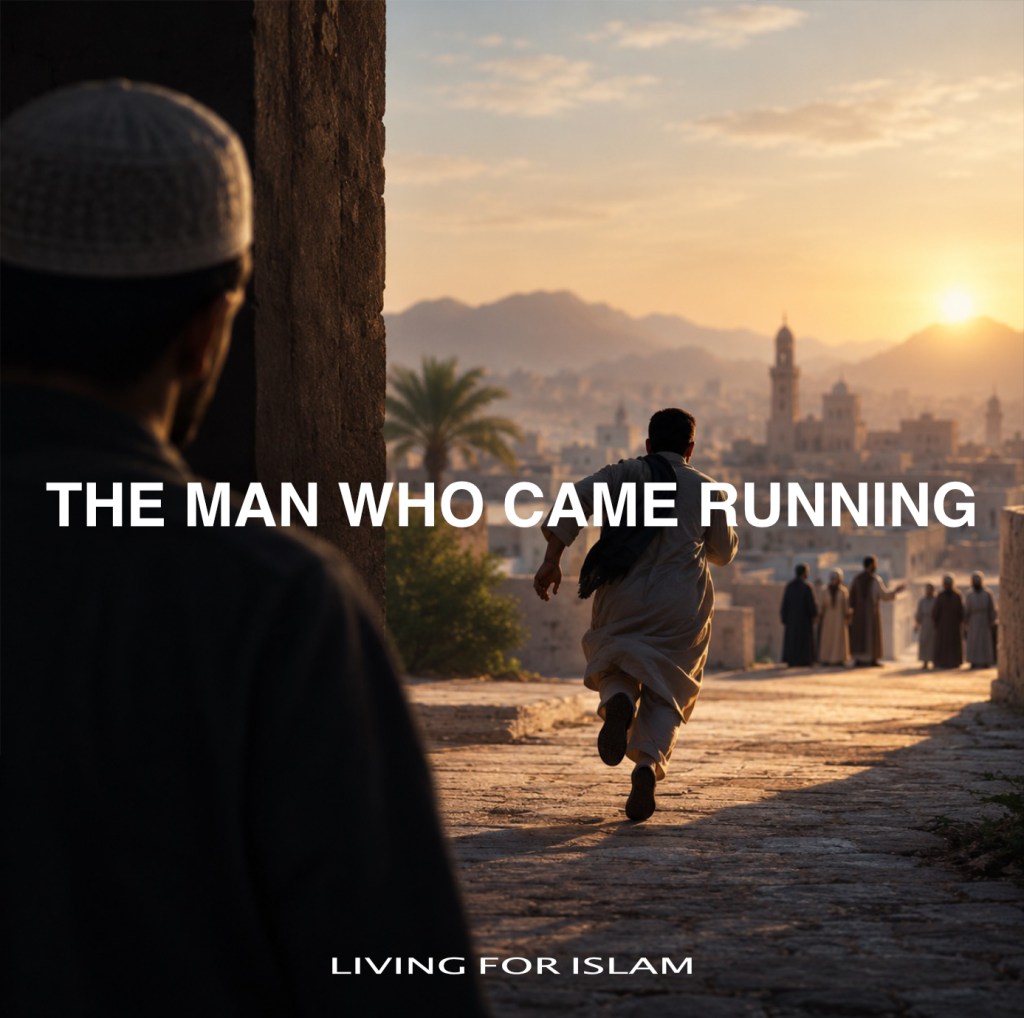
SURAH YA-SIN INTRODUCES us to a man whose name we do not know, but whose example Allah has preserved in the Qur’an. His example challenges both those who carry the da’wah and the wider Ummah.
وَجَاءَ مِنْ أَقْصَى الْمَدِينَةِ رَجُلٌ يَسْعَى
And there came from the farthest part of the city a man, running. (Ya-Sin 20)
Some people recognise the truth and accept it. Others recognise the truth and feel compelled to do something about it. In this remarkable passage, Allah introduces us to a man whose response to the truth was to run towards it.
Messengers had come to his town, calling its people towards Allah. The passage does not tell us how this man first learned about them, what he had been doing before this moment, or what position he held in society. Instead, Allah begins with three details that deserve our attention: he came, he came from the farthest part of the city, and he was running.
From the Furthest Part of the City
Wa jā’a min aqṣā al-madīnah, and he came from the farthest part of the city.
The word aqṣā conveys the meaning of the furthest extremity. The Qur’an could simply have told us that a man came to support the messengers. Instead, distance is part of the picture Allah gives us. Whatever the man’s circumstances, he did not allow that distance to prevent him from reaching the messengers.
Then Allah tells us that he was yasʿā, from the Arabic root س ع ي, which conveys striving, purposeful effort and active pursuit. In this context, the word depicts him hastening towards his people.
The description gives the scene a sense of movement and urgency. Before we hear a single word from him, we see something about his character: he is a man who acts.
How different this is from the way we sometimes respond to matters of the deen. We may recognise that something is right, agree with it and even speak positively about it, yet remain unmoved. We wait for someone else to take responsibility, someone else to speak, someone else to make the effort. But the man from Surah Ya-Sin does not remain where he is. The distance and the urgency are enough to make us reflect on the relationship between belief and action.
When we recognise the truth, does it move us.
A Man Whose Name we do not Know
There is another remarkable feature of this section. Allah tells us that a man came running, but does not disclose his name.
The personal details by which people usually measure importance, family, wealth, social position and influence, are simply absent. Some scholars of tafsir have mentioned reports from Judeo-Christian sources identifying him, but the Qur’an leaves his identity unknown. The emphasis is on what he did, not who he was.
For those involved in da‘wah, a key lesson is that we can get caught up in visibility, recognition, and audience size. We might judge success by how many people recognise our name or how far our words spread. But the Qur’an draws our attention to a nameless man. His example has endured because of his response to the truth, not because of any worldly recognition attached to him. The question is not whether people know who we are. It is whether we are doing what Allah expects of us.
For the wider Ummah, this is also a reminder that supporting Islam is not just the responsibility of famous scholars, public speakers or those who lead organisations. A person does not need a prominent position to contribute to the cause of Islam. Each of us has knowledge we can share, people we can reach, responsibilities we can fulfil and opportunities to support the truth.
“O My People”: Challenging Without Disowning
Allah continues:
فَقَالَ يَا قَوْمِ اتَّبِعُوا الْمُرْسَلِينَ
He said, “O my people, follow the messengers.” (Ya-Sin 20)
His first words are not an attack on his people. They are an appeal.
The expression yā qawmi, O my people, conveys a sense of belonging. He addresses them as his people even as he calls them to abandon their rejection of the messengers.
He does not allow his disagreement with them to erase his connection to them. Nor does his concern for them lead him to dilute the message.
This is one of the great balances of da’wah. We should be ready to question what is wrong, even if others accept it. However, the goal of this challenge is not to show we are better than others, but to guide them towards the truth.
The man doesn’t ask his people to follow him; he tells them to follow the messengers. He wants them to respond to Allah’s guidance, not just become his followers.
Then, in the next verse, he explains why they should do so:
اتَّبِعُوا مَن لَّا يَسْأَلُكُمْ أَجْرًا وَهُم مُّهْتَدُونَ
Follow those who ask of you no reward and who are rightly guided. (Ya-Sin 21)
He points to two signs: the messengers seek no reward from the people they call, and they are rightly guided. His argument directs attention away from personalities and towards the message and the sincere qualities of those carrying it.
For those involved in da‘wah, this is a reminder to examine our intentions. Are we calling people towards Allah, or some other motive or gain? For the wider Ummah, it is a reminder to assess those who carry the message by the standards of the Qur’an and Sunnah, rather than judging them by their popularity or lack of it. The criterion remains the truth.
And when the truth is being carried, the believer from Surah Ya-Sin shows us that it deserves active support.
The Distance between Belief and Responsibility
Muslims love Allah and His Messenger ﷺ, observe the obligations of their faith and want Islam to be respected. Yet when it comes to defending the Deen, challenging its misrepresentation and supporting those who carry its message, many leave the responsibility to scholars, activists and a small group of committed individuals.
The man came from the furthest part of the city. Many Muslims today may be spiritually distant from the cause of Islam, not because they reject it, but because they have yet to see its responsibilities as their own. They may appreciate the efforts of those who speak up, while remaining reluctant to do so themselves, particularly when it risks criticism or inconvenience.
Supporting Islam does not mean that every Muslim must perform the same role. Our knowledge, abilities, circumstances and responsibilities differ. Nor does it mean defending every person or group that claims to represent Islam. Our support must remain guided by the truth.
But differences in our capacities should lead us to contribute in different ways, not become an excuse for leaving the work to others. The question is not whether we can all do what this man did in precisely the same way. It is whether we have allowed our belief to move us towards the responsibilities Allah has placed before us.
When Belief Becomes Movement
The opening of this passage is brief, but its effect is profound. Allah shows us a man’s belief not detached from action. The world around him shaped his actions and brought him towards those carrying the message.
The man from Surah Ya-Sin reminds us that recognising the truth is not the end of our responsibility. It is where that responsibility begins.
Perhaps the question we should take away from these verses is a simple one: When the truth calls, are we still standing where we were, or are we running towards it?
|QUR’ANIC REFLECTION · SURAH YA-SIN 20-21|
Part 1 of the Man of Surah Ya-Sin Series: He ran. He reasoned. He declared. He was honoured.

