
THERE ARE TIMES when I look at the world around me and wonder if this really is the world we live in?
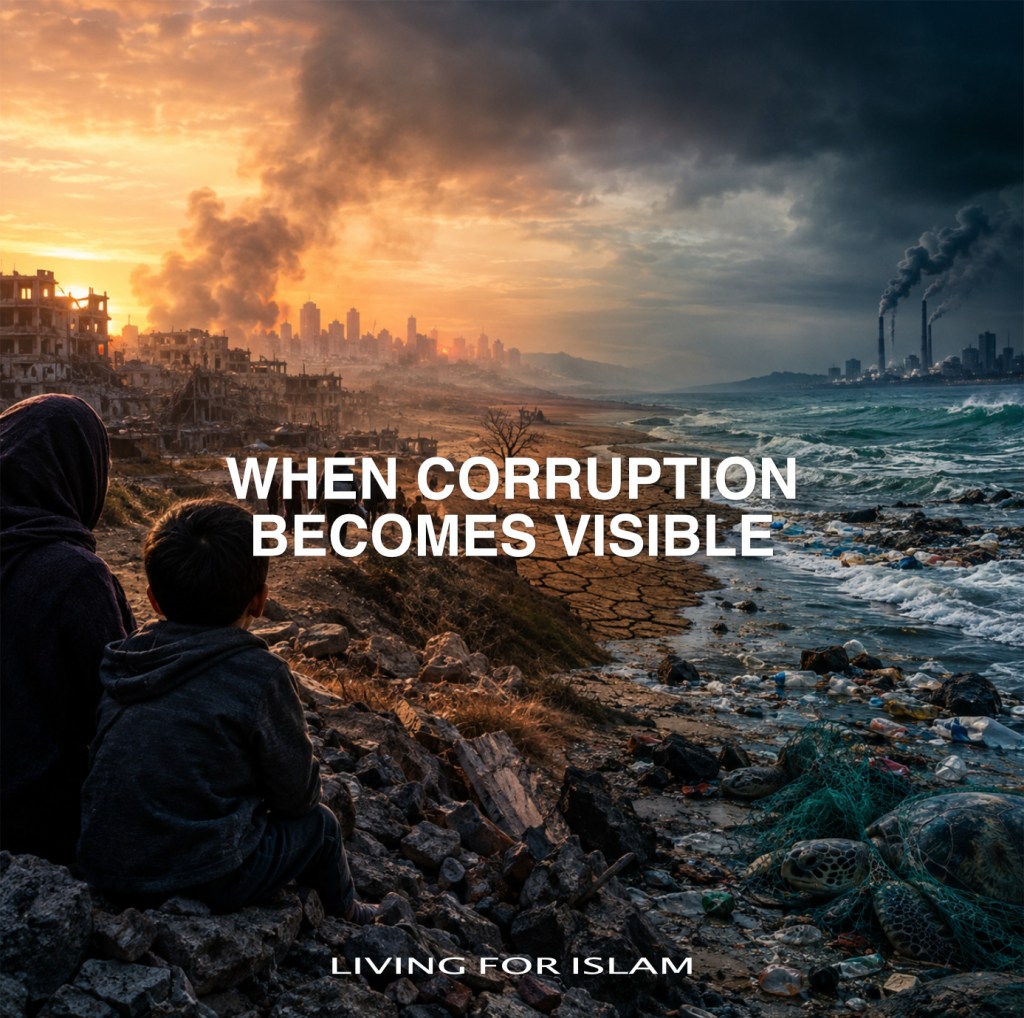
War. Destruction. Displacement. Climate change. Famine. Hatred. People being killed because of who they are. Children growing up surrounded by violence. Vast wealth existing alongside terrible deprivation. Human beings doing things to one another that seem almost impossible to comprehend.
Sometimes it can leave you with a sense of hopelessness.
Yet, the Qur’an gives us an extraordinary āyah that makes us look at all of this differently.
Allah says:
ظَهَرَ الْفَسَادُ فِي الْبَرِّ وَالْبَحْرِ بِمَا كَسَبَتْ أَيْدِي النَّاسِ لِيُذِيقَهُم بَعْضَ الَّذِي عَمِلُوا لَعَلَّهُمْ يَرْجِعُونَ
Corruption has appeared throughout the land and sea because of what people’s hands have earned, so that He may make them taste some of what they have done, perhaps they will return. (ar-Rūm 41)
It is a profound āyah.
Allah begins: Ẓahara al-fasādu, corruption has appeared.
The word ẓahara means to become apparent, to emerge into visibility. Something that may have been developing beneath the surface has now become manifest.
And notice the word Allah chooses: al-fasād. Fasād is corruption, disorder, deterioration, the spoiling of something from the condition in which it should be.
It speaks of corruption wherever the proper order of things has been disturbed. That can be in the environment, but also in societies, economies, politics, relationships and human conduct. A society can have: injustice and spiritual decline before social breakdown becomes visible. Economic exploitation before a crisis. Political oppression before rebellion.
Then Allah says: fī al-barri wa al-baḥri, in the land and the sea. The expression gives the āyah a remarkable breadth. It encompasses the world around us, the spaces in which human life unfolds.
And then comes the uncomfortable part: bimā kasabat aydī al-nāsi, because of what people’s hands have earned.”
Allah could have simply said, “because of what people have earned.” Instead, He mentions their hands.
The hand is the instrument of action. It represents what we do, build, produce, consume and destroy. We use the same language today: “I did this with my own hands.” “He had a hand in it.” The physical organ represents human agency and action.
The corruption we see is therefore not simply “the way the world is”.
Some of it is the consequence of our own hands. The verb kasabat, to acquire, earn or gain through one’s action further emphasises that human beings are not merely passive victims of history. Their actions and choices matter. What is tolerated, built and destroyed matters.
But then the āyah gives us a remarkable qualification: liyudhīqahum ba’ḍa alladhī ʿamilū, so that He may make them taste some of what they have done.
Allah chooses the remarkable word: liyudhīqahum, so that He may make them taste. Not simply punish them but taste. There is something vivid about this expression. To taste something is to experience a portion of it, to encounter something directly.
The word ba’ḍa, some, that comes after is also interesting. Allah is telling us that what human beings experience in this world is only a portion of the consequences of what they have done.
There is an implicit warning about the Hereafter in this. If this world already contains consequences for some deeds, then what about the deeds whose full consequences have not yet appeared?
The āyah establishes a broader reality: human wrongdoing can produce real corruption and real consequences in the world.
But then, just when the āyah seems to be moving towards judgment, its direction changes. Allah neither says: “So that they will suffer.” Nor does He say: “So that they will be destroyed.”
He says: laʿallahum yarjiʿūn, perhaps they will return.
This is the extraordinary turn in the āyah. The corruption, its consequences and human responsibility are all real. But despair is not the conclusion.
The Qur’an leaves the door open to return.
The word yarjiʿūn, from rajaʿa, means to return, to go back. It carries the sense of someone who has gone away and now turns back.
And perhaps that is why the āyah is so relevant to the world we see around us.
When we look at all the that is going on around us it is easy to see only an accumulation of problems and negativity.
Allah asks us to see something else.
He asks us to recognise corruption and to recognise that human choices have consequences. Then He asks whether these consequences might encourage us to change our path.
This is where I think the meaning of yarjiʿūn, they return, becomes even deeper.
The return is not simply an invitation for individuals to feel closer to Allah while the world around them remains unchanged. It is a return to Allah and to the order He intended for human life.
When Allah created Adam (as), He announced to the angels:
إِنِّي جَاعِلٌ فِي الْأَرْضِ خَلِيفَةً
“Indeed, I am placing upon the earth a khalīfah.” (al Baqarah 30)
Human beings were not placed on earth simply to be passive inhabitants, responding to whatever forces shape the world around them.
Allah gave us agency. He gave us responsibility. He gave us the capacity to cultivate, build, govern, protect, judge and establish what is right.
But that agency was never absolute. We are servants of the Creator, living in a creation that belongs to Him and bound by the limits He has set.
That is the balance that fasād breaks. When greed takes over, power overrides accountability, desire replaces truth, and the pursuit of wealth outweighs justice, corruption becomes clear everywhere.
Perhaps one of the great problems of our age is that we have forgotten what it means to be khulafā’.
We have become accustomed to seeing ourselves primarily as consumers, workers, voters and spectators of events that happen around us.
We look at what is happening around us and always wonder what someone else will do. But the Qur’anic perspective asks something more fundamental: What has Allah made us responsible for?
This is why the mention of the hands is so powerful.
The same hands that can produce fasād are also the hands through which human beings can work for the opposite ṣalāḥ, meaning righteousness, goodness, or order.
Whilst the end of every matter lies with Allah, we are not powerless spectators. Our agency has not disappeared. We have simply become accustomed to surrendering it.
The question is therefore not simply whether the world is becoming more broken. The more important question is what kind of people we become when we recognise that brokenness. Do we become numb, cynical and hopeless. Or do we allow what we see to awaken us and return.
Return to Allah and His guidance. Return to justice and to responsibility. Return to the balance that comes from recognising that we are not the owners of this world, but servants of its Creator put on this earth to maintain His balance.
That is the challenge today. To ask why the world has become like this, and then to ask what Allah has entrusted our hands to do about it.
|QUR’ANIC REFLECTION · SURAH AR RUM 41|
 Living For Islam