

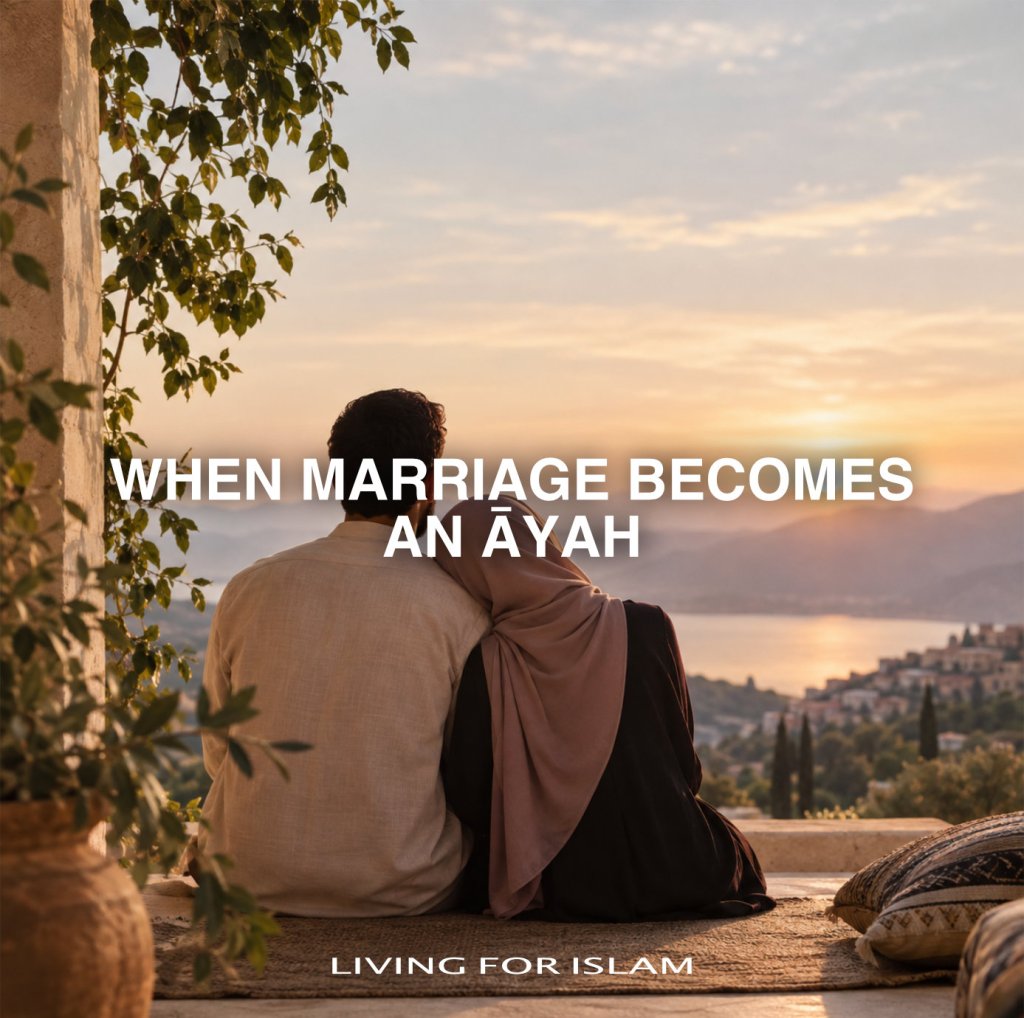
THERE ARE VERSES in the Qur’an that we hear so often that familiarity can make us forget how extraordinary they are.
Surah al-Rūm, verse 21, is perhaps one of them.
وَمِنْ آيَاتِهِ أَنْ خَلَقَ لَكُم مِّنْ أَنفُسِكُمْ أَزْوَاجًا لِّتَسْكُنُوا إِلَيْهَا وَجَعَلَ بَيْنَكُم مَّوَدَّةً وَرَحْمَةً ۚ إِنَّ فِي ذَٰلِكَ لَآيَاتٍ لِّقَوْمٍ يَتَفَكَّرُونَ
And among His Signs is that He created for you, from yourselves, spouses, so that you may find tranquillity in them; and He placed between you affection and mercy. Surely in that are Signs for a people who reflect. (ar-Rūm 21)
We see it on wedding invitations. We hear it at weddings and when speaking about marriage. We turn to it when describing love between husband and wife.
But it is worth pausing over the opening words, because Allah does not begin by saying: Marriage is… He begins: wa min āyātihi, and among His Signs.
Allah is not merely teaching us about marriage here. He is teaching us how to look at it.
Marriage as an Āyah
The word āyah means a sign, something that points beyond itself.
The heavens and the earth are signs. The alternation of night and day, and rain falling upon dead earth and bringing it back to life, are signs.
And here Allah tells us to look at this too: at the relationship between a man and a woman, at the way hearts become attached, at the tranquillity one person can find in another, at affection and mercy.
Marriage, therefore, is not merely something we experience. It teaches us something about the One who created it.
He Created For You, From Yourselves
Allah says an khalaqa lakum, that He created for you.
He created human beings with a longing for companionship, with the capacity to love and be loved, and with a desire for closeness and belonging. There is generosity in that small word lakum, for you.
Allah knows that beneath our strength is vulnerability, and that there are burdens we were never designed to carry entirely alone. So He created, among the means of His mercy, the possibility of finding another human being with whom life can be shared.
But He does not stop there. He tells us where these spouses come from: min anfusikum, from yourselves.
Your spouse is not presented as something alien to you. They share your humanity, with its fears, weaknesses and capacity to be wounded. They are not a perfect being descending into your life to solve everything. They are human, just as you are.
And that is precisely why marriage requires mercy. The person closest to you is not flawless.
Tranquillity Before Love
Then comes what may be the most beautiful phrase in the verse: litaskunū ilayhā, so that you may find tranquillity in them.
The verb comes from the root sīn-kāf-nūn, carrying the sense of settling and becoming still. Allah does not begin by describing marriage as excitement or attraction, and He does not open with the word “love.” He opens with sukūn, a settling of the soul.
Our lives are so often about struggle, about a world that constantly asks something of us. Yet Allah created within marriage a possibility of rest: a place where the heart can settle, a person before whom you do not always have to perform, someone beside whom silence does not need to be filled.
Romance can excite the heart; sukūn settles it.
The preposition ilayhā also conveys direction. You turn towards the spouse, and there you settle. There is almost a journey contained in the language: restlessness, turning towards, settling.
This may also explain why Allah does not say “so that you may love them.” Feelings rise and fall. Attraction and circumstances change. People change. Marriage has to survive all those days too.
Tranquillity is not a promise that marriage will always be peaceful. It is a gift that can sustain the relationship when emotional intensity is absent and life becomes difficult.
Placed Between You
Allah continues: wa jaʿala baynakum, and He placed between you.
He does not speak only of something existing inside each person, but of something existing between them, a bond that belongs to the two of them together. There is you, there is me, and then there is us.
A marriage is not simply two individuals living parallel lives. There is something created between them that needs to be protected, and their words, arguments, forgiveness and neglect all act upon it.
Perhaps one of the most important questions a husband or wife can ask in a difficult moment is not “Am I right?” but “What am I doing to what Allah has placed between us?”
And it is worth remembering that the capacity for affection is itself a divine gift. Two strangers meet, trust develops, one person’s happiness begins to matter to another, and one person’s pain becomes another’s pain.
Allah placed that capacity inside human beings. So love itself becomes an āyah.
Affection That Takes Form
What Allah placed between spouses first is mawaddah, affection.
Mawaddah is associated with love and loving regard. It is not merely a feeling trapped inside the heart, but affection that is experienced.
A gentle word. A thoughtful gesture. Being tender when the other is vulnerable.
We sometimes say, “Of course I love you, you know that.” But love that never becomes visible is difficult for another person to experience.
Mawaddah invites love to take form, to become behaviour and presence.
Mercy That Remains
But Allah does not stop at mawaddah. He adds wa raḥmah, and mercy.
This is where the verse becomes profoundly realistic.
Marriage does not consist only of beautiful days. There will be illness, exhaustion, grief, and moments when one spouse has very little left to give. There will also be moments when you are the one who is difficult to live with.
Mercy means that another person’s weakness does not make them unworthy of kindness. It recognises their humanity and responds with care, even when doing so requires patience and sacrifice.
Together, mawaddah and raḥmah give marriage something stronger than romantic feeling alone. Mawaddah finds joy in the beloved; raḥmah remains when the beloved is struggling. One expresses love. The other carries it through weakness.
Signs for a People Who Reflect
Notice the architecture of the verse. It opens with wa min āyātihi, among His Signs, and closes with inna fī dhālika la-āyātin, surely in that are Signs.
The entire description of marriage sits inside this frame. The frame is an instruction in how to see the marriage.
Allah then gives the key: liqawmin yatafakkarūn, for a people who reflect.
Two people can experience the same marriage. One sees another person, while the Qur’an invites the other to ask who created this person, who placed affection between them, and who allows one human being to become a source of rest, love and mercy for another.
That question turns the creation into a door onto the Creator.
A Place to Know Allah
Marriage can become a place where we learn about Allah.
Mercy, because we discover how much of it human beings need. Patience, because another’s needs rarely fit conveniently into our plans. Humility, because sometimes we must admit we were wrong. Gratitude, because another person’s presence in our life was never something we were entitled to.
Through all of this, the relationship points beyond itself. The spouse is not the destination. Allah is.
This is also where the verse offers a protection. We sometimes place an impossible burden on marriage, expecting another human being to become our complete source of happiness and healing.
But the verse never promises that a spouse will fulfil everything within us. The spouse is a gift from Allah, the affection is from Allah, and the tranquillity is from Allah.
When they cannot give you what only Allah can give, you do not resent them for being human. You turn back to the One who created you both.
The Final Invitation
Perhaps one day we will look back and realise that some of the greatest Signs Allah placed in our lives were not dramatic miracles but ordinary moments: a cup of tea made without being asked, a weakness kept private, an apology accepted, a harsh word swallowed.
These things look small. But Allah says, inna fī dhālika la-āyātin liqawmin yatafakkarūn, surely in that are Signs, for a people who reflect.”
The question worth asking is not only “Am I happy in my marriage?” but “What is Allah teaching me about Himself through this marriage?”
About mercy, patience, gratitude, forgiveness, and my own need for Him. Marriage is not merely something to have. It is something to understand.
And if we learn to look deeply enough, we may find that the person beside us is one of the many places in our lives where Allah is asking us to stop and look at His wisdom, His mercy, and His generosity.
|QUR’ANIC REFLECTION · SURAH AR RUM 21|
 Living For Islam