
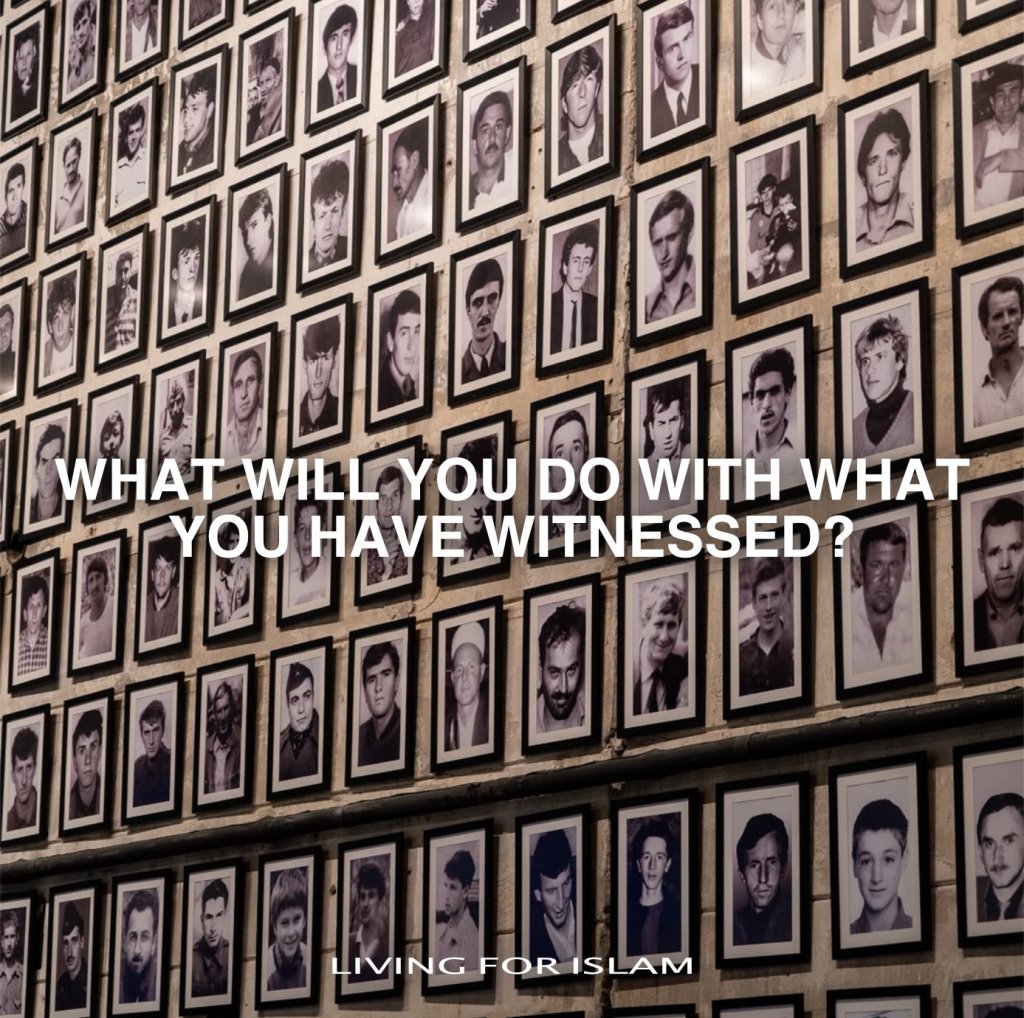
STANDING AT THE Srebrenica Genocide Museum, with each exhibit offering another painful reminder of what happened, there is an inevitable question that comes to mind.
Why were they killed?
Why were thousands of men and boys separated from their families and communities, driven into the forests, executed, and thrown into mass graves? Why were their families left behind to carry the loss?
The answer to the first question is, in part, found in the Qur’an’s description of how believing communities have been persecuted throughout history.
In Surah al-Burūj, Allah describes an earlier believing people who were thrown into pits of fire because they refused to abandon their faith. Allah tells us why they were persecuted:
وَمَا نَقَمُوا۟ مِنْهُمْ إِلَّآ أَن يُؤْمِنُوا۟ بِٱللَّهِ ٱلْعَزِيزِ ٱلْحَمِيدِ
And they resented them for no reason other than that they believed in Allah, the Almighty, the Praiseworthy. (al-Burūj 8)
What was their crime? Nothing. Their only offence was īmān.
But, as so often happens with the Qur’an, there are details in the verses surrounding the obvious meaning that can easily be missed.
I found myself stopped by the verses immediately before this one:
إِذْ هُمْ عَلَيْهَا قُعُودٌ وَهُمْ عَلَىٰ مَا يَفْعَلُونَ بِالْمُؤْمِنِينَ شُهُودٌ
When they were sitting around it, witnessing what they were doing to the believers. (al-Burūj 6-7)
Allah could simply have told us that the believers were thrown into the fire. Instead, He slows the scene down and tells us more about the nature of the perpetrators: Idh hum ʿalayhā quʿūdun, when they were sitting around it.
There is something deeply unsettling about that image. The perpetrators are not merely present. They are sitting. And then Allah describes them as: shuhūd, witnesses.
The word ʿalā is also striking: ʿalā mā yafʿalūna bil-muʾminīn. Literally, they are over or upon what they are doing to the believers.
The image is one of proximity. They have created the scene. They have surrounded it. And they remain there to watch.
Allah draws our attention not only to the fire, but to the people sitting around it. Not only to what was being done. But to those who were watching it being done.
The cruelty here is twofold. The perpetrator does not simply commit the act. He remains there to watch it unfold. The sitting itself becomes part of the horror. There is no urgency in the scene. No attempt to stop what is happening. No instinct to turn away.
They sit around the fire. And they watch.
Walking through the museum, one exhibit stood out: a video of a father being forced to call out to his son hiding in the forest. ‘Come down, you will be safe,’ he calls. His son eventually comes out of hiding only for the pair to be executed. The video was taken by the army officers, proud evidence of their criminality.
Standing in Srebrenica, I could not separate that image from the words on the plaque at the entrance to the memorial:
“Srebrenica genocide — the failure of the international community.”
Not simply the failure of the killers. The failure of those who watched. Srebrenica was not an atrocity that happened in complete darkness, beyond the reach of the outside world. Srebrenica had been declared a United Nations safe area. There were international forces on the ground. There were governments receiving information. There were people who knew that the situation was deteriorating and that civilians were in danger.
And yet protection failed. A genocide happened. And the world watched.
This is where the two kinds of witnessing in the Qur’anic passage become apparent.
The people around the trench were both the perpetrators and the audience to their own cruelty. They had created the scene and then remained to watch it. Their witnessing was part of their oppression.
The world’s witnessing of Srebrenica was different.
Governments were not carrying out the executions. They were not the ones pulling the triggers. But they knew that people were in danger. They had people on the ground. They had information. They had institutions. They had responsibilities. And still, the people of Srebrenica were left exposed.
Different kinds of guilt. Different kinds of responsibility. But the image of witnessing without intervention is painfully familiar. We have seen versions of it since, among the Rohingya, in Sudan and, most visibly, in Gaza. The details and circumstances differ in each case, but there is something recognisable about the experience of watching suffering unfold while possessing some ability to respond.
Witnessing is not always innocent or neutral. Seeing often creates responsibility, and the longer we remain looking without acting, the harder it becomes to pretend that seeing had nothing to do with us. Gaza has taught us that there is less distance between suffering and the witness than there has ever been; we see, we scroll, we watch, and then we return to our lives. That makes the Qur’anic word shuhūd uncomfortable in a different way. Perhaps the question is no longer simply: did you know? It becomes: what did you do with what you knew?
But there is another question. If witnessing creates responsibility, what are we actually supposed to do? Are we simply meant to feel sadness? Anger? Guilt? Are we supposed to watch, condemn, share and remember? Or does Islam give us a different model?
This is where the image of the shield becomes important. The Prophet ﷺ said: “The Imam is but a shield behind whom the Muslims fight and by whom they are protected.” (Muslim)
A shield is an entirely different image from an audience. An audience watches what is happening. A shield exists to protect those who are being threatened. It stands between the danger and the people behind it. It absorbs what was meant for them. It is there because someone has taken responsibility for protection.
What would that look like in practice? It looks like a unified Muslim state that isn’t fractured along national or sectarian lines. It is one that steadily builds its resources and infrastructure, so they exist when danger arrives. And it is one that has the political will to intervene when a community is under threat, not only through statements of condemnation, but through diplomatic leverage, economic weight, and, where necessary, force used in defence of the defenceless. None of this exists in the Ummah today, and that gap, between the ideal of the shield and the reality of scattered, competing, powerless nation states, is itself part of what Srebrenica should force us to reckon with.
And perhaps this is one of the great lessons Srebrenica leaves for the Ummah. “Never again” cannot simply mean remembering. It cannot mean annual commemorations, solemn speeches and photographs of graves. Memory matters. But memory alone does not protect anyone.
An Ummah that wants to protect its people needs more than emotion. It needs political unity, leadership, resources, power, and the willingness to assume responsibility for people who are under threat.
Without it, the alternative is painfully familiar. The victims are left exposed. The world watches. The graves multiply. And afterwards everyone promises: Never again.
Surah al-Burūj closes this passage with one of its most powerful reversals:
ٱلَّذِى لَهُۥ مُلْكُ ٱلسَّمَـٰوَٰتِ وَٱلْأَرْضِ ۚ وَٱللَّهُ عَلَىٰ كُلِّ شَىْءٍۢ شَهِيدٌ
To whom belongs the dominion of the heavens and the earth. And Allāh, over all things, is Witness. (al Buruj 9)
There is a beautiful connection in the language. The people around the trench are shuhūd. Witnesses. And Allah is Shahīd. The Witness.
The oppressors imagined themselves to be the ones watching. Allah reminds them that the watchers are watched.
Human beings may witness something and then forget it. They may look away. They may deny it. They may explain it away. They may write reports about it decades later.
But Allah does not forget. No death disappears because the world failed to intervene. No injustice becomes insignificant because history moves on. No grave is hidden from Allah. No tear falls unseen.
Moving out to the Memorial and standing among the thousands of white headstones, I found myself thinking the people who died. And more so about the people who watched. The ones who could see. The ones who had responsibility. The ones who could have acted.
And I was thinking about myself. Because the Qur’an does not just address the past. It asks a question of every generation: What will you do with what you have witnessed?
May Allah have mercy on the martyrs of Srebrenica. May He grant patience to those they left behind. May He protect the people of Gaza and all those suffering under oppression. And may He make this Ummah worthy of the responsibility He has placed upon it. May He never make us a people who simply witness oppression. And may He give us the courage, wisdom and strength to reestablish the shield that protects those who cannot protect themselves. Āmīn.
|QUR’ANIC REFLECTION · SURAH AL BURUJ 6-9|

