
I HAVE PREVIOUSLY written about how the Srebrenica genocide in the 90s was a turning point in my life.
As a 20 year old, It was the first time I truly became conscious of the horrors of war, the deep-rooted hatred against Muslims in Europe, the blindness of those who speak of higher values while atrocities unfold before them, and the inability of Muslims to defend themselves when faced with such brutality.
It changed the way I looked at the world.
I wrote those words years ago and I returned to it every year.
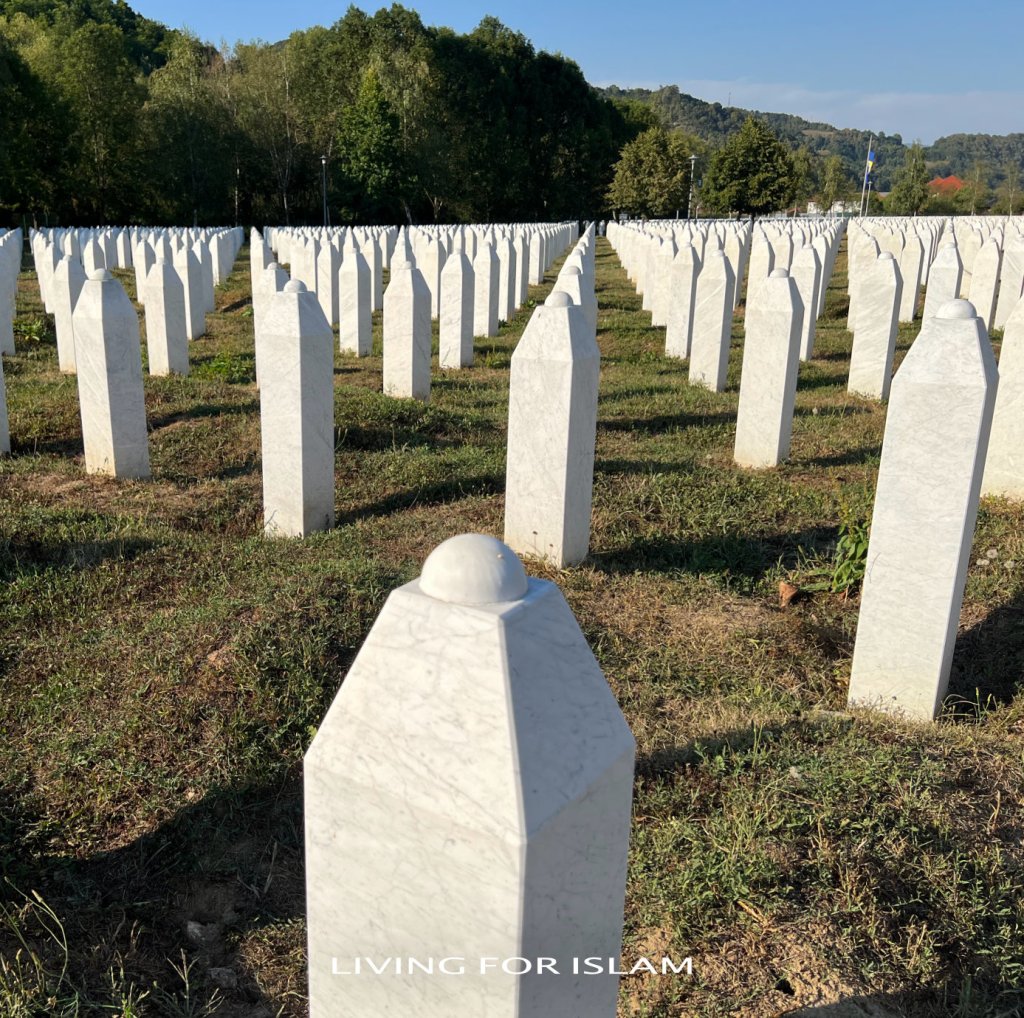
Today, I stood at the Srebrenica–Potočari Memorial and Cemetery for the Victims of the 1995 Genocide
We were late.
The journey from Sarajevo was long, winding through the mountain highways, and my youngest son had become car sick along the way. By the time we arrived at the memorial centre, the curators were about to turn off the exhibition lights and close for the day.
“Give us 20 minutes to look around,” I said. “We travelled so long to get here.”
They looked at us.
They knew my name. “You must be so and so. We got your email that you would be coming.”
Every visitor had been accounted for (several thousand that day) except our family.
The middle-aged curator, who had lived through the genocide herself and whose husband was a survivor, took another hour of her time and gave us a personal tour. We were the only ones at the exhibition.
“You came all this way. You cared. You need to know the truth.”
There were three exhibitions in the former factories used by the Dutch UN forces that were supposed to protect the people. Each one a harrowing and haunting account of what happened here thirty years ago.
On the way to Potočari, I had asked my son two things. The history of Islam in Bosnia and to find out something about the genocide.
I’ll talk about the former in another post but when it came to the genocide, “About 8,300 men and boys were separated and then executed,” he told me “That’s a lot of people.”
When we stood before the endless sea of white headstones at Potočari, I told him: “This is what that number looks like.”
Not a number. People. Fathers. Brothers. Sons. Husbands. Nephews. Grandfathers. Each one with a name. Each one with a family. Each one with someone who loved them.
Killed in the most brutal way.
I spoke to the curator about my own story. I told her how Srebrenica had affected me all those years ago. It was different to the live stream genocide that my children’s gencoide were witnessing in Gaza. There wasn’t social media or the internet at that time. Just news reports and snippets of what people managed to report back.
I told her that perhaps these are some of the realities Allah sends to test us. Not only those who suffer, but those who witness.
What do we do when we see injustice? Do we remain silent? Do we make it our life’s mission, as she has, to tell the truth? Do we dedicate our lives to changing the circumstances that allow these things to happen?
She agreed.
Then she told me about her own struggles.
This part of Bosnia is still dominated by Bosnian Serbs. She can be harassed by the authorities because they don’t want or like that part of history to be told. Many of the people, Bosnian Serbs, were part of that story, took part in the atrocities or remained silent when their neighbours were killed and raped. This is not something that just disappears. She also worries about the younger generation and the increasing strength of the hatred against Muslims. Many Bosniak Muslims have left the area or gone abroad.
But she remains.
Because she believes the story needs to be told. Even if it costs her.
And perhaps that is another lesson Srebrenica has taught me.
There are those who kill. There are those who watch. There are those who suffer. And there are those who refuse to let the truth disappear.
Thirty years later, she is still here, telling the story.
And today, I brought my children to hear it. The past and the present, connected by the same problems of hatred and betrayal and the absence of the shield to unite the ummah and protect us..
 Living For Islam