

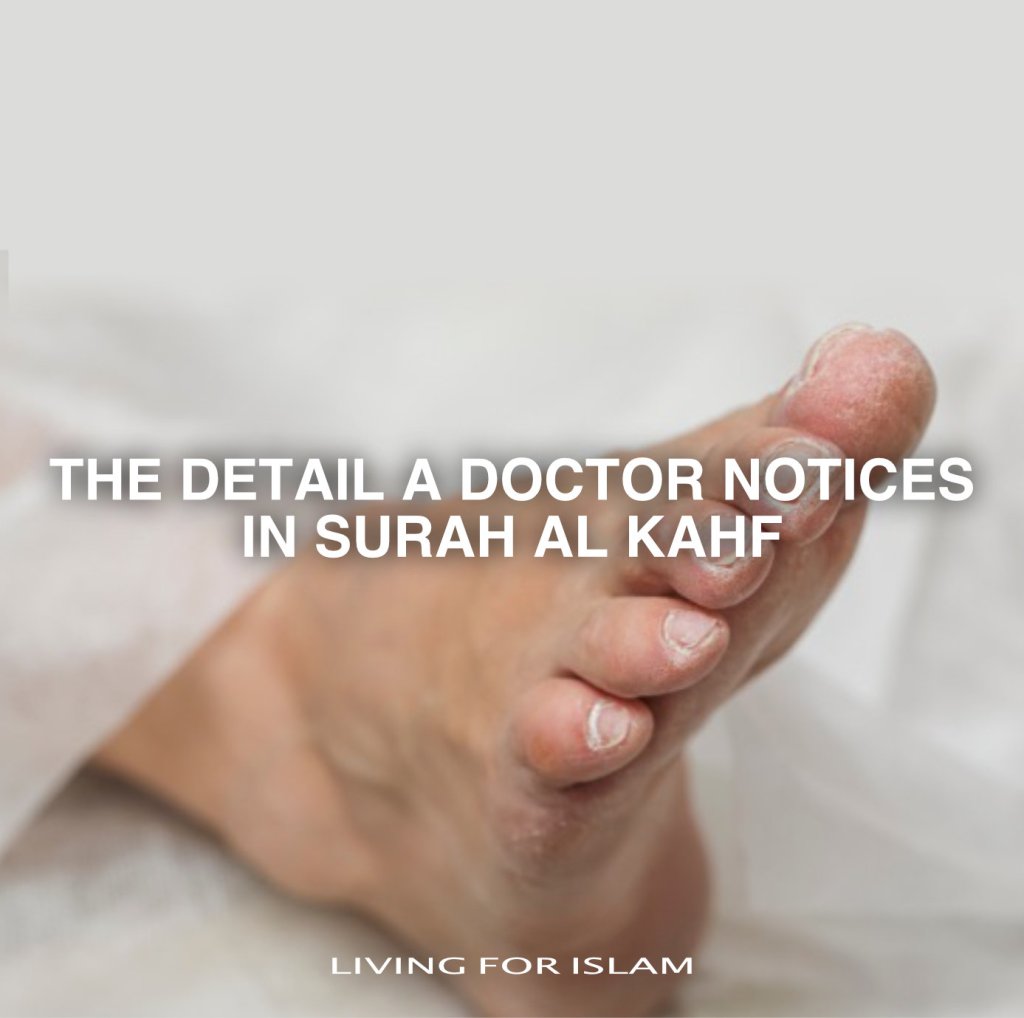
IT IS EASY to overlook small details when reading the Book of Allah. Many of us read Surah al-Kahf on Fridays, and recently, I noticed something in ayah 18.
وَتَحْسَبُهُمْ أَيْقَاظًۭا وَهُمْ رُقُودٌۭ ۚ وَنُقَلِّبُهُمْ ذَاتَ ٱلْيَمِينِ وَذَاتَ ٱلشِّمَالِ ۖ وَكَلْبُهُم بَـٰسِطٌۭ ذِرَاعَيْهِ بِٱلْوَصِيدِ ۚ لَوِ ٱطَّلَعْتَ عَلَيْهِمْ لَوَلَّيْتَ مِنْهُمْ فِرَارًۭا وَلَمُلِئْتَ مِنْهُمْ رُعْبًۭا
“And you would have thought they were awake, though they were asleep. We turned them over, to the right and left, while their dog stretched his forelegs at the entrance. Had you looked at them, you would have certainly fled away from them, filled with horror.”
There are many lessons that can be taken from this one ayah.
What we see is not necessarily the reality of what is happening. Allah preserves and protects those who serve His cause. Even something as ordinary as a dog can be elevated by the company it keeps.
But one phrase caught my attention: wa-nuqallibuhum dhāta al-yamīni wa-dhāta al-shimāl, and We turned them to the right and to the left.
In thirty years of medical practice, I have seen what happens when an immobile body is not turned.
It begins with redness at the heel, the sacrum, the hip, the pressure points where weight builds up and blood flow is compromised. Left unaddressed, the tissue breaks down. An ulcer forms. What was preventable becomes a wound, and what began as a wound can develop into a serious and sometimes life-threatening complication.
An immobile patient therefore needs to be repositioned regularly and consistently. Specialist mattresses and other measures can help, but careful repositioning remains an important part of pressure-area care. It requires vigilance and care from nurses and as a doctor, you intervene when problems arise.
So when I read, “And We turned them to the right and to the left,” I noticed something that I might once have simply read past.
The People of the Cave were asleep for an extraordinary span of time, completely passive and beyond the reach of any human care. Yet Allah tells us that they were turned from side to side. It is a small detail in the story. Clinically, it is an important one.
Some would read this ayah and call it another scientific miracle, evidence that the Qur’an anticipated what medicine would later discover.
I look at it differently.
The clinical resonance is certainly striking. But the “scientific miracle” framing hands authority to the wrong source. It positions science as the validator and the Qur’an as the text awaiting confirmation. As if Revelation were on trial, and the laboratory were its judge.
That is not what this ayah does to me.
Allah is not merely the author of this ayah. He is the Creator and continuous Sustainer of every process by which the human body functions: the circulation of blood, the biology of tissue, and the physiology that makes prolonged immobility dangerous.
When I recognise in the ayah something I know to be clinically true, I am not watching science illuminate scripture. I am watching the created bear witness to its Creator.
The coherence runs from Allah outward. It does not run from the textbook inward.
This is why I do not see such ayat primarily as scientific discoveries waiting to be verified. They are signs that invite us to look beyond the detail itself to the One who created everything with such precision.
That recognition is not proof. It brings something deeper and more durable than proof.
It brings conviction.
|QUR’ANIC REFLECTION · SURAH AL KAHF 18|
 Living For Islam