
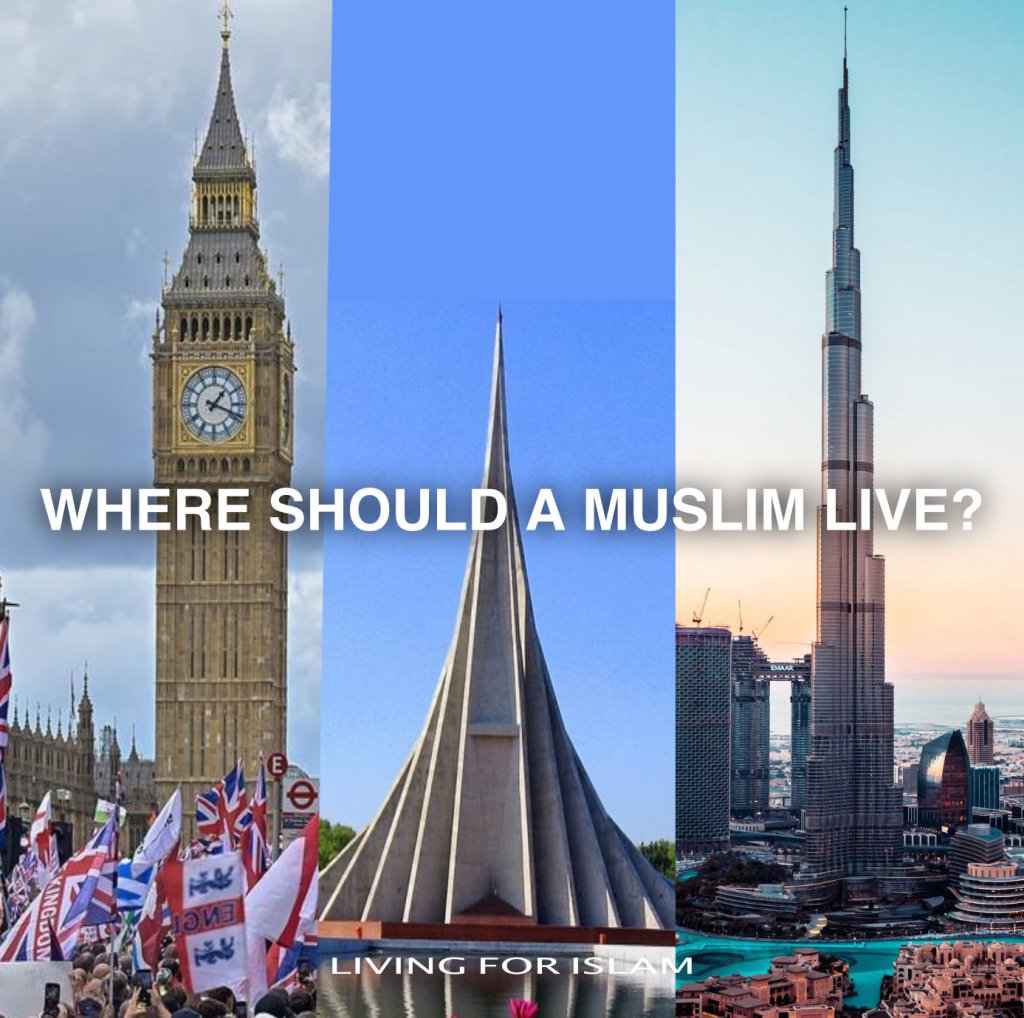
MANY MUSLIMS LIVING in Britain are asking an increasingly difficult question: Should we stay, or should we leave?
This is not an abstract question. Rising Islamophobia, hostility towards Muslims, political rhetoric, discrimination and anxiety about the environment in which our children will grow up can make life feel increasingly constricted. Some therefore consider moving to Muslim-majority countries, particularly the wealthy Gulf states, hoping to find greater religious security and a better environment for their families.
There is nothing inherently wrong with such a decision. Islam recognises that sometimes changing one’s environment is necessary, and the Qur’an explicitly says:
يَا عِبَادِيَ الَّذِينَ آمَنُوا إِنَّ أَرْضِي وَاسِعَةٌ فَإِيَّايَ فَاعْبُدُونِ
O My servants who believe, surely My earth is spacious, so only worship Me. (alʿAnkabūt 56)
But this remarkable āyah deserves careful reflection before we interpret it as simply: “If Britain becomes difficult, move to a Muslim country.”
The key to the verse is not actually arḍī wāsiʿatun, my earth is spacious. It is what follows: fa-iyyāya faʿbudūn, so only worship Me.
The verse does not simply tell us that there are other places we can go. It tells us why that spaciousness matters. The purpose is Allah.
A person may leave Britain, or another Western country, because they genuinely want an environment in which they can practise Islam, educate their children and live according to their faith. That may be a sincere and noble intention.
But another person may move for wealth, comfort, status, luxury, security or lifestyle and subsequently give the move a religious justification.
The outward action can be identical. The spiritual reality can be completely different.
This is why fa-iyyāya, only Me is so powerful. The Qur’an places Allah Himself at the centre of the decision.
The question is not simply: “Where will life be better?” It becomes: “Where can I more faithfully be Allah’s servant?”
That is a much harder question.
The Muslim World Is Not One Place
There is another problem with imagining that the answer must simply be “move to a Muslim country”. The Muslim world is not one environment.
In parts of South and Southeast Asia, Islam is woven into the ordinary fabric of life. Mosques are everywhere. The adhān is part of the soundscape. Ḥalāl food is taken for granted. Ramadan changes the rhythm of society. Islamic festivals are public occasions. Children grow up surrounded by Muslims.
For someone who has spent years living as a Muslim minority, this can feel like a profound relief. But religious familiarity is not the same as an ideal society.
The same environment can come with poverty, corruption, overcrowding, pollution, weak institutions and daily frustrations that are difficult to appreciate from a distance.
The mosque may be next door. The adhān may fill the streets. But the government office may still demand a bribe. The hospital may still struggle. Poverty may still be visible everywhere.
Then there are the wealthy Gulf states.
A person can move to Dubai, Abu Dhabi or another wealthy society and similarly find mosques everywhere, the adhān throughout the day, halal food, Ramadan as a public experience and Islamic culture woven into everyday life.
Yet none of this guarantees greater closeness or adherence to Islam.
A person may acquire a larger house without acquiring greater knowledge of the Qur’an. They may increase their wealth without increasing their ṣalāh. They may become surrounded by Islamic symbols without becoming more attached to Allah.
A society may make outward religious practice easy while restricting other aspects of the moral and political life Islam demands.
The question of Palestine has made this particularly difficult to ignore. Over the last few years, Muslims across the world have seen how a society can make prayer, fasting and Islamic family life comfortable while placing severe restrictions on political expression or criticism of injustice.
All this means that no existing society should automatically be equated with the complete Islamic ideal simply because it is Muslim-majority or visibly Islamic.
So where do we go? That remains the uncomfortable question.
Ease is Also a Test
The Qur’an gives us a remarkable principle:
وَنَبْلُوكُم بِالشَّرِّ وَالْخَيْرِ فِتْنَةً
We test you with evil and with good as a trial. (al Anbiyāʾ 35)
Notice that both evil and good can be a test. Hardship can test us. But so can wealth. Persecution can test us. But so can acceptance. Restriction can test us. But so can freedom. Poverty can test us. But so can luxury. Different places can therefore test us in very different ways.
Britain may ask: Can you remain faithful when being Muslim can come at a social cost? A wealthy Gulf society may ask: Can you remain faithful when outward religious practice requires less conscious effort? A poorer Muslim-majority society may ask: Can you remain faithful amid poverty, corruption, disorder and material hardship?
There is no geography in which the test disappears. The nature of the test simply changes. This does not mean that all environments are equally good or equally harmful. Some places will clearly be better for a particular person or family. Some circumstances genuinely become intolerable. Migration can be an act of obedience.
But we should be careful about imagining that somewhere else will finally remove the struggle.
What Does “Islamic Environment” Actually Mean?
Is a place genuinely better for our dīn simply because it has mosques, Arabic signs and a Muslim majority?
Islam is more than outward religious practice. The Qur’an commands justice, speaks against oppression, demands honesty and calls believers to stand firmly for what is right:
كُونُوا قَوَّامِينَ بِالْقِسْطِ شُهَدَاءَ لِلَّهِ
Stand firmly for justice, as witnesses for Allah. (an Nisāʾ 135)
An Islamic environment cannot be reduced to the visibility of Islamic rituals or symbols. Being able to pray easily is important. But Islam also forms our conscience.
A society may make ṣalāh easy while making speaking against injustice difficult. Another may give us political freedoms while surrounding our children with values that challenge their Islamic identity. Another may offer a deeply Muslim social environment while subjecting its people to corruption, poverty or poor governance.
None of them should be romanticised. So rather than describing somewhere as “better for Islam”, perhaps we should ask: What kind of Muslim does this environment actually help me become?
You Take Yourself With You
There is another danger in imagining that geography will solve a spiritual problem.
Wherever you move, you take yourself with you. Your nafs gets on the plane. Your love of dunya gets a new address. Your distractions receive a new residency permit. Your taqwā comes with you too.
Changing geography can transform a person’s life, but it cannot automatically transform the heart. A person can migrate geographically without migrating spiritually. And this is why the wording of the ayah gives us something deeper to reflect upon.
Allah begins: Yā ʿibādiya, O My servants, and ends: faʿbudūn, worship Me. Both expressions come from the same root, ʿayn-bā-dāl. The Qur’an begins by defining who we are and ends by reminding us what we are here to do.
And between those two expressions Allah says: Inna arḍī wāsiʿatun, Indeed, My earth is spacious.
Notice the possessive pronoun: arḍī, My earth. The earth does not belong to us in any ultimate sense. Britain is Allah’s earth. Dubai is Allah’s earth. Bangladesh is Allah’s earth. Every place we might choose to call home remains His.
So the Qur’an gives us a remarkable sequence: Who are you? A servant of Allah. Where are you? On Allah’s earth. What are you here to do? Worship Him.
Your identity comes before your geography.
That has a practical consequence. Before asking which country offers the better lifestyle, schools, salary or even religious atmosphere, we should ask what we are actually moving towards. Will this move make me a better servant of Allah, or simply a more comfortable person?
So Where Do We Go?
Perhaps this is why the question is more difficult than it first appears.
Britain has real problems for Muslims. The Gulf has its own serious contradictions. Other parts of the Muslim world may offer a stronger Islamic social environment while struggling with poverty, corruption or weak governance.
We can move from one set of problems to another. But where do we go if what we are looking for is not simply a Muslim-majority country, but a society in which Islam shapes the wider political, economic and social order?
Historically, from the Madinah of the Prophet ﷺ, through the successive Khilāfah, until the fall of the Ottoman Khilāfah, Muslims could look to a political home that sought to embody Islam and represent the Muslim community.
Today, no equivalent home exists. There is no state that Muslims across the world can simply turn to and find their conception of Islam embodied in its law and government. That absence is itself part of the predicament.
The problem, then, is not simply choosing between countries. Each offers something and each carries its own contradictions.
That does not make migration pointless. Sometimes leaving is an act of obedience. Sometimes staying is. Sometimes a family genuinely needs to leave. Sometimes remaining allows a Muslim family to build a strong home and contribute to a Muslim community precisely where Islam is under pressure.
But the Qur’an does not tell us where to go. It tells us what we are wherever we go: servants of Allah.
|QUR’ANIC REFLECTION · SURAH ANKABUT 56|
 Living For Islam