
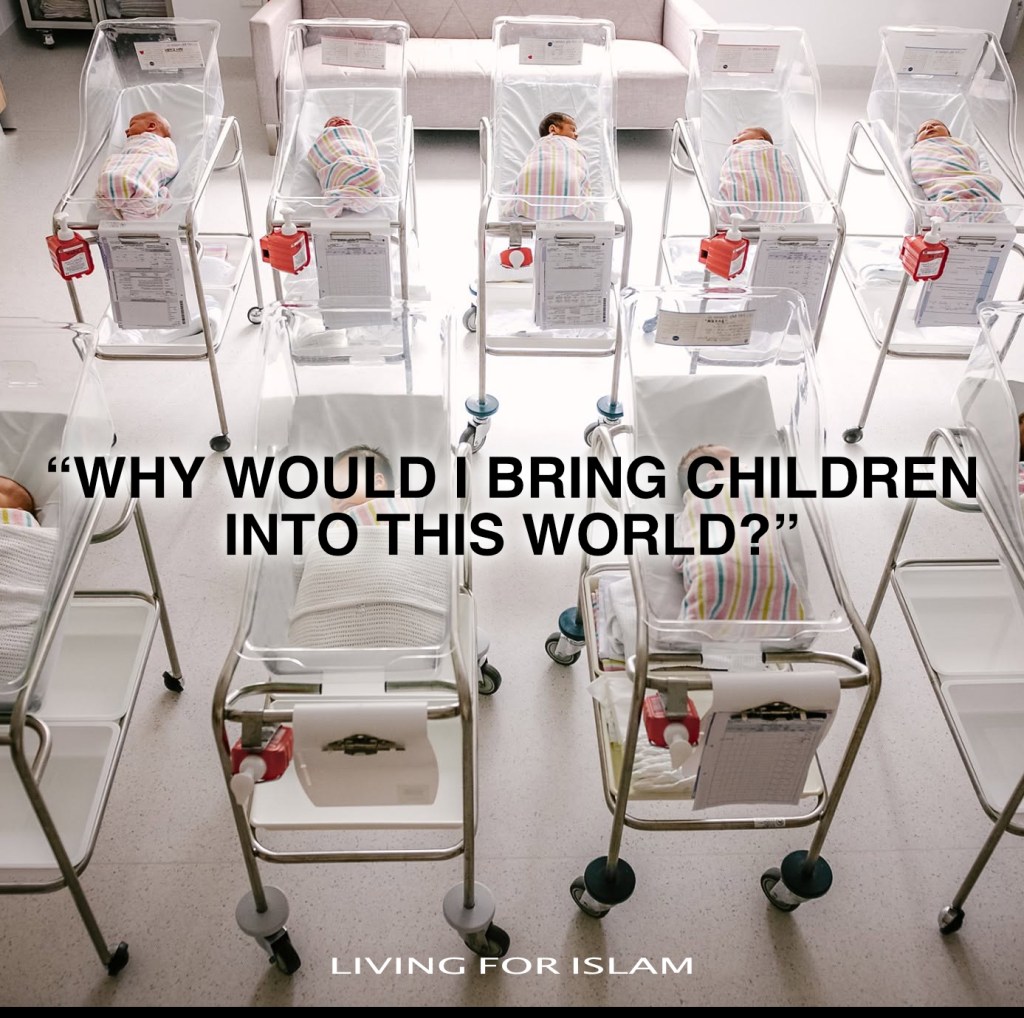
A BBC ARTICLE quoted a woman explaining her decision not to have children: “It’s just not a very nice world to bring people into, and why would I consciously do that when I can choose not to?”
The statement warrants consideration. Not to mock it, and not to dismiss it as mere selfishness, but because it reveals something important about the civilisation Muslims in the West are living inside. Behind those words lies an entire philosophical inheritance, one that has been building for centuries and is now settling subtly even into Muslim households too.
When Suffering Loses Its Meaning
Throughout human history, people have built families in conditions far harsher than anything most people in Britain experience today. They raised children through plague, famine, war, and political tyranny, not because they were naive about suffering, but because suffering had a place in their understanding of existence. It pointed somewhere. It meant something.
The modern secular mind has largely lost that framework. What remains is the suffering itself.
When Allah is removed from the picture, pain stops being a moral and spiritual reality to be navigated with trust and patience. It becomes instead an argument against existence. If this world is all there is, no akhirah, no justice beyond the grave, no Creator who holds every soul in account, then looking honestly at what life contains and asking why would I consciously bring someone into this? is not an unreasonable question. It is, in fact, a logical one.
The Qur’an, by contrast, never conceals what the dunya is. Allah tells us directly:
وَلَنَبْلُوَنَّكُم بِشَىْءٍۢ مِّنَ ٱلْخَوْفِ وَٱلْجُوعِ وَنَقْصٍۢ مِّنَ ٱلْأَمْوَٰلِ وَٱلْأَنفُسِ وَٱلثَّمَرَٰتِ ۗ وَبَشِّرِ ٱلصَّـٰبِرِينَ
We will surely test you with something of fear and hunger and a loss of wealth and lives and fruits, but give good tidings to the patient. (al Baqarah 155).
This is not a warning to be endured reluctantly. It is a description of the world as it actually is, given to people equipped to receive it, people who understand that inna lillahi wa inna ilayhi raji’un is not a funeral phrase but a complete understanding of reality. We belong to Allah. We return to Allah. Everything that happens between those two points is within His knowledge and mercy.
Suffering, in the Islamic framework, is not evidence that life is not worth living. It is part of what life, in this world, is.
The Individualisation of Everything
There is a second strand to the modern reluctance, distinct from despair but intertwined with it: the reduction of all human decisions to personal cost and personal benefit.
Modern Western culture asks, relentlessly, whether any given commitment will serve your individual fulfilment. Parenthood, like marriage, community, and religious obligation before it, has been drawn into this calculus. The question is no longer what does it mean to bring life into the world? but what will it cost me?
This is a profound narrowing of what it means to be human. The Qur’an presents human beings not as sovereign individuals optimising their experience, but as khalifah, stewards entrusted with something larger than themselves.
وَهُوَ ٱلَّذِى جَعَلَكُمْ خَلَـٰٓئِفَ ٱلْأَرْضِ
And it is He who has made you successors upon the earth. (al An’am 165).
Our choices carry weight beyond our own lifetimes. The child we raise may worship Allah in an age we will never see. The values we transmit may shape communities a century from now. This is not a burden, it is the dignity of the human role.
The Prophet ﷺ said: “When a person dies, his deeds come to an end except for three: ongoing charity, knowledge that is benefited from, and a righteous child who prays for him.” (Muslim)
Parenthood, in the prophetic vision, is not a lifestyle choice evaluated against personal happiness. It is participation in something eternal.
Children as the Adornment of This Life
The Qur’an describes children with a word that should stop us:
ٱلْمَالُ وَٱلْبَنُونَ زِينَةُ ٱلْحَيَوٰةِ ٱلدُّنْيَا
Wealth and children are the adornment of the worldly life. (al Kahf 46).
The word used, zīnah, is the same word used for the beauty Allah has placed in the heavens and the earth. Children are not an addition to an otherwise complete life. They are part of how Allah has made this world beautiful.
This does not mean parenthood is without difficulty. The Qur’an is honest about that too, it describes the weight of pregnancy, the labour of raising children, and the grief that can accompany them. Prophet Yaqub (as) wept for decades over Yusuf. Prophet Nuh (as) watched his son drown and had to be corrected by Allah Himself about the nature of family. The pain of parenthood is real, and Islam does not pretend otherwise.
But Islam holds the difficulty and the beauty together, neither lost to romanticism nor despair. That is precisely what the modern secular framework cannot do.
Raising Light in a Dark World
The secular response to a broken world is, increasingly, withdrawal. If the world is this way, do not add to its population. Do not extend the chain of suffering.
The Islamic response is the opposite: the world contains darkness, therefore we must raise people of light.
Allah does not ask Muslims to wait for favourable conditions before worshipping Him, building families, or continuing His deen across generations. Every prophetic community lived through difficulty. The Sahaba raised children under persecution, in poverty, in exile. They did not conclude that the world was too broken for family. They understood that family was precisely how broken worlds are repaired — one generation at a time, one household at a time, with tawakkul in Allah and hope anchored not in the news cycle but in His promise.
إِنَّ ٱللَّهَ لَا يُضِيعُ أَجْرَ ٱلْمُحْسِنِينَ
Allah does not allow the reward of the muhsineen to be lost. (at Tawbah 120).
The woman quoted by the BBC is not an outlier. She represents a civilisational conclusion, the endpoint of a long process in which meaning has been removed from suffering, individuality has been elevated above continuity, and hope has been untethered from anything beyond this world.
Muslims have an answer to every part of that conclusion. The question is whether we are living it clearly enough for it to be visible, to our neighbours, and to ourselves.

