
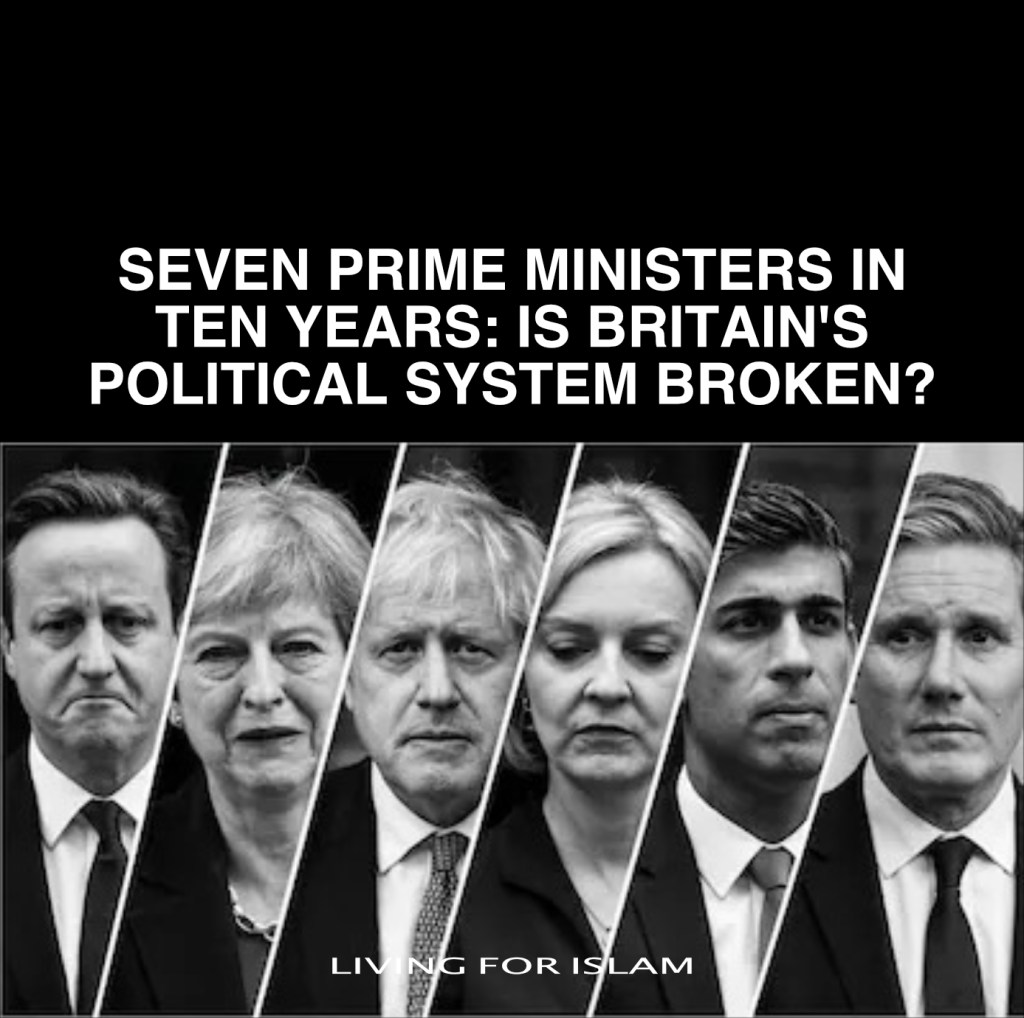
BRITAIN HAS NOW had seven Prime Ministers in just ten years.
That statistic alone says a great deal about the state of British politics.
For a country that proudly describes itself as the “mother of democracies” and the birthplace of parliamentary government, it is a sobering record. Andy Burnham becoming the latest occupant of Downing Street is therefore about more than another change of leadership. It invites a deeper question about whether the political system itself encourages stable and accountable government.
What makes this period even more remarkable is that only three of those seven Prime Ministers first entered Downing Street after leading their party to victory in a general election. David Cameron, Boris Johnson and Keir Starmer all became Prime Minister following an electoral mandate from the public. Theresa May, Liz Truss, Rishi Sunak and Andy Burnham instead assumed office after winning an internal party leadership contest.
This is entirely constitutional. Westminster has long allowed a governing party to replace its leader without returning to the electorate.
Yet constitutional procedure is not the same as democratic health.
If representative democracy is intended to reflect the will of the people, what does it say when four of the last seven Prime Ministers first entered office without winning a general election?
The issue extends beyond how leaders are chosen.
Frequent changes in leadership make effective long-term governance far more difficult. No institution functions well if its leader keeps changing. Every new Prime Minister arrives with different priorities, different advisers and often a different vision. Projects are abandoned. Policies are reversed. Years of preparatory work are discarded. It is ordinary people who ultimately bear the consequences.
The areas that matter most, healthcare, education and other public services, cannot be transformed within a four or five-year electoral cycle. They require consistent planning and investment over decades, with leaders expected to see those plans through and be judged on the results.
Yet constant political turnover often has the opposite effect. Rather than strengthening accountability, it weakens it.
Every new administration inherits the unfinished work of its predecessor, blames existing failures on the government that came before, and asks the public for more time. By the time voters expect to see meaningful results, another election or another change of leadership arrives and the cycle begins again.
The result is that responsibility becomes increasingly diluted. The politicians who designed policies are often no longer in office when their consequences become clear. Their successors insist they inherited the problems, while promising that their own reforms simply need longer to take effect. Accountability, which elections are supposed to provide, becomes increasingly difficult because the chain between decisions and those responsible for them is repeatedly broken.
I saw this same problem highlighted at a medical conference I attended last year. Senior clinicians argued that healthcare policy is frequently shaped around electoral timetables rather than public health. Ministers naturally favour initiatives that produce visible improvements before the next election, while reforms requiring ten or twenty years struggle to gain sustained political support. If politicians cannot claim immediate political credit, worthwhile initiatives are often neglected. It is therefore unsurprising that many of Britain’s deepest public policy challenges remain unresolved.
This points to a broader constitutional principle.
Political systems do not merely determine how leaders are chosen. They also determine how leaders are held accountable for the consequences of their decisions.
Every political system must therefore answer two fundamental questions. How does someone become the ruler? And once they are in office, how are they held accountable?
Modern democratic debate tends to focus on the first question. Classical Islamic political thought gives equal attention to the second.
Islam establishes the Bay’ah, the pledge of allegiance, as the constitutional mechanism that transforms an individual into the Khalifah. It creates a contractual relationship of mutual rights and obligations between the ruler and the Ummah. Unlike modern electoral systems, the Khalifah does not govern according to fixed electoral terms. This removes the pressure of governing for the next election and allows long-term planning for the welfare of society.
But the absence of a fixed term is not the absence of accountability.
The Khalifah is not sovereign in the modern sense of the word. Sovereignty belongs to the Shariah. His authority is therefore constitutional rather than absolute. He governs within a legal framework he neither creates nor controls and is bound by the same divine law that governs every other Muslim.
This is the first and most fundamental form of accountability. His legitimacy rests upon governing according to the Shariah, not according to personal preference or political expediency.
Islamic political thought also developed institutional mechanisms to ensure that this accountability was continuous and practical.
Rooted in the Qur’anic principle of shūrā (consultation), a representative Majlis al-Ummah (Council of the Ummah), or Shura Council, would serve as the voice of the people within the state. Its members represent the interests of their constituencies and have the right to scrutinise the actions of the Khalifah, question government policy and hold the executive to account. In this way, shūrā is not a favour granted by the ruler, but a constitutional right that enables the Ummah to participate in governance and hold its leaders to account.
An independent judiciary provides a second safeguard. At its centre is the Mahkamat al-Maẓālim, the Court of Unjust Acts, which has jurisdiction over complaints against the state and its officials, including the Khalifah himself. Unlike an ordinary court, it does not need to wait for a private litigant before acting. It may initiate investigations into oppression on its own authority, examine whether state actions and adopted laws conform to the Shariah, remove officials who abuse their authority and, where a Khalifah persistently violates the conditions of his Bay’ah, remove him from office.
Accountability is not confined to state institutions alone. Scholars, political parties and ordinary citizens all have both the right and the obligation to account the ruler under the Qur’anic principle of commanding the good and forbidding the wrong.
This does not mean the Islamic system always functioned perfectly. Muslim history contains examples of succession disputes, political turmoil and rulers who evaded accountability. Islam does not promise perfect rulers. It provides principles and institutions through which imperfect human beings seek to implement a perfect divine system.
That is the relevant comparison.
The question is not whether Muslims have always governed well.
The question is which political structure is more likely to encourage good governance and more capable of restraining bad governance.
Political systems create incentives.
A system built around fixed electoral cycles naturally rewards policies that produce visible results before the next election. It encourages short-term political calculation and can weaken accountability by repeatedly breaking the chain between those who make decisions and those who answer for their consequences.
A system built around continuous accountability to the Shariah and the Ummah creates different incentives. The ruler remains answerable to the Shariah, subject to institutional oversight and accountable to society throughout his tenure. His continuation in office depends not upon surviving an electoral calendar but upon fulfilling the obligations of legitimate rule. Good stewardship is rewarded with continuity. Persistent injustice provides grounds for removal.
Individuals will always vary. Some rulers will govern well and others badly. But institutions matter because they shape the incentives under which leaders govern.
If Britain can produce seven Prime Ministers in ten years, most of whom first entered office without winning a general election, perhaps the problem is not simply the individuals passing through Downing Street. Perhaps it also lies in the incentive structure the political system itself creates.
This deserves serious consideration, especially across the Muslim world.
For more than a century, many Muslim-majority countries have adopted constitutional arrangements inspired by Western political thought. Yet these systems have frequently struggled to produce stable, accountable and long-term governance. Some have experienced repeated military coups. Others have oscillated between authoritarian rule and fragile electoral politics. Others still have suffered from chronic instability and weak public institutions.
Rather than continuing to imitate political systems that increasingly struggle to fulfil their own promises, Muslims should have the confidence to re-examine their own political heritage. The Khilafah should not be dismissed as a relic of history or reduced to the failures of particular rulers. It should be assessed on its constitutional principles, its institutions and the incentives it creates.
The question is not which system promises perfection. No political system can eliminate the reality of flawed human beings.
The real question is which structure gives good leadership room to flourish, and bad leadership a reason to stop.

