
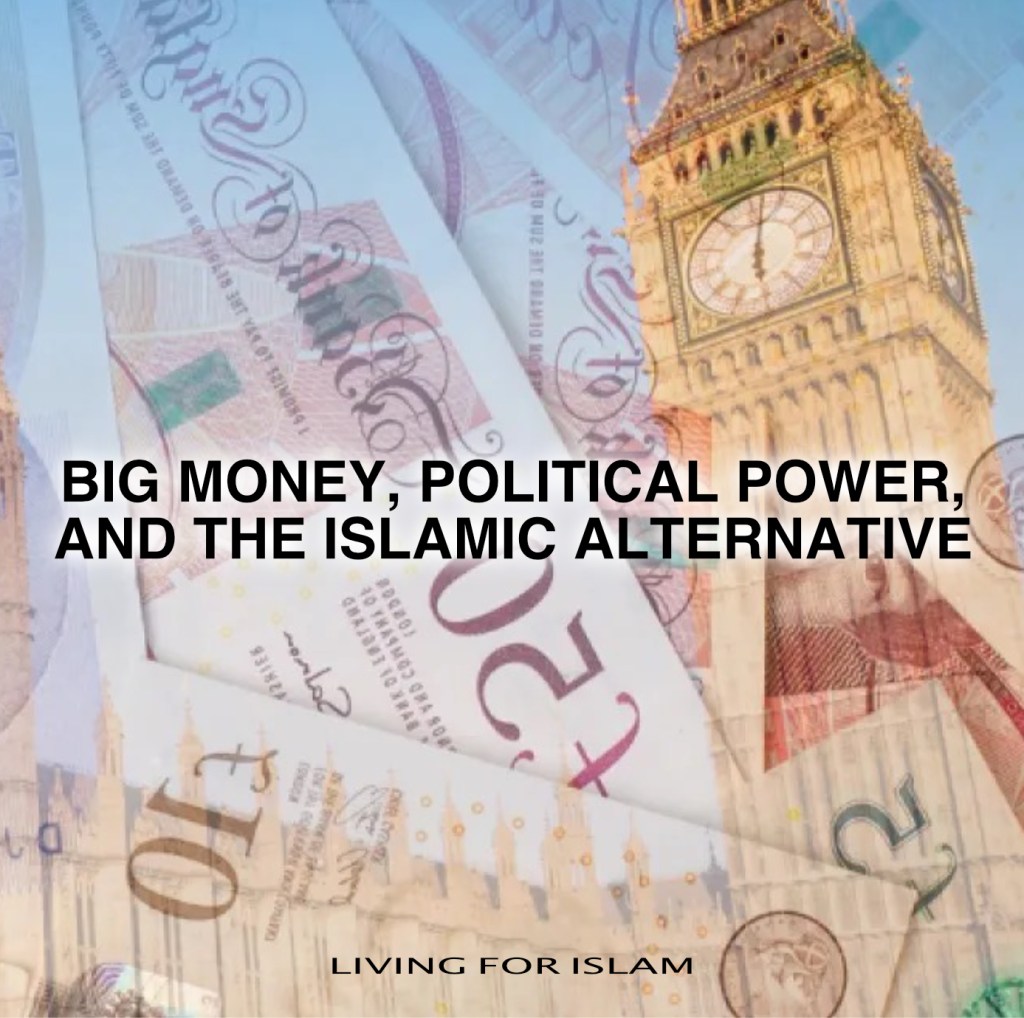
ACROSS THE WORLD today, one of the most serious questions facing democratic societies is the relationship between wealth and political power.
Modern democracies are built on the principle of political equality. Whilst every citizen has a right to vote and participate in public life, what we find repeatedly is that those with the deepest pockets inevitably enjoy greater access to, and influence over, decision-makers than the majority of ordinary people. Political campaigns, lobbying, policy advocacy and media influence all require money. Speech may be free, but it costs to be heard.
This is not simply a problem of dishonest individuals. It is structural. When political systems depend on fundraising and competition for influence, those with the greatest wealth will naturally have the greatest opportunity to shape outcomes, regardless of how honest any individual politician may be.
Islam approaches this question from a fundamentally different starting point. Rather than asking how wealth can be prevented from corrupting legislation, Islam begins by asking who has the authority to legislate in the first place.
The Law Belongs to Allah, Not the Wealthy
Islam does not place the authority to define right and wrong in human hands at all. Allah says:
إِنِ ٱلْحُكْمُ إِلَّا لِلَّهِ
Judgement belongs to Allah alone. (Yusuf 40)
And He says:
وَمَن لَّمْ يَحْكُم بِمَآ أَنزَلَ ٱللَّهُ فَأُو۟لَـٰٓئِكَ هُمُ ٱلْكَـٰفِرُونَ
Whoever does not judge by what Allah has revealed, it is they who are the disbelievers. (al Ma’idah 44)
A ruler does not invent truth according to political pressure, public opinion or the interests of those who supported his rise to power. His responsibility is to apply and enforce guidance that already comes from Allah.
This creates a barrier that simply does not exist in systems where legislators possess the authority to redefine what is lawful and unlawful.
A wealthy man may support a political leader. He cannot purchase a change to what Allah has made lawful or unlawful.
The Ruler Is Bound by the Law, Not Above It
In many political systems, those who make the law also determine its limits. Islam establishes something fundamentally different: even the ruler is subject to the Shariah.
Allah commands:
يَـٰٓأَيُّهَا ٱلَّذِينَ ءَامَنُوٓا۟ أَطِيعُوا۟ ٱللَّهَ وَأَطِيعُوا۟ ٱلرَّسُولَ وَأُو۟لِى ٱلْأَمْرِ مِنكُمْ ۖ فَإِن تَنَـٰزَعْتُمْ فِى شَىْءٍۢ فَرُدُّوهُ إِلَى ٱللَّهِ وَٱلرَّسُولِ إِن كُنتُمْ تُؤْمِنُونَ بِٱللَّهِ وَٱلْيَوْمِ ٱلْـَٔاخِرِ
O believers! Obey Allah and obey the Messenger and those in authority among you. If you disagree over anything, refer it to Allah and His Messenger, if you truly believe in Allah and the Last Day.” (an Nisa 59)
Allah and His Messenger ﷺ are obeyed absolutely, whereas those in authority are obeyed only so long as they obey Allah and His Messenger ﷺ. Authority in Islam is therefore not something a ruler owns. It is an amanah (trust) for which he will be held accountable before Allah.
The Prophet ﷺ said: “Each of you is a shepherd, and each of you is responsible for his flock.” (al-Bukhari)
Leadership is not a privilege to be enjoyed but a responsibility for which one will be questioned.
Islam also discourages the pursuit of political office for personal ambition. The Prophet ﷺ advised Abd al-Rahman ibn Samurah (ra): “Do not ask for leadership, for if you are given it because of your request, you will be left to yourself; but if you are given it without asking for it, you will be helped in it.” (al-Bukhari)
The objective is not to cultivate political careers but to entrust authority to those capable of fulfilling it as a duty.
Law Cannot Be Purchased
One of the clearest examples of this principle appears in the case of the woman from Banu Makhzum who was caught stealing. Her tribe was powerful and well-connected, and they wanted the prescribed punishment quietly set aside.
They therefore approached Usamah ibn Zayd (ra), one of the people most beloved to the Prophet ﷺ, hoping his closeness to the Messenger of Allah ﷺ would influence the outcome.
This is not simply a story about equality before the law. It demonstrates the rejection of influence based on personal proximity to power rather than the merits of the case itself.
The Prophet ﷺ refused completely, declaring: “By Allah, if Fatimah, the daughter of Muhammad, were to steal, I would cut off her hand.” (Muslim)
The principle is unmistakable: status, wealth, family connections and personal relationships do not purchase a different outcome. Access to authority is not for sale.
A System Not Built on Constant Fundraising
Modern political systems depend upon continual election cycles. Parties and politicians must repeatedly raise enormous sums of money to remain electorally competitive.
This creates one of the principal channels through which organised wealth gains political leverage, not necessarily through outright bribery, but because political survival itself depends upon continued financial support.
The Islamic model of governance, the Khilafah, operates differently. Leadership is established through bay’ah rather than repeated electoral campaigns. As a result, a ruler is not continually dependent upon fundraising to secure another term in office. This removes one of the major mechanisms through which wealth is converted into political influence in modern electoral systems.
Bribery Is More Than Illegal, It Is a Sin
Islam directly prohibits using wealth to manipulate judgement.
Allah says:
وَلَا تَأْكُلُوٓا۟ أَمْوَٰلَكُم بَيْنَكُم بِٱلْبَـٰطِلِ وَتُدْلُوا۟ بِهَآ إِلَى ٱلْحُكَّامِ لِتَأْكُلُوا۟ فَرِيقًۭا مِّنْ أَمْوَٰلِ ٱلنَّاسِ بِٱلْإِثْمِ وَأَنتُمْ تَعْلَمُونَ
“Do not consume one another’s wealth unjustly, nor deliberately bribe authorities in order to consume a portion of other people’s wealth knowingly and sinfully.” (al-Baqarah 188)
The Prophet ﷺ likewise said: “Allah curses the one who gives a bribe and the one who accepts a bribe.” (Ahmad)
Corruption is therefore not merely an administrative failure to be managed. It is a moral violation for which a person is accountable before Allah.
Extreme Wealth Concentration Is Limited
Wealth naturally translates into influence when it becomes concentrated in the hands of a small elite.
Islamic economic law therefore contains a number of mechanisms intended to prevent excessive concentration of wealth.
Allah explains one of the objectives behind economic distribution:
كَىْ لَا يَكُونَ دُولَةًۢ بَيْنَ ٱلْأَغْنِيَآءِ مِنكُمْ
“…so that wealth does not merely circulate among the rich from among you.” (al-Hashr 7)
Zakat is perhaps the best-known of these mechanisms, but it is only one part of a broader framework.
Islam prohibits riba and many modern economic practices based upon excessive uncertainty and speculation. It prohibits practices such as hoarding essential goods in order to manipulate prices. Public resources essential to society (such as water, major energy resources and public utilities) are treated as public property rather than left to private monopoly.
Classical Islamic commercial law regulates partnerships and ownership through clearly defined contractual forms that tie rights to responsibilities and accountability and would place limits on some of the corporate structures we see today. It is difficult to envisage giant corporations that are ‘too big to fail’ under an Islamic system.
Islamic inheritance law further disperses wealth by dividing estates among multiple fixed heirs instead of allowing fortunes to pass to selected successors indefinitely.
Together these mechanisms seek to prevent the kind of extreme concentration of wealth that allows a handful of individuals or corporations to exercise disproportionate influence over political life.
The Strength of the Islamic Khilafah Is Accountability, Not Perfect Rulers
It would be mistaken to claim that simply having a Muslim ruler guarantees justice. Rulers remain human, and Islamic history contains examples of both righteous and unjust leadership.
The strength of the Islamic model was never the assumption that rulers are incorruptible. Rather, it lies in the restraints placed upon them.
The Islamic system incorporates institutions of accountability. Judges are independent of the executive, scholars are expected to speak the truth to those in authority, and ordinary Muslims are commanded to account rulers and forbid wrongdoing. These are not optional ideals but essential parts of the system itself.
We saw this perhaps best in the time of Umar ibn al-Khattab (ra) when the state was mature and large enough to see how it all came together clearly. As a ruler he monitored the wealth of his governors and questioned unexplained increases that occurred while they held public office. Where he believed officials had enriched themselves inconsistently with the trust placed in them, he did not hesitate to investigate, remove them from office or recover wealth for the public treasury. At the same time, the public did not hesitate to question him. On one occasion, when Umar (ra) addressed the people wearing a garment that appeared to require more cloth than had been distributed to each individual, a man openly challenged him to explain its source. Umar (ra) answered publicly that his son had given him his own share of cloth, and only then did the people accept his explanation. The point was not the garment itself, but the principle: even the head of state was expected to answer legitimate public questions.
This was the essence of muhasabah, continuous public accountability.
When corruption and elite capture emerged during later periods of Muslim history, they did not demonstrate the failure of the Islamic model itself. Rather, they reflected the weakening of the very accountability mechanisms the model requires.
The lesson from those periods is not that Islamic governance is unworkable, but that its principles only function when the accountability practised by the Rightly Guided Khulafā’ is genuinely maintained both by the rulers and the ruled.
A Different Vision of Justice
Modern political systems ask: How can we prevent wealthy people from purchasing influence over lawmakers?
Islam begins with a more fundamental question: Why should anyone possess the authority to sell changes to the law in the first place?
When legislation belongs to Allah rather than human beings, rulers become custodians of justice instead of owners of legislation.
This is the Islamic vision: a society in which justice is not determined by wealth, status or political access, but by obedience to Allah and accountability before Him.

