
THREE MONTHS AGO, as war erupted between Iran, Israel and the United States, I wrote an article: The Fall of False Shelters: What the Attack on Iran Teaches the Ummah.
The central argument was simple. Whilst Muslims should oppose war and the killing of innocents wherever it occurs, we should not confuse any modern nation-state with a genuine protector of the Ummah. Whether Sunni or Shia, monarchy or republic, modern states ultimately act according to their own interests. The deeper crisis facing the Muslim world is not sectarian. It is structural.
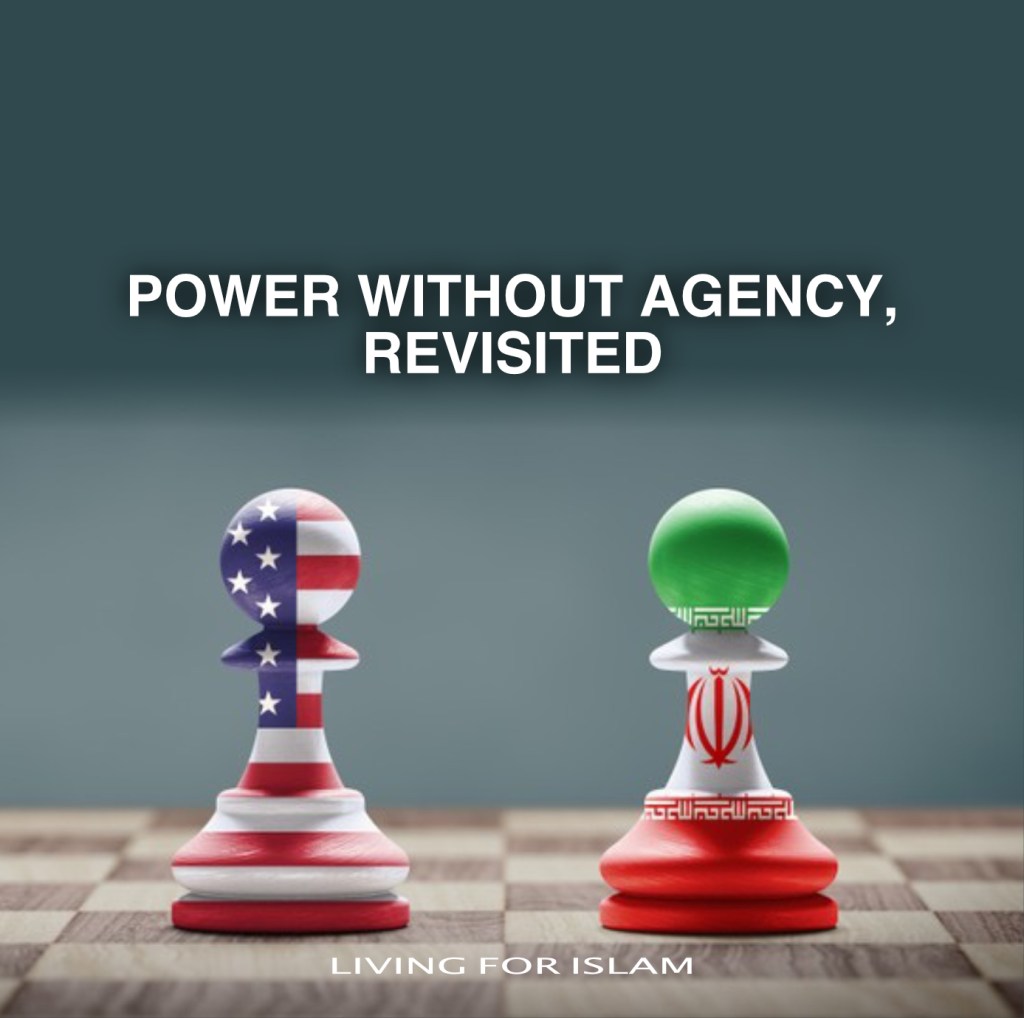
Later, as the closure of the Strait of Hormuz disrupted global energy markets and forced governments around the world to respond, I wrote another article titled Power Without Agency. That article examined a different question. If the Ummah possesses so much strategic leverage, why does it appear so powerless?
The Memorandum of Understanding now signed between the United States and Iran provides perhaps the clearest answer yet to both questions.
The Nation-State Acts for Itself
The agreement contains provisions on sanctions relief, reconstruction funding, the release of frozen assets, the reopening of the Strait of Hormuz, the termination of military operations, and guarantees relating to Lebanon.
What it does not contain is equally revealing.
There is no mention of Gaza.
This omission matters because the agreement demonstrates that leverage existed. Iran possessed sufficient leverage to force negotiations, secure economic concessions, and compel the world’s most powerful state to reconsider the costs of continuing the conflict.
Yet that leverage was exercised when the survival of the Iranian state was threatened, not when Gaza was being destroyed.
This is not a uniquely Iranian failing. It is the operating logic of the nation-state system itself.
Nation-states mobilise decisively when their own security, prosperity, or survival is at stake. Beyond that threshold, moral concern may remain, but meaningful action becomes conditional, limited, and negotiable.
Three months ago this was an argument. Today it is a matter of public record.
Even Superpowers Follow the Same Logic
The lesson is not limited to Iran.
Throughout the crisis, American officials repeatedly discussed the economic consequences of a prolonged closure of the Strait of Hormuz. Concerns about energy markets, supply chains, inflation, and economic contraction became central to the discussion. At the recent G7 summit Trump said oil reserves would run out in about four weeks if the Strait of Hormuz stayed closed. At one point he even invoked Herbert Hoover, saying he did not want to be remembered as the president who brought about another depression.
For all the language of values, security, and international order, the underlying calculation was familiar. Iran acted when its survival was threatened. America acted when its prosperity was threatened. Different states. Different interests. The same political logic.
The modern state system rewards precisely this behaviour. Every government is incentivised to prioritise its own stability above all else. The stronger the state, the more effectively it can pursue that objective. But the logic itself remains unchanged.
Power Without Agency
There is, however, a second lesson in this agreement. It demonstrates with remarkable clarity that the power was always there.
For more than a century, Muslims have been conditioned to think of themselves as weak, dependent, and incapable of shaping world events. Yet the restriction of a single strategic waterway bordering Muslim lands altered global markets, disrupted energy supplies, and forced major powers to negotiate.
The Strait of Hormuz is only one example. The Bab al-Mandab. The Suez Canal. The Bosphorus. The vast energy reserves beneath Muslim lands. The strategic geography connecting three continents. The nearly two billion Muslims who make up the Ummah.
The problem was never the absence of capability. The problem was the absence of a political structure capable of directing that capability toward collective objectives.
This is the distinction explored in Power Without Agency. Power and agency are not the same thing.The Ummah possesses immense power. What it lacks is the mechanism through which that power can be exercised as a single political will.
The Missing Half of Walijah
Allah says:
وَاعْتَصِمُوا بِحَبْلِ اللَّهِ جَمِيعًا وَلَا تَفَرَّقُوا
“And hold firmly to the rope of Allah, all together, and do not become divided.” (Āle ʿImrān 103)
Notice what Allah commands us to hold. Not oil. Not waterways. Not trade routes. Not strategic resources. These are tools. Means that can be used for good or ill. The thing we are commanded to hold together is His rope.
The deeper lesson of these last three months is therefore not merely that the Ummah possesses leverage. That much is now obvious. The real question is what binds that leverage together, and in whose service it will ultimately be used.
This brings us back to walijah. The capability exists. The resources exist. The leverage exists. What remains absent is the collective political loyalty that allows those resources to be directed toward the interests of the Ummah rather than the interests of fifty separate states.
The challenge before Muslims is therefore not discovering power. It is recovering a state unified under Islam, led by a single ruler, who puts the Islamic cause first and foremost. It is not merely recognising where shelter does not lie. But building the conditions in which it can.

