

THERE IS AN entire industry dedicated to making you feel that your life is insufficient.
It is not accidental. Much of modern advertising and platform design depends upon cultivating dissatisfaction and aspiration. Show people what they do not have, make it appear within reach, and harvest the agitation that follows. Platforms are engineered not only to display other people’s lives but to curate them: the holiday at its most luminous, the home at its most composed, the career at its most triumphant. What you are shown is not life. It is life arranged to maximise envy. The algorithm and the advertising do not rest. It knows what makes you linger, what makes you look back, what makes you ache with a vague sense that you are somehow falling behind. Considerable intelligence and significant capital is spent to do this.
However, long before modern consumer culture, Allah said:
وَلَا تَمُدَّنَّ عَيْنَيْكَ إِلَىٰ مَا مَتَّعْنَا بِهِ أَزْوَاجًا مِّنْهُمْ زَهْرَةَ الْحَيَاةِ الدُّنْيَا لِنَفْتِنَهُمْ فِيهِ ۚ وَرِزْقُ رَبِّكَ خَيْرٌ وَأَبْقَىٰ
And do not extend your eyes toward that by which We have given enjoyment to some groups among them, the flower of worldly life, so that We may test them through it. And the provision of your Lord is better and more lasting. (Ta Ha 131)
The verse is extraordinarily precise. Allah does not say: do not notice what others have. He does not say: do not appreciate beauty. He says: lā tamuddanna ’aynayk, do not extend your eyes toward it.
The verb madda describes a gaze that stretches, follows, clings, reaches beyond its natural resting point. The nūn of emphasis, tamuddanna, intensifies the prohibition. Both eyes are named in the dual: ’aynayk. The language evokes more than a passing glance. It suggests a gaze that lingers and reaches, revealing something deeper in the heart. This is not merely about what the eyes see, but about what the heart has begun to pursue through them..
The Qur’an is diagnosing something the consumer economy has monetised.
But the heart of this ayah, what lifts it above a general caution about envy, is the word Allah chose to describe the world’s attractions.
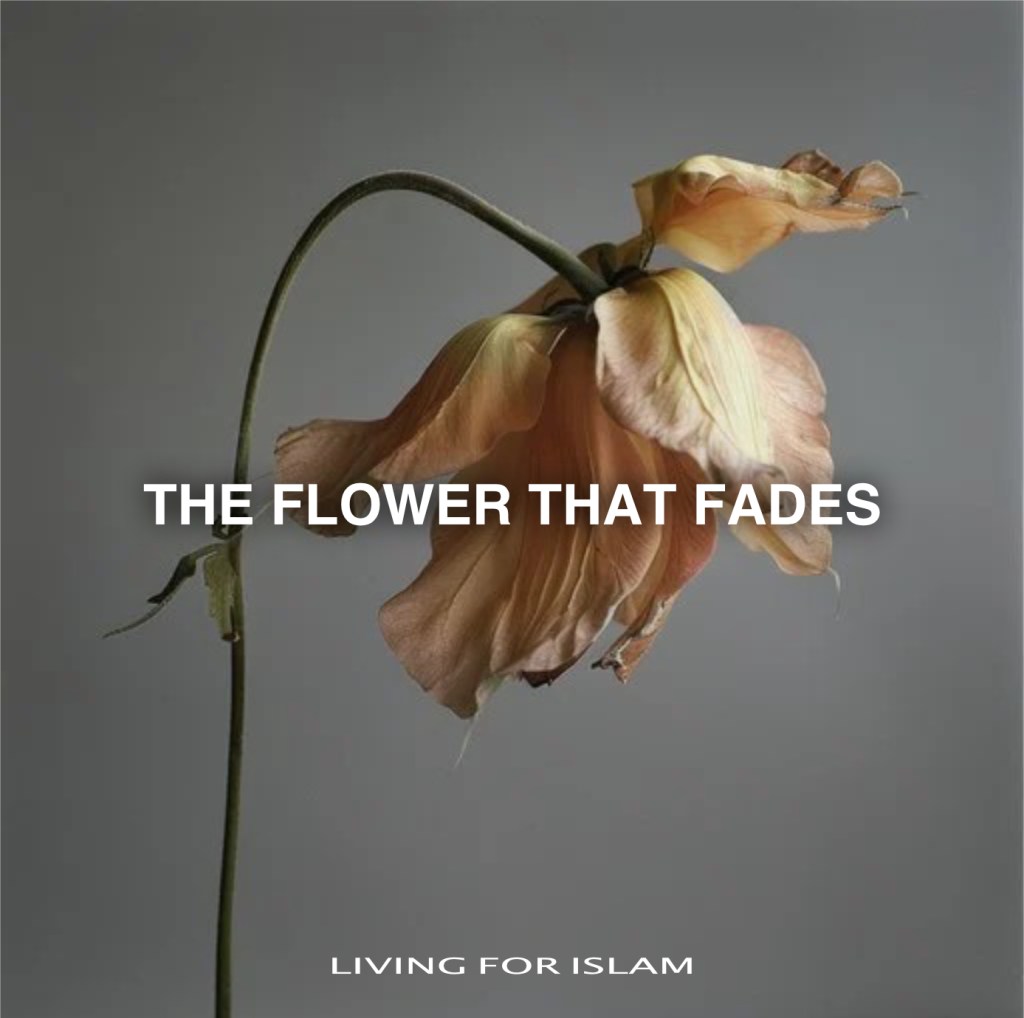
He calls them zahrat al-ḥayāt al-dunyā: the flower of worldly life. Not a mirage. Not an illusion. Not a lie. But a flower.
This single word dismantles two opposing errors simultaneously.
The first error is the one this age perfects: mistaking the flower for the fruit. A flower is genuinely beautiful. It is part of Allah’s creation. The Qur’an does not ask us to pretend otherwise, to look away from beauty as though it were contamination, or to treat wealth and comfort as inherently corrupt. Islam is not that. The flower, its colour and the pleasure it gives to the eye are all real.
But a flower is not the fruit. Fruit nourishes. Fruit sustains. Fruit is why the tree exists. A flower is the precursor to fruit, or it may simply fall without producing anything at all. When a civilisation organises itself around flowers, beauty, status, acquisition, and the appearance of flourishing, it may find itself perpetually stimulated and yet spiritually undernourished.
The second error is the opposite extreme: treating dunya with contempt, a trap to be escaped, a realm to be endured with minimum engagement. But Allah did not call it a mirage. A mirage is not real. You reach it and find nothing. He called it a flower, something that exists, that is created, that has its place, but that must be understood for what it is and not what it is not.
This is the Qur’anic balance. See the flower clearly. Enjoy it for what it is. Do not mistake it for anything more than nit is and certainly do not mistake either for the destination.
The verse then says something unsettling: linaftinahum fiihi, so that We may test them through it.
What we envy may itself be a fitna for its owner.
The luxury, the influence, the status, the apparent ease, these are not necessarily signs of divine favour. Rather, they may be a test of whether gratitude will follow blessing, whether humility will survive elevation, whether generosity will accompany abundance, whether the heart will remain tethered to Allah when the world opens its hands. Ibn al-Qayyim writes extensively on this inversion: that the greatest tribulations sometimes arrive dressed as gifts, precisely because the nafs is more easily undone by comfort than by hardship.
We look at someone’s blessing and ache for it. The Qur’an asks us to consider that we may be watching a test in progress.
This is not a call to console ourselves with the thought that the wealthy are secretly suffering. It is a call to look at reality deeply. The gaze that extends with envy is a gaze that has stopped seeing clearly. It sees the flower and calls it fruit. It sees a test and calls it a reward.
Allah closes with a contrast that is not a condemnation of dunya but a calibration of it: warizqu rabbika khayru wa abqā, And the provision of your Lord is better and more lasting.”
Khayr: better. Abqā: more lasting, more enduring, more capable of remaining.
Notice that the comparison is not between something real and something false. It is between two real things, one of which is greater and one of which lasts. Worldly rizq is certainly all from Allah. Yet the verse directs our attention to another category of rizq. To have īmān, contentment, closeness to Allah, and the fruit of righteous action in this life and the next. These are not consolations for those who could not obtain worldly goods. They are a category of provision that the consumer economy cannot display, cannot curate, and cannot manufacture envy around, because they are invisible to the gaze that only looks at the material.
The person who has trained their eyes to linger on the flowers of other people’s lives has not simply developed a bad habit. They have, gradually and often without noticing, recalibrated what they understand rizq to mean. The Qur’an does not merely tell them to stop looking. It offers them a different object of orientation entirely.
The flower will fade as they always do.
The question this ayah leaves open is not whether you have flowers in your life or in your line of sight. Everyone does. The question is whether you have trained your eyes to extend toward them, to linger, to ache, to measure your life against their brightness, or whether you have learned to see them for what they are: beautiful, temporary, and not the point.
The provision of your Lord is better. And it remains.
|QUR’ANIC REFLECTION · SURAH TA HA 131|

