
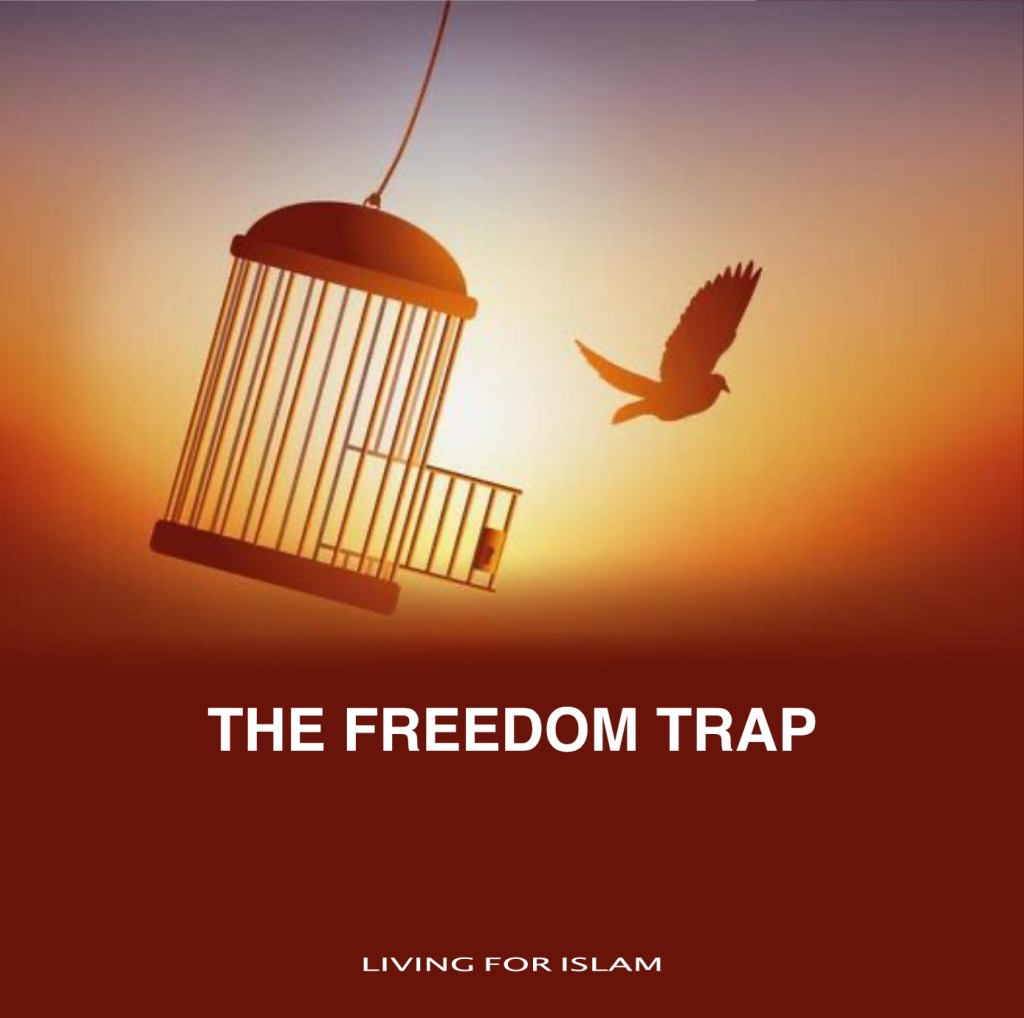
“RELIGION IS JUST a bunch of rules that stop you from living your life. Real freedom means choosing everything for yourself.”
It’s a view you hear constantly, and not just from critics of Islam. It’s baked into the assumptions of modern life. But does freedom really lead to a better life?
The Oldest Deception
This idea, unlimited freedom, transcending all limits, being answerable to nothing, is not a modern invention. It is the oldest deception there is.
When Shaytaan tempted Adam (as) and Hawwa, what did he promise them? Not just pleasure. He promised transcendence. The Qur’an captures the temptation clearly:
رَبُّكُمَا عَنْ هَـٰذِهِ ٱلشَّجَرَةِ إِلَّآ أَن تَكُونَا مَلَكَيْنِ أَوْ تَكُونَا مِنَ ٱلْخَـٰلِدِينَ
Your Lord only forbade this tree lest you become angels or immortals. (al A’raf 20)
The whisper was not merely about the tree. It was about escaping limitation itself. Becoming more than what they were created to be.
Dress that same promise in contemporary language, and it is the same whisper. The packaging changes. The offer doesn’t.
This matters before we say anything else. Because once you see it, you cannot unsee it. Every subsequent argument about freedom, who is making it, what it promises, what it produces, has to be understood against that original scene.
What the Modern Project Promised
We’ve been raised to believe that more choice equals more freedom equals more happiness. Remove the constraints, and liberation follows. It was a compelling promise. And for a while, it felt like it might be true.
But experience, and increasingly, research, tells a different story.
The psychologist Barry Schwartz documented what he called the paradox of choice: the more options we have, the more anxious and dissatisfied we become. Not freer. More lost. More paralysed. And when something goes wrong, there’s no one else to look to. You chose this. You own the failure entirely.
The philosopher Erich Fromm went deeper. In Escape from Freedom, he observed that when people are given too much freedom without meaning or belonging, it doesn’t liberate them, it terrifies them. They become desperate to surrender that freedom to something. A trend. A crowd. An influencer. An ideology. Whatever fills the emptiness.
And then Isaiah Berlin drew a distinction that much of modern culture had been quietly evading all along. He wrote about negative freedom, freedom from rules and restrictions, and positive freedom, freedom to grow, to flourish, to become who you are meant to be. Remove every guardrail, and you are not automatically liberated. Sometimes you are simply left exposed.
Follow the thread through all three: the modern promise of self-determination produces anxiety, then surrender to substitutes, and finally even its own honest thinkers are forced to admit that freedom has to mean more than the absence of restraint.
These secular minds could see something was broken. However, they couldn’t tell you what would make it whole.
The Fitrah Knows
Islamic thought offers something the modern framework cannot.
Islam speaks of the fitrah, an innate orientation toward Allah, a kind of original factory setting woven into human nature itself. And when you hold that alongside what Schwartz and Fromm were observing, something becomes clear: the restlessness they were documenting was not merely social or psychological. It was the fitrah pushing back.
When the modern world promises that you can create yourself from nothing, that your identity is entirely yours to invent, it sounds exciting. But for many people it also feels faintly hollow. Something is missing and they cannot name what.
That feeling is not random. It is recognition. The fitrah knows that self-invention was never going to be enough, because the self was not made to be its own source.
The Appeal Is Real
Allah gave us intellect and the capacity to choose. The Qur’an does not treat people as machines carrying out commands blindly. The desire to think, to question, to resist arbitrary authority, all of that is part of how we were created. So the pull toward self-determination, toward not being controlled, toward questioning rather than merely obeying, is something deeply human.
The problem was never the desire for freedom itself.
The problem is where that desire finally leads.
The Hardest Master
The Qur’an warns about people who take their hawa, their desires, their own ego, as their god. Not as a metaphor. As a real form of worship.
The person who says, “I don’t follow any religion, I just follow myself,” has not escaped servitude. They have simply changed masters.
And the self is a brutal master. Its demands never settle. Its standards constantly shift. It promises satisfaction and keeps moving the finish line.
This is what Fromm was circling without being able to name directly. Human beings cannot live without surrendering themselves to something. When they lose sight of Allah, they do not become free. They hand themselves over to substitutes, trends, crowds, ideologies, status, desire.
They reach for substitutes because they have lost the original.
What We Actually Have
Every person serves something. The only real question is whether the thing you serve is worthy of you.
Desires don’t end. Trends change. People’s approval shifts. Status is a moving target. But Allah is constant.
When we say I am a servant of Allah, we are not diminishing ourselves. We are freeing ourselves from serving things that will never satisfy. We do not have to invent our purpose from scratch. Allah already told us why we are here. Our direction is settled, not by our own guesswork, but by the One who created us and therefore actually knows what we need.
That is what the philosophers could not give. Schwartz saw the illness. Fromm saw the desperation. Berlin saw that freedom had to point somewhere. But none of them could tell you who you are, why you are here, or Who you belong to.
They found pieces. We have been handed the whole.
The purpose, the identity, the direction, the belonging, all of it given, not constructed.
True freedom was never about the absence of limits. True freedom is being protected from serving the wrong things. True freedom is knowing exactly why you were created and Who you belong to.
Knowing that is a gift.
And gifts, when you truly understand their value, produce only one thing: Gratitude.

