
THE POLITICAL PENDULUM swings again. The Democrats have secured control of both chambers of the US Congress. For many, the result is a welcome change. Others will see it as a cause for concern.
But perhaps we should step back and ask a more fundamental question: will anything really change?
When the Democrats were in power, many Americans felt that their concerns about the cost of living, immigration, employment and the direction of their country were being ignored. Trump tapped into that frustration, presenting himself as an outsider who would challenge the establishment and put ordinary Americans first.
Now, those who have become disillusioned with Trump are looking towards the Democrats as the alternative.
And so the cycle continues. People become frustrated with one party, place their hopes in another, and eventually find themselves disappointed again.
There are differences between the parties, and their policies have real consequences for people’s lives. Yet, while their rhetoric, priorities and methods differ, both operate within the same broad political and economic framework: secular, liberal capitalism. They may disagree about how the economy should be managed, the extent of state intervention or the priorities of government, but they accept the same underlying assumptions about political authority and the organisation of economic life.
The result is that people are offered different ways of managing the same system, rather than a fundamentally different vision of how their problems should be resolved.
The Politics of Personalities
When the underlying framework is left unquestioned, politics increasingly becomes a contest of personalities.
We are encouraged to ask whether one politician is better than another. Who is more honest? Who is more compassionate? Who understands ordinary people? Who is less corrupt? Who will stand up to the establishment?
The character and competence of those in positions of authority matter. But these questions can distract us from something more fundamental: what political and economic order are these individuals seeking to establish or preserve?
A good person operating within an established framework does not automatically produce a fundamentally different outcome.
Someone may enter politics with genuine convictions and a determination to challenge injustice, only to discover that the institutions, constitutional arrangements and political compromises of the system define the limits of what they can achieve.
They negotiate, form alliances, make concessions and pursue what is considered politically possible. Over time, the ambition to change things can become an exercise in managing what already exists. The system does not always need to defeat those who enter it seeking change. Sometimes it simply absorbs them.
When Muslim Representation Becomes the Measure of Progress
This raises an important question for Muslims living in the West.
We increasingly celebrate the election of Muslims to positions of political authority. Their achievements are presented as milestones for Muslim representation and evidence of greater acceptance within society.
There is nothing inherently wrong with challenging discrimination or celebrating the removal of barriers faced by Muslims. But we need to distinguish between Muslims gaining access to political institutions and Islam providing the basis for organising society.
The recent example of Abdul El-Sayed, the Muslim Democratic candidate who has now won a Senate seat in Michigan, illustrates an important aspect of this discussion.
During his campaign, El-Sayed was challenged at a town hall to disavow the Muslim Brotherhood. He agreed, but challenged the assumption that his Muslim identity implied divided loyalties. He drew a comparison with John F. Kennedy, who had faced similar suspicions about whether his Catholic faith would compromise his loyalty to the American political order.
El-Sayed pointed to the US Constitution’s guarantee of religious freedom and argued that it was the common basis of allegiance for him and his questioner. He went further, describing the Constitution as his “guiding light”.
The question put to him was clearly framed around suspicion of his Muslim identity. His response needs to be understood in that context. But the exchange also raises a wider question that goes beyond the prejudice directed towards Muslim candidates.
It asks whether Muslims themselves have accepted the boundaries of secular political thought, within which the constitutional order is treated as the settled foundation of political life.
For a Muslim, what should ultimately determine the principles by which society is organised? The constitutional framework of the country in which we live, or the revelation of Allah?
There is a difference between recognising the legal and constitutional framework within which we operate and accepting that framework as the ultimate authority by which political and social questions are judged. The first is a recognition of our circumstances. The second is a question of where we locate our ultimate political and intellectual reference point.
This is the wider difficulty with Muslim representation in Western political institutions. Muslim politicians may campaign against poverty, advocate healthcare reform, challenge discrimination and defend the rights of the oppressed. These may all be worthwhile objectives. But the underlying political philosophy within which these activities take place is rarely questioned. Secularism, human sovereignty and the exclusion of divine revelation from political and legislative authority remain accepted foundations.
Muslims may be welcomed when they explain how Islam inspires them to care for the poor, oppose injustice and protect the vulnerable. Islam is accepted as a source of personal morality and motivation.
But what happens when a Muslim goes further and argues that Islam itself provides solutions to the problems facing society? What happens when they explain that Islam has its own principles for organising the economy, distributing wealth, exercising political authority and establishing justice?
The discussion changes. Islam is no longer being presented simply as a personal faith that influences an individual’s values. It is being presented as an alternative framework for society. That challenges the very foundations of secularism, which excludes revelation as a source of political and legislative authority.
The issue, therefore, is not simply whether Muslims can enter positions of political authority. It is whether Muslims themselves are prepared to question the political philosophy that defines the boundaries within which that authority is exercised.
But is This a Realistic Aspiration in the West?
Some may argue that an Islamic political order should be an aspiration for Muslims in the Muslim world, but the circumstances of Muslims living in Britain, America and elsewhere are entirely different. As minorities, they cannot realistically establish such an order. Their immediate concerns are protecting their rights, preserving their Islamic identity and securing the best possible outcomes for their communities.
There is practical truth in recognising these different circumstances. We must be realistic about the political, demographic and social conditions in which we live. But we should distinguish between what is immediately achievable and what we believe should ultimately guide society.
The fact that Muslims live within a secular political order does not make that order the standard by which they should judge their political and economic convictions. Nor should our geographical circumstances determine whether we regard Islam as providing guidance for the organisation of society.
We can engage with the realities around us, challenge injustice and work to improve people’s lives without accepting the underlying assumptions of the system as unquestionable.
The danger is that what begins as a practical accommodation to our circumstances gradually becomes an intellectual acceptance of the prevailing order. We stop asking what Islam requires of society and instead ask how much of Islam can be accommodated within the society we already have.
Recognising the realities in which we live should inform our approach. It should not redefine the principles by which we judge those realities.
Are Muslims Falling Into the Same Trap?
Perhaps the greatest danger is that Muslims fall into precisely the same political cycle as everyone else.
We become frustrated with the political establishment, look towards a different party or personality, and invest our hopes in the promise of change. We celebrate when someone who shares our religious identity enters a position of authority. Yet we rarely step back and question the underlying principles upon which the system operates.
We become preoccupied with which politician will manage things better, rather than asking whether the system is capable of delivering what people actually need.
Consider the problems facing ordinary people: the cost-of-living crisis, unaffordable housing, growing economic inequality, the privatisation of essential services and political decisions that frequently favour powerful interests over the wider population.
It is not enough to complain about these problems. Muslims should be able to identify their underlying causes from their roots and explain how Islam approaches them. We should understand how Islam addresses ownership, wealth distribution, the circulation of wealth and the responsibilities of the state. We should be able to explain its understanding of political authority, accountability and the obligations of those entrusted with power. And, when confronting war and international injustice, we should be able to articulate how Islam views relations between states, the protection of the oppressed and the responsibilities of the Ummah.
This requires more than inserting some Islamic values into policies developed within an entirely different ideological framework. It requires understanding the Islamic principles themselves and how they provide a different basis for organising society.
Allah reminds us:
إِنِ الْحُكْمُ إِلَّا لِلَّهِ
Legislation and judgement belong to none but Allah. (Yusuf 40)
This is a fundamental principle that extends beyond personal belief and worship. It establishes that our understanding of right and wrong, justice and injustice, and the organisation of human affairs must ultimately be guided by the revelation of Allah.
If we accept this principle, we cannot treat the prevailing political framework as beyond question.
The Importance of Having an Alternative
There is a difference between criticising the shortcomings of an existing system and being able to articulate a coherent alternative. Muslims should be able to do both. And not allow the limitations of the political environment in which we live to become the limitations of our own thinking.
An idea does not lose its validity because it is not currently in power. Nor should Muslims abandon the responsibility of articulating and advocating what they believe simply because the prevailing political environment does not accommodate it.
If Muslims cannot articulate what makes the Islamic vision different, how can we expect ourselves, let alone wider society, to recognise it as an alternative?
The starting point is to stop treating the prevailing system as the unquestionable reality within which all political discussion must take place. We need to recover the ability to examine society through Islam, understand the causes of its problems and explain how Islamic principles offer a different way forward.
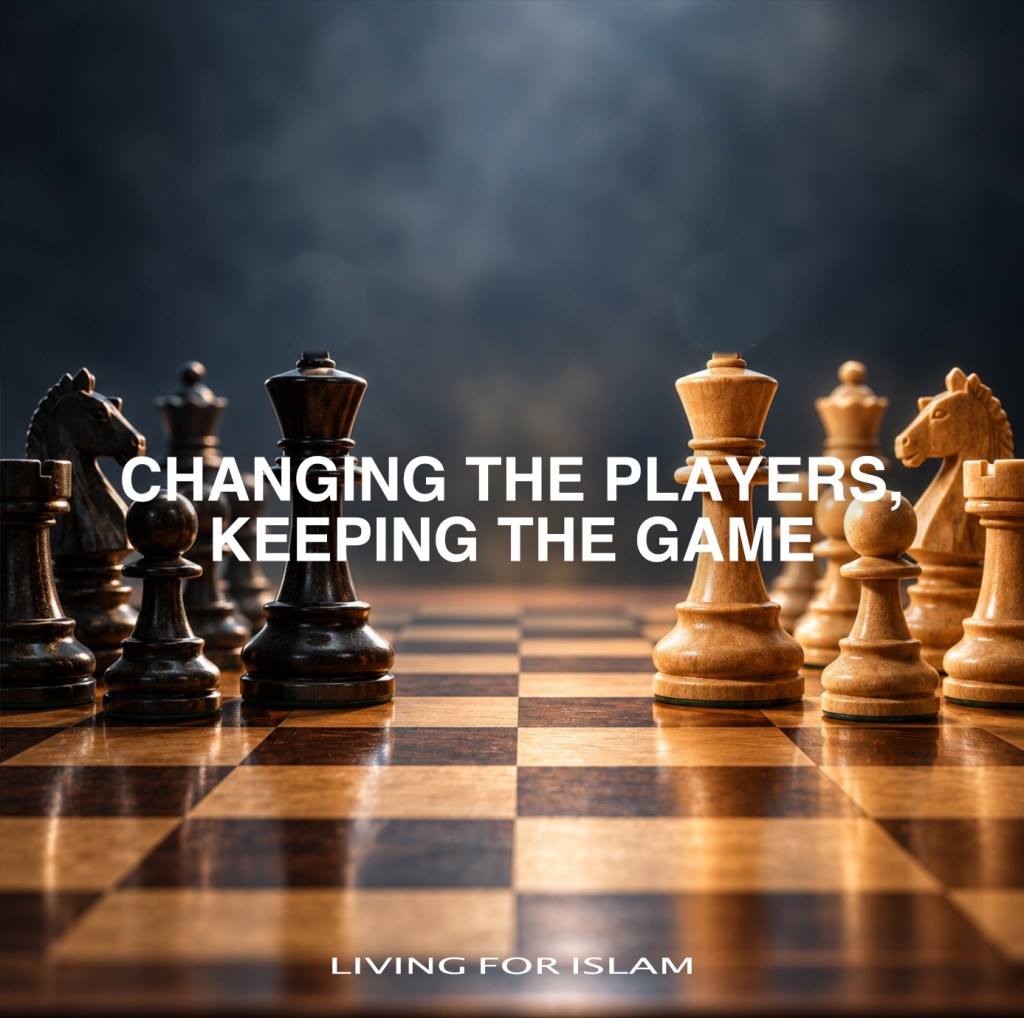
Changing the Players, Keeping the Game
The American elections are a reminder of how easily political hopes become attached to individuals and parties.
When one disappoints, another offers hope. When that hope fades, the electorate looks elsewhere. The political landscape changes, but the underlying system remains remarkably resilient.
There may be improvements, reversals of harmful policies and genuine differences in the lives of ordinary people. These should not be dismissed. But we should not confuse changes in policy with a transformation of the principles upon which society is organised.
The same applies to Muslim political participation. We should not mistake greater representation for the advancement of Islam, or the ability to influence particular policies for the establishment of an Islamic alternative.
A system’s resilience is not necessarily demonstrated by its ability to prevent change, but by its ability to accommodate change without changing its fundamental character.
We can keep changing the players. But if the game itself remains unquestioned, we should not be surprised when, sooner or later, we find ourselves back where we started.
The challenge for Muslims is not simply to become better participants in a political system whose foundations we have never questioned. It is to understand those foundations, measure them against the revelation of Allah, and have the knowledge and conviction to articulate an alternative rooted in Islam.

