
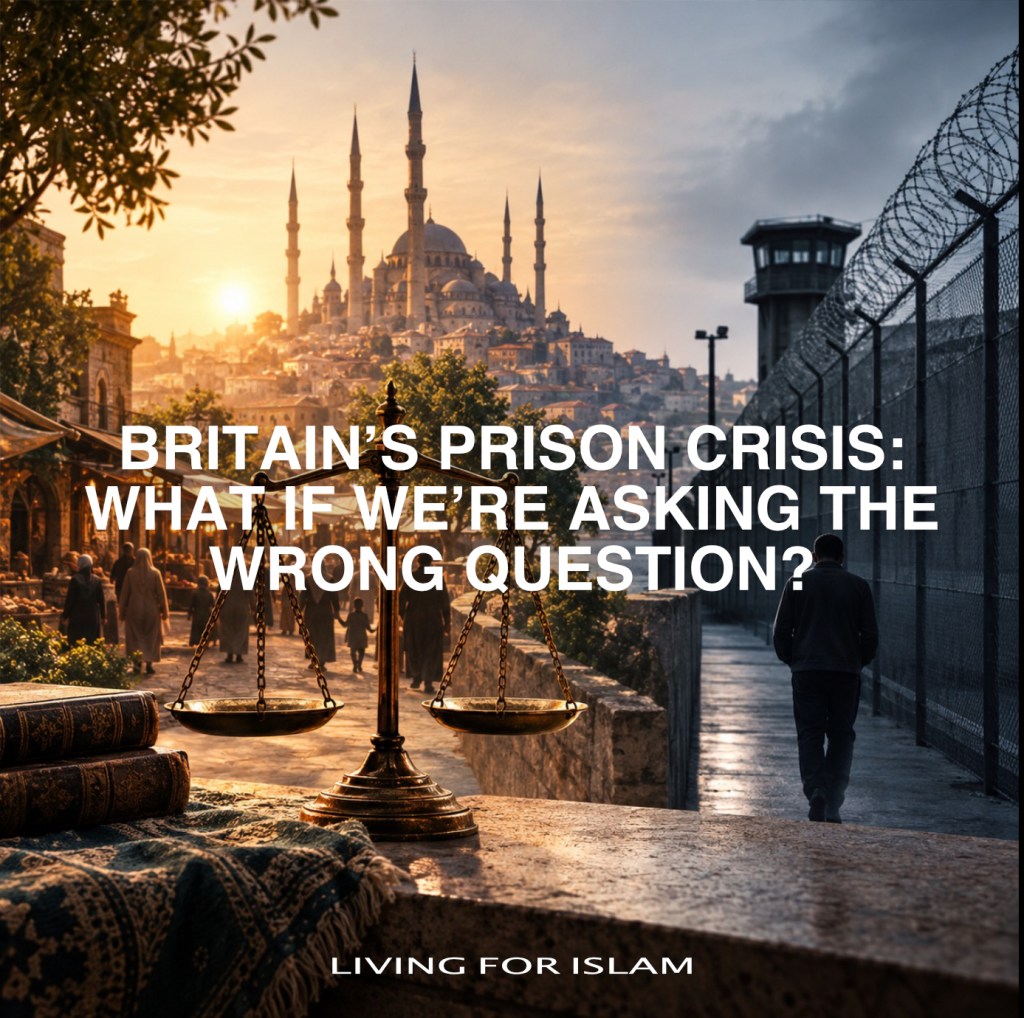
THIS MONTH, THE British government has begun releasing prisoners early in an effort to ease overcrowding. The latest release arrangements are expected to affect around 4,500 prisoners between October 2026 and June 2027. The prison system has been struggling with a lack of space, alongside problems including violence, drug use and inadequate opportunities for rehabilitation.
For some victims, especially those of domestic abuse, the prospect of their abuser returning early to the community is frightening.
The debate continues about whether releasing prisoners early can resolve the immediate crisis and what the cost of that might be.
But there are more fundamental questions we should be asking.
Why is there so much crime in the first place? And what kind of society produces people who are willing to steal, exploit, assault and harm others?
Crime is a daily reality for many people in Britain. Cars and phones are stolen. Houses are broken into. Shops experience theft. Savings disappear through fraud. People are assaulted, women fear violent partners, and passengers endure racial abuse on public transport.
These incidents become statistics, but behind every number is a person whose life has been affected. The focus has become on what happens after the crime.
But there is another way of approaching the problem. Instead of beginning with the criminal, begin with the society.
This is where Islam offers something much more comprehensive than a discussion about punishment.
Islam Does Not Begin With the Prison Cell
Islam begins with the human being.
It teaches that there is a Creator before whom every person will eventually stand. You may avoid the police, escape conviction or conceal your actions from your family, but you cannot hide them from Allah.
This belief is not simply a religious idea confined to a masjid. It is intended to shape how people live.
A Muslim is taught to control their desires, fulfil trusts, respect other people’s property, honour commitments, care for their family, restrain anger, avoid intoxicants and gambling, and uphold sexual morality. They are taught that oppression has consequences and that they will be accountable to Allah for how they treat others.
But Islam does not leave these responsibilities to personal conscience alone. It establishes duties within families, obliges the wealthy to fulfil their responsibilities towards those in need, regulates trade and inheritance, prohibits exploitation and establishes rules governing property and financial dealings.
These are not separate religious teachings sitting alongside a criminal justice system. They are interconnected parts of the same system. Islam seeks to cultivate internal restraint through taqwa, consciousness of Allah and accountability before Him, while establishing external boundaries through law.
But People Will Still Commit Crimes
Islam addresses real human beings, not angels, and has never claimed that crime will disappear entirely.
Even during the lifetime of the Prophet ﷺ, among the best generation of Muslims, people committed serious crimes. Islam recognises a basic truth about human nature: even in a society organised around faith, morality and justice, some people will still choose to do wrong. That is why Islam has a criminal justice system functioning through a state and why the hudud exist.
The aim is to deter crime, protect people and establish justice when victims rights are violated.
Contrary to public perception, a hadd punishment cannot be imposed simply because someone has been accused of an offence. The relevant offence must be established, and the specific legal conditions for the punishment must be satisfied. Islamic jurisprudence contains detailed rules governing evidence, procedure and the circumstances in which a hadd may be applied.
These safeguards are integral to the system. The implementation of criminal punishments is a matter for legitimate judicial authority, not private individuals taking the law into their own hands.
But Aren’t Muslim Countries Full of Crime Too?
If Islam offers such a comprehensive approach to reducing crime, why do we see crime, corruption and injustice in Muslim-majority countries?
To understand why we need to understand history.
A Muslim-majority population is not the same thing as a society organised according to the Shariah. Nor does a government enforcing certain Islamic punishments necessarily mean it has implemented the Islamic system.
For much of the thirteen centuries following the emergence of Islam, Shariah shaped the legal and social institutions of Muslim societies across a vast geographical area. It informed family life, inheritance, commerce, property rights, charitable obligations and criminal justice. Scholars developed legal traditions, judges administered justice, and institutions such as zakah and charitable endowments helped meet social needs.
These societies were not perfect. Muslim rulers could be unjust and corrupt, and the way Shariah was applied wasn’t always as it should be. However, the historical importance remains: Islam was not just a set of personal beliefs or a punishment theory. It offered a functioning structure for how societies managed their lives for centuries.
Colonial rule and the dissolution of the Ottoman Khilafah after the First World War displaced and dismantled this structure. In its place, nation-state models developed legal and political systems in which Islam no longer provided the organising framework for society as a whole. In some places, Islamic rules survived in particular areas, while much of public life came to be governed by other frameworks.
This doesn’t work. Islam is a complete system with laws, values, obligations, and institutions that are all deeply interconnected. These elements cannot be treated as separate policies and expected to achieve the same outcomes on their own.
Consider the punishment for theft.
Islam prohibits theft and prescribes a hadd punishment under specific legal conditions. But the same Shariah establishes obligations towards the poor and needy, places financial responsibilities upon individuals towards their dependants, regulates economic transactions and prohibits the unjust consumption of wealth.
These are not unrelated teachings. They belong to the same system.
We cannot look at the punishment for theft without considering the larger issues of economic obligations and social responsibility. This doesn’t mean that being poor excuses theft. It means that punishment should not be viewed separately from the broader system it belongs to.
The well-known example of Umar ibn al-Khattab (ra) during a famine shows this principle. Reports that he didn’t enforce the punishment for theft in such situations have been discussed by Muslim jurists to understand how necessity and circumstances influence the law.
What is Britain Failing to Address?
A society that places individual freedom at the centre of its values faces a difficult question: what should limit that freedom when one person’s choices harm another? If morality is treated primarily as personal choice, what establishes the boundaries that protect people from exploitation? And if the criminal justice system concentrates on detection, prosecution and imprisonment, what is being done to shape behaviour before the law is broken?
Britain’s prison crisis gives us an opportunity to ask whether the values and institutions underpinning its social order are sufficient to address crime, or whether a more comprehensive approach is needed.
What is the Muslim Contribution?
Public discussion of Islamic criminal law too often reduces the Islamic approach to a handful of severe punishments, detached from the wider system in which they operate. The hudud are serious punishments, and their deterrent function is part of their purpose. But they are one component of a broader framework of values, social obligations, laws and institutions, administered through legitimate state authority.
Muslims should be able to explain that framework clearly, including its safeguards and the responsibilities it places on society. We should neither shy away from its punishments nor allow them to obscure everything else Islam offers.
This is what Islam offers: not merely a different way to punish criminals, but a different way to organise society itself.
The responsibility of Muslims is to understand this system as a whole, explain how its different parts work together, and make the case for it as a genuine alternative to the prevailing social order.

