
ONE OF THE most remarkable features of the Qur’an is its refusal to discuss violence in isolation from history. Modern political discourse often begins at the moment violence becomes visible. The Qur’an, however, insists on asking what came before.
This is especially evident in the verse:
ذَٰلِكَ وَمَنْ عَاقَبَ بِمِثْلِ مَا عُوقِبَ بِهِۦ ثُمَّ بُغِىَ عَلَيْهِ لَيَنصُرَنَّهُ ٱللَّهُ ۗ إِنَّ ٱللَّهَ لَعَفُوٌّ غَفُورٌۭ
“And whoever retaliates with the like of that with which he was afflicted, then is transgressed against again, Allah will surely aid him. Indeed Allah is Pardoning, Forgiving.” (al Hajj 60)
The verse is often cited as evidence that Islam permits retaliation against oppression. While this is true, a closer reading reveals something deeper. The verse does not merely permit retaliation; it establishes a moral framework that limits it, contextualises it, and ultimately points beyond it.
Although revealed in a particular historical context, the ethical principles articulated here remain profoundly relevant to contemporary conflicts, including Gaza.
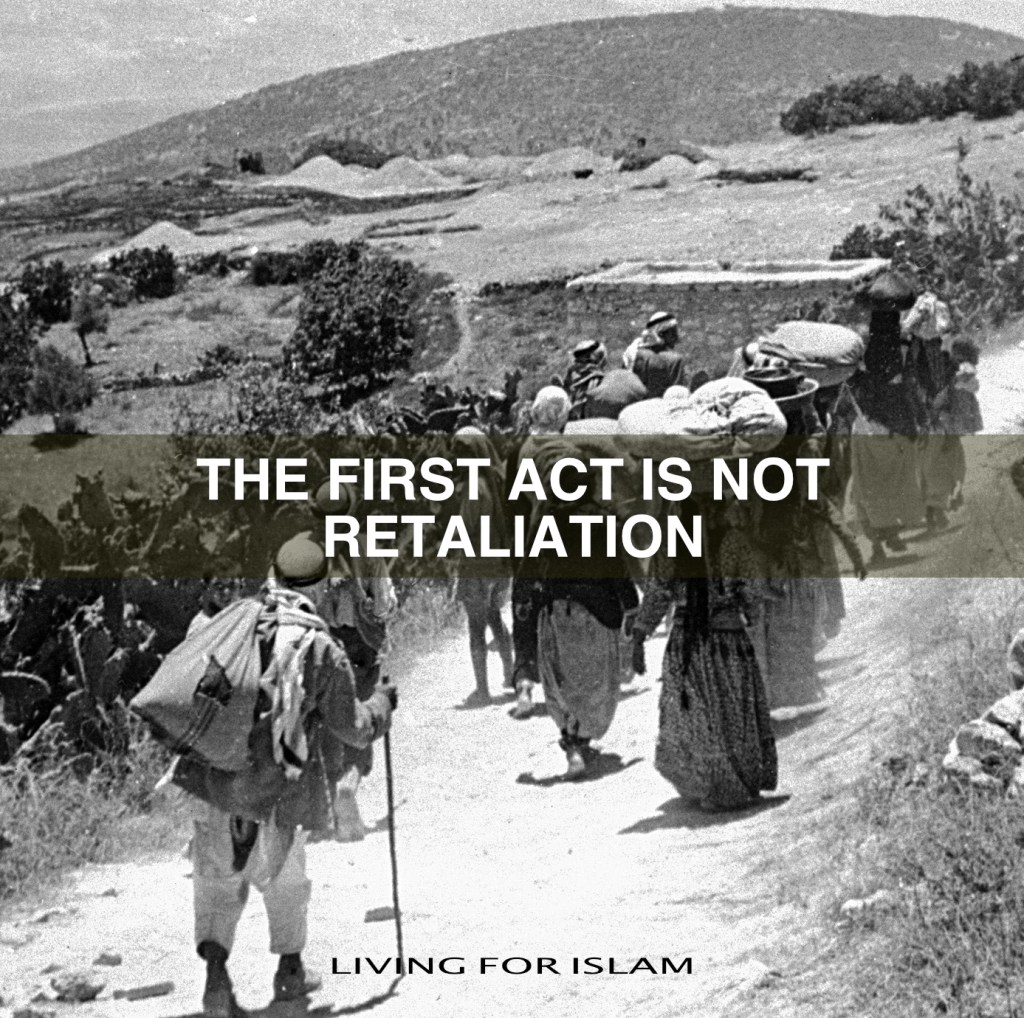
The First Act Is Not Retaliation
The verse begins: “Whoever retaliates with the like of that with which he was afflicted…”
This wording is significant.
The Arabic verb ʿāqaba comes from a root associated with what follows or comes after something else. In this verse, retaliation is presented as a response rather than an initiating act.
The verse does not begin with aggression. It begins with prior suffering.
Even more striking is the phrase: “with the like of that with which he was afflicted.”
The person described is first the recipient of harm. Only afterwards does he respond.
This may appear obvious, but it challenges a common tendency in public discourse. Narratives are often constructed as though history begins at the moment one side strikes back. The preceding decades of dispossession, occupation, siege, discrimination, or violence fade into the background.
The Qur’an does not permit moral analysis to ignore what preceded the retaliation. Before evaluating the response, it acknowledges the preceding wrong.
The Forgotten Question: What Happened First?
The verse proceeds chronologically. First, there is oppression. Second, there is retaliation. Third, there is renewed aggression. Only then comes the promise of divine support.
A reader cannot honestly engage with this verse while ignoring the events that produced the retaliation in the first place.
This does not mean every retaliatory act is justified. The Qur’an is not endorsing an endless cycle of revenge. Rather, it insists that moral analysis cannot begin in the middle of the story.
When conflicts are discussed without reference to their origins, justice becomes distorted. The response is scrutinised while the conditions that produced it are forgotten.
The Qur’an refuses to separate ethics from history.
Indeed, this verse sits within a broader passage in which permission to fight is granted to those who have first been wronged. The framework throughout is one of responding to oppression, not initiating it.
The Most Important Word in the Verse
If there is one word that carries the weight of the entire verse, it is: bimithli, ‘with the equivalent of’.
Retaliation is permitted, but only within limits.
This single word dismantles the idea that suffering grants unrestricted moral licence.
The verse does not say: ‘Whoever has been wronged may do whatever is necessary’. Nor does it say: ‘Whoever has suffered has no limits’. Instead, the permission is immediately restricted by proportionality.
The response must correspond to the original injury. Not greater. Not unlimited. Not collective. Not indiscriminate. But equivalent. The permission and the restriction arrive together.
This understanding is also reflected in the classical tafsīr tradition, where scholars consistently understood the verse as permitting measured retaliation while prohibiting excess.
In modern conflicts, proportionality is often the first casualty. Once a state invokes self-defence, questions about scale, restraint, and limits frequently disappear from public discussion.
For the Qur’an, self-defence does not eliminate proportionality. It activates proportionality.
The Moral Danger of Victimhood
Perhaps the most profound lesson of this verse is that genuine suffering does not remove ethical constraints.
The audience addressed by the verse, the Companions, had endured persecution. They had been expelled from their homes. They had suffered injustice. Yet Allah still imposes limits upon them. This is extraordinary.
The Qur’an does not treat victimhood as a blank cheque. It does not say: ‘You have suffered, therefore your actions are beyond moral scrutiny.’ Instead, it teaches that even the wronged remain accountable to divine justice.
This principle has uncomfortable implications.
A people may have experienced historic oppression and yet commit oppression themselves. But suffering does not transform injustice into justice. A nation may carry collective trauma but is still required to respect moral limits.
The Qur’an recognises that victims can become oppressors and that pain, while deserving of compassion, does not create moral exemption.
This may be one of the most important ethical teachings of the entire verse.
Then He Was Wronged Again
The verse continues: “Then he was transgressed against again.”
The wording here is subtle.
Allah does not say that the person retaliated again. The focus remains on the fact that he continues to suffer injustice. The grammatical centre of the verse is not vengeance. It is oppression. The concern is not how effectively one can punish an enemy but how injustice can be restrained.
Even when retaliation is permitted, the emotional heart of the verse remains with the oppressed person.
Why Does the Verse End with Forgiveness?
After discussing oppression, retaliation, and divine support, the reader expects the verse to conclude with divine power. Instead, Allah says: “Indeed Allah is Pardoning, Forgiving.”
This ending is astonishing.
The verse grants the right to retaliate, yet concludes with mercy. It acknowledges the legitimacy of justice while reminding believers that justice is not the highest aspiration. Forgiveness remains higher.
The final note is not vengeance. It is mercy. The final horizon is not escalation. Rather, it is reconciliation.
A Qur’anic Challenge to Modern Politics
The verse offers a framework that is simultaneously realistic and demanding.
It acknowledges oppression. It recognises the legitimacy of resistance. It insists on historical context. It imposes proportionality. It rejects moral exemption. And it ends with mercy.
In a world where most sides seek to justify their own excesses and minimise those of its allies, this verse stands as a profound challenge.
The Qur’an neither ignores injustice nor sanctifies retaliation. Instead, it reminds us that even in moments of deepest grievance, there remain limits that cannot be crossed.
Justice is not whatever the powerful declare it to be. Nor is it whatever the wounded feel entitled to do.
Justice remains justice, even when we are angry. Especially then.
|QUR’ANIC REFLECTION · SURAH AL HAJJ 60|

