

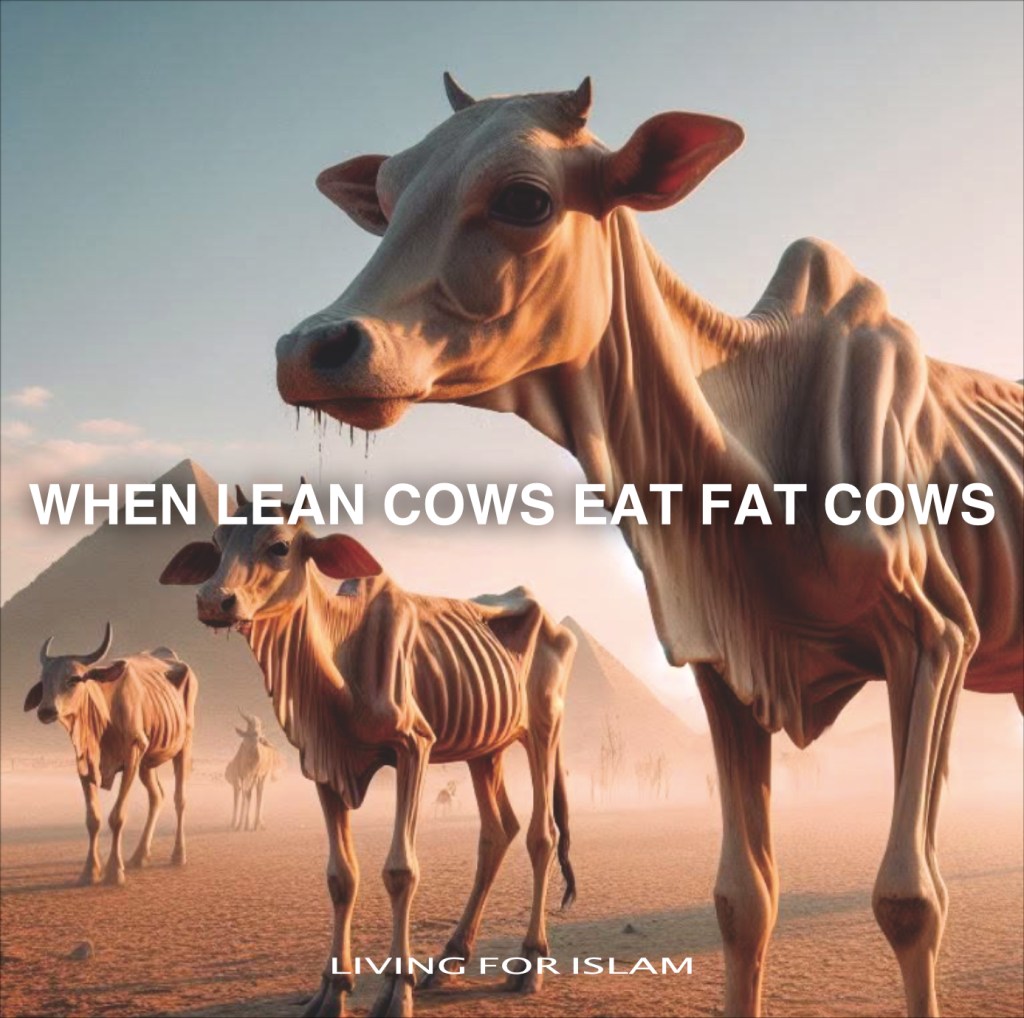
ONE OF THE most striking images in the Qur’an appears in the story of Yusuf (as).
The king of Egypt sees a troubling dream:
وَقَالَ ٱلْمَلِكُ إِنِّىٓ أَرَىٰ سَبْعَ بَقَرَٰتٍۢ سِمَانٍۢ يَأْكُلُهُنَّ سَبْعٌ عِجَافٌۭ وَسَبْعَ سُنۢبُلَـٰتٍ خُضْرٍۢ وَأُخَرَ يَابِسَـٰتٍۢ
“Indeed, I saw seven fat cows being eaten by seven lean ones, and seven green ears of grain, and others dry…” (Yusuf 43)
At first glance it seems like an unusual dream requiring interpretation. But beneath the imagery lies something that speaks to every believer, in every age, a meditation on what we do with ease before hardship arrives, and on what hardship, once it comes, is capable of consuming.
An Image That Refuses to Be Forgotten
Seven healthy, well-fed cows are being eaten by seven lean, emaciated cows.
The image reverses what we would expect. Healthy cows are stronger than weak ones. Yet in the dream, the weak consume the strong.
Something of this reversal is carried in the Arabic itself. The fat cows are simān, full, well-nourished. The lean cows are ʿijāf, a word that doesn’t simply mean thin; it carries the sense of having been hollowed out, wasted away. These are not cows that were always small. They are cows that have been consumed from within.
And the verb used for what they do to the fat cows, yaʾkuluhunna, eating them, describes an action unfolding, not a state already completed. The king doesn’t see seven lean cows standing where seven fat cows once were. He sees the eating itself, the fat cows still visibly being devoured.
This is one of the beauties of the Qur’an’s rhetoric. Rather than simply stating that difficult years will follow prosperous years, it shows consumption in progress. The lean years do not merely replace the fat years. They eat them.
A period of unemployment can consume years of savings. A health crisis can swallow not just money but the time and energy that had been devoted to other things. A family emergency can deplete in months what took years to build. The same pattern plays out beyond the individual: a community’s strength, its institutions, its scholarship, its cohesion, can be built carefully over generations and eroded in a fraction of that time by a single period of crisis, division, or neglect. Years of ease do not guarantee that what was built in them will last. What is built in them must also be guarded.
Yusuf’s (as) Response: Faith and Planning
Yusuf (as) does not simply interpret the dream and leave the people to deal with it. He presents a practical strategy:
تَزْرَعُونَ سَبْعَ سِنِينَ دَأَبًۭا فَمَا حَصَدتُّمْ فَذَرُوهُ فِى سُنۢبُلِهِۦٓ إِلَّا قَلِيلًۭا مِّمَّا تَأْكُلُونَ
You will sow continuously for seven years, and what you harvest leave in its ears, except a little from which you eat. (Yusuf 47)
Work diligently during years of abundance. Consume only what is needed. Preserve the remainder for what is to come.
It is worth pausing on what this means for how we understand our deen. Yusuf (as) had just been given a divine interpretation of a dream, about the next 14 years that was, in a sense, already decided. And yet his response was not to tell the people to wait for what was coming. It was to plan for it, in detail, for years.
Saving Is Not Enough, Preserve What You Save
One detail in Yusuf’s (as) advice is often overlooked. He tells the people to leave the harvest fī sunbulihi, in its ears, to store the grain within its husk, where many scholars explain it remains protected for longer.
Yusuf (as) was not simply teaching the people to save. He was teaching them how to preserve what they saved. Anyone can accumulate. Wisdom lies in preserving what has been accumulated, not merely gathering it. We are often taught to think of financial responsibility as “not spending.” Yusuf’s (as) advice points to something deeper: how something is kept matters as much as how much of it there is.
Notice, too, the connection between the king’s dream, sabʿa sunbulātin khuḍr, seven green ears of grain, and Yusuf’s (as) solution, to store the harvest fī sunbulihi, in its ears. The same word, sunbula, appears at both ends of the story: first as part of the warning, then as part of the remedy. It is as though the dream contains not only the problem but also a clue to its solution, hidden in plain sight within its own imagery. Allah’s guidance often provides not only awareness of what is coming, but also the means to prepare for it, if we look closely enough to see it.
Five Traits the Dream Asks of Us
Modern financial literacy programmes teach concepts such as budgeting, saving, delayed gratification, and long-term planning. It is striking that all of these appear within this Qur’anic narrative, yet the story of Yusuf (as) shows that long before they were techniques, they were traits of character, and each one is already folded into the image of the cows.
The fat cows did not know they would one day be eaten. The people of Egypt, told of this in advance, were asked to act as though they did, to live, at least in part, by a question that does not come naturally: not only what do I need today? but what will I need when today’s ease is gone? This is foresight, the willingness to let a future that has not yet arrived shape a present that feels, for now, secure.
Foresight on its own changes nothing if it is not acted on. The people could have consumed the entire harvest during the years of abundance, fattening themselves as the cows had been fattened. Instead they were asked to hold much of it back, before any need for it had even appeared. This is sabr, patience not only in enduring hardship once it arrives, but in resisting ease before hardship arrives, a small, repeated choice to delay the pleasure of the dunya for the sake of what lasts.
That restraint only makes sense if the years of abundance are seen rightly in the first place, as a gift rather than an entitlement. A person who is truly grateful for a blessing does not waste it. To save, to avoid waste, to use what one has been given carefully, this is not separate from gratitude. It is one of its clearest expressions. This is shukr, and it is what turns saving from mere caution into worship.
Underneath all of this is a question of ownership. In Islam, what we hold is never fully ours; it is amanah, a trust, given to us for a time. The fat years were never the people’s to consume as they pleased, just as the cows’ health was never theirs to keep. This reframes the question from “can I spend this?” to “am I managing what has been entrusted to me responsibly?” This is amanah, and it was never about wealth for its own sake. It was about ensuring that what had been given would still be there to meet a need that had not yet arrived.
And finally, all of this rests on a paradox that only makes sense in light of iman. Yusuf (as) knew, more certainly than anyone, that Allah controls what is to come; he had just been given a dream that told him so directly. And yet his response was not to set planning aside. He instructed the people to work, save, preserve, and prepare, for years. This is tawakkul as it is meant to be understood: trust in Allah’s decree does not relieve us of the means; it is, if anything, the reason to take them seriously. To plan, to save, to prepare for what has not yet come are not signs of weak iman. They are signs of what iman, properly understood, looks like in practice.
A simple framework holds much of this together: spend some, save some, give some. Spend what is needed for today. Save what may be needed tomorrow. Give what may be needed by someone else, now, while it is still possible to give.
The Lean Cows Are Not Just About Money
Hardship can consume more than wealth. It can consume health, time, knowledge, relationships, opportunities, and strength, none of which, once spent, are easily recovered.
The Messenger of Allah ﷺ captured this directly: “Take advantage of five before five: your youth before your old age, your health before your illness, your riches before your poverty, your free time before your work, and your life before your death.” (Bayhaqī)
This is why seasons of ease should never simply be enjoyed and forgotten. When health is strong, habits can be built that will carry us through illness. When time is available, knowledge can be sought that will be needed later. When wealth is plentiful, what is saved and given may be what sustains us, or others, in years that have not yet come. When life is easy, the relationship with Allah strengthened now is what will be drawn on when it is not.
It is also not just about individuals but about what an ummah chooses to do. While the king saw the dream, its interpretation was needed by leaders willing to act responsibly, and a nation choosing to sacrifice today for something tomorrow.
Questions Worth Considering
What have been the “fat years” of my life so far, and what did I do with them? For myself, for the ummah?
What is my “ear of grain” right now, health, knowledge, a relationship, a position of trust, that I am using up rather than preserving?
If seven difficult years arrived tomorrow, what would I wish I had done differently during the easy ones?
Conclusion
The lesson of Surah Yusuf is not simply to save money. It is to recognise that ease is temporary, and that what is done with it is not.
The dream told Egypt what was coming. It did not tell them whether they would be ready for it.
That part was left to them. It still is.
|QUR’ANIC REFLECTION · SURAH YUSUF 43|

