

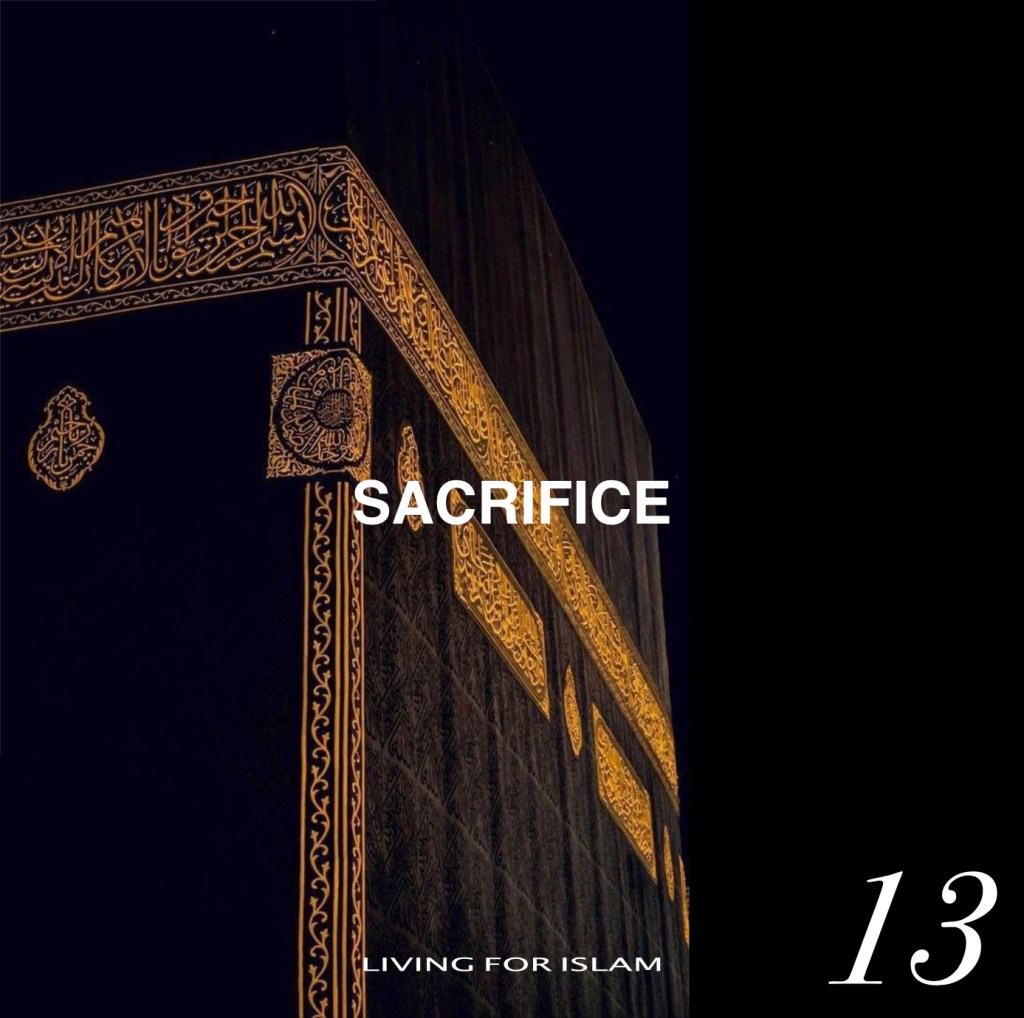
AFTER THE STONING of the jamarat comes the sacrifice.
A thought came to me that comes every year.
Ibrahim (as) was asked to sacrifice his son. Not in a moment of impulse, but through a recurring dream, and the dreams of the prophets are revelation. He knew what he was being asked. He had to live with the weight of it.
This was his only son. Born late in his life, at a time when sons were your wealth, your standing, your continuity. The same son he had already been commanded to leave in an empty valley with nothing but his mother and a limited supply of food and water. And now this.
Yet Ibrahim (as) did not turn away.
What is extraordinary is that it was not only the father who submitted. When Ibrahim told his son what Allah had commanded, Ismail (as) replied: do what you have been commanded. You will find me, if Allah wills, among the patient.
فَلَمَّاۤ اَسۡلَمَا وَتَلَّهٗ لِلۡجَبِيۡنِ
And when they had both submitted and he put him down upon his forehead. (as-Saffaat 103)
Both submitted. Father and son, together. That word, aslamā, is from the same root as Islam. To submit. To place yourself entirely in the hands of Allah, without condition, without negotiation, without holding back.
Then Allah called out to Ibrahim. The trial was complete. A ram was sent in place of his son. Because the real sacrifice had already happened. Not on the ground. In the heart.
The point was never the blood itself, but the surrender behind it. Would Ibrahim (as) place Allah above everything else? Above comfort, above attachment, above the thing he loved most in the world?
That is the question Eid al-Adha asks us every year.
The point of the story is not that we imitate the outward act. It is that we confront the same inward question: what occupies the place in our hearts that belongs only to Allah?
Each one of us has an Ismail.
Something we love. Something we hold close. Something that, if we are honest, sits between us and complete submission to Allah.
For some it is the pursuit of career, wealth, or status. For others, the comfort of the life we have built. For others still, it is the quieter things, habits, desires, a resentment, the fear of what people will say. Or perhaps something harder to name: a version of ourselves we are not yet willing to let go of.
These are not small things. Ibrahim’s trial was immense precisely because what was asked of him was immense. The difficulty is part of the point. The reward is proportionate to what is surrendered.
But the path to Allah has always required surrender. It has required movement towards Him.
Ibrahim’s (as) trial shows us what that movement looks like at its most complete. He did not wait until surrender felt comfortable. He moved. He submitted. He placed the thing he loved most entirely in Allah’s hands, and in doing so, revealed what was already in his heart.
The Qur’an then makes this principle explicit, stripping the act of sacrifice down to its bare essence:
لَن يَنَالَ اللَّهَ لُحُومُهَا وَلَا دِمَاؤُهَا وَلَٰكِن يَنَالُهُ التَّقْوَىٰ مِنكُمْ
Their meat will never reach Allah, nor their blood. But what reaches Him is your taqwa. (al-Hajj 37)
Notice the language. Allah does not simply say that He has no need of it. He uses lan, a form of absolute negation. It will never reach Him. The meat stays on the earth. The blood falls to the ground. The animal feeds people. It does not ascend to Allah.
Then the verse turns on a single word: taqwa.
The same verb that was just used to deny yanāla, to reach, is used again to affirm. What reaches Allah is not the animal. It is the taqwa from within you. The verse ends with minkum, from you. The sacredness does not reside in the ritual itself. It emerges from the human heart.
This is not only a statement about qurbani. It is a statement about worship itself.
A person may pray without presence. Fast without transformation. Give charity for reputation. Perform Hajj while the heart remains untouched. The outward form can be executed while the inner reality is entirely absent. The Qur’an does not let us settle there. It tears through the performance and asks what is actually reaching Allah.
And what reaches Him is taqwa, that mindfulness of Allah, that reverence, that awareness that He sees what no one else sees, that sincerity which cannot be performed for an audience because it exists only between the servant and the Lord.
That is the connection between Ibrahim’s (as) trial and our worship today. What Allah accepted from Ibrahim (as) was not merely the act itself, but what the act revealed about his heart.
The heart was always the centre of the story.
Ibrahim (as) was asked to make an immense sacrifice. He did not flinch. His reward was immense.
وَتَرَكْنَا عَلَيْهِ فِي الْآخِرِينَ
And We left for him favourable mention among later generations. (as-Saffaat 108)
His name is on the lips of every Muslim in every salah, in every corner of the earth, until the end of time.
May Allah allow us to bring our own Ismail to the altar for sacrifice and grant us sincere surrender in these sacred days.

