
BACK IN RAMADHAN, I mentioned a hadith. The Messenger of Allah ﷺ said, “Prophethood will remain among you as long as Allah wills.” Then, Allah will raise it up when He wills. Then, there will be Khilafah on the Prophetic method, and it will remain as long as Allah wills. Then, Allah will raise it up when He wills. Then, there will be a biting monarchy, and it will remain as long as Allah wills. Then, Allah will raise it up when He wills. Then, there will be a tyrannical rule, and it will remain as long as Allah wills. Then, Allah will raise it up when He wills. Then, there will be Khilafah on the Prophetic method.’ Then he remained silent.” (Ahmad)
Whilst it is open to interpretation, many today will probably position us in the time of tyrannical rule.
If the hadith suggests where we might be in time, the Qur’an is far more direct about how we are meant to live within such a condition.
The distinction matters. Knowing the chapter you are in is one thing. Knowing how to conduct yourself within it is another. And for those living through an era of tyrannical rule, that second question is not abstract. It is daily. It is personal. It is the question that determines what kind of person you become by the time this chapter ends.
There is a verse in Surah Hud that addresses that question directly. It is not addressed to tyrants. It is addressed to everyone around them.
Allah says:
وَلَا تَرْكَنُوٓا۟ إِلَى ٱلَّذِينَ ظَلَمُوا۟ فَتَمَسَّكُمُ ٱلنَّارُ وَمَا لَكُم مِّن دُونِ ٱللَّهِ مِنْ أَوْلِيَآءَ ثُمَّ لَا تُنصَرُونَ
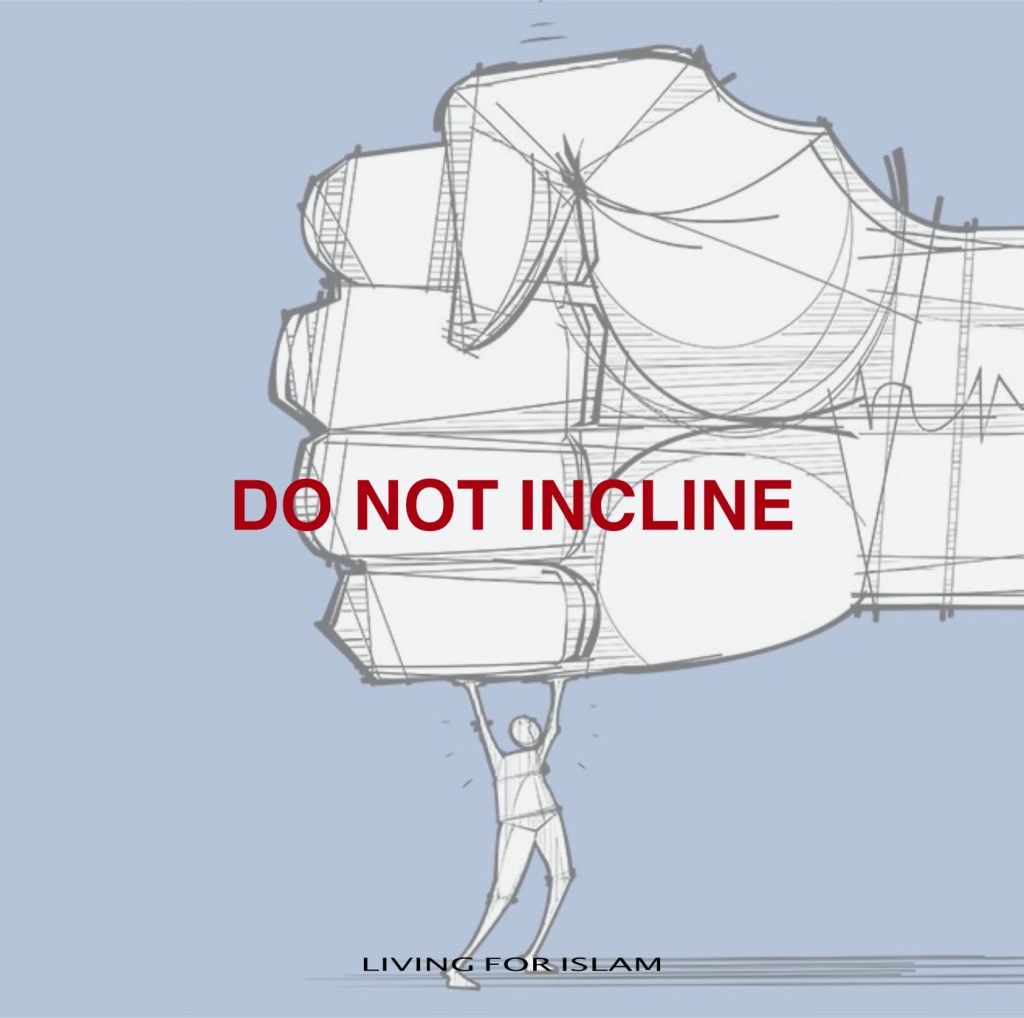
Do not incline toward those who do wrong, lest the Fire touch you. And you will have no protectors besides Allah, nor will you be helped. (Hud 113)
The wording is precise. It does not only forbid wrongdoing. It forbids inclining toward those who do wrong.
The Arabic term tarkanu carries the meaning of leaning, settling, becoming comfortable. Classical scholars such as Ibn Kathir highlight that this refers to a subtle but significant shift: not necessarily an action, but a disposition. A person may not commit injustice themselves, yet still begin to orient their sympathies, their justifications, or their sense of security toward those who do.
That is what the verse interrupts.
Oppression has rarely depended on oppressors alone. It is sustained by those around them; those who rationalise decisions, excuse what should not be excused, or grow accustomed to structures that are fundamentally unjust. None of these require direct participation in wrongdoing. But they involve a form of alignment with it.
This concern is reflected in the stance of scholars as well. Imam Abu Hanifa (may Allah have mercy on him), for example, is well known for refusing certain state positions when he believed they would be used to legitimise injustice. Whilst there is a scholarly debate about how far one can interact with tyranny to prevent a greater harm or preserve some measure of justice, what remains consistent across these approaches is the seriousness with which moral alignment was treated.
The pressure to incline toward power is not difficult to understand. Power appears stable. It appears protective. It has benefits: to safety, to resources, to opportunity. The tendency to lean toward it often begins not with admiration, but with fear: the fear of being left exposed without it.
The Qur’an addresses that fear directly:
وَمَا لَكُم مِّن دُونِ ٱللَّهِ مِنْ أَوْلِيَآءَ
You will have no protectors besides Allah.
It recalibrates in our minds where protection actually lies. Worldly structures may offer a sense of security, but they are neither absolute nor enduring.
History repeatedly demonstrates this. Political systems that appear entrenched can shift rapidly. Networks built around them, often with the assumption of permanence, can dissolve just as quickly. What seemed stable reveals itself to have been contingent all along. The fall of Bashar al Assad in Syria and Sheikh Hasina in Bangladesh in recent years are good examples to consider.
The Qur’anic response is not to deny that power exists, but to deny that it deserves ultimate reliance.
This is where the verse becomes most clear. It does not ask us to withdraw from the world, nor does it ignore the complexity of navigating imperfect systems. But it draws a firm line at internal alignment, at the point where a person begins to feel settled with, or dependent upon, what is fundamentally unjust.
The question it raises is not abstract.
Did you begin to lean, subtly, gradually, perhaps under pressure, toward what you knew was wrong?
Or did you maintain your compass, even when that came with difficulty?
The Qur’an addresses oppressors in many places, and their accountability is made clear. But this verse is directed at those around them: ordinary people, navigating complicated realities, deciding where to place their trust and how to position themselves.
Its answer is consistent and unambiguous.
Not in unjust power. Not in the systems it builds. Not in the security it appears to provide.
But in Allah.
That moral compass does not remove difficulty. It does, however, preserve clarity, about where one stands, and what one refuses to become. And it is precisely that kind of person through whom the next chapter of this prophecy begins to take shape.
| QUR’ANIC REFLECTION · SURAH HUD 113 |

