
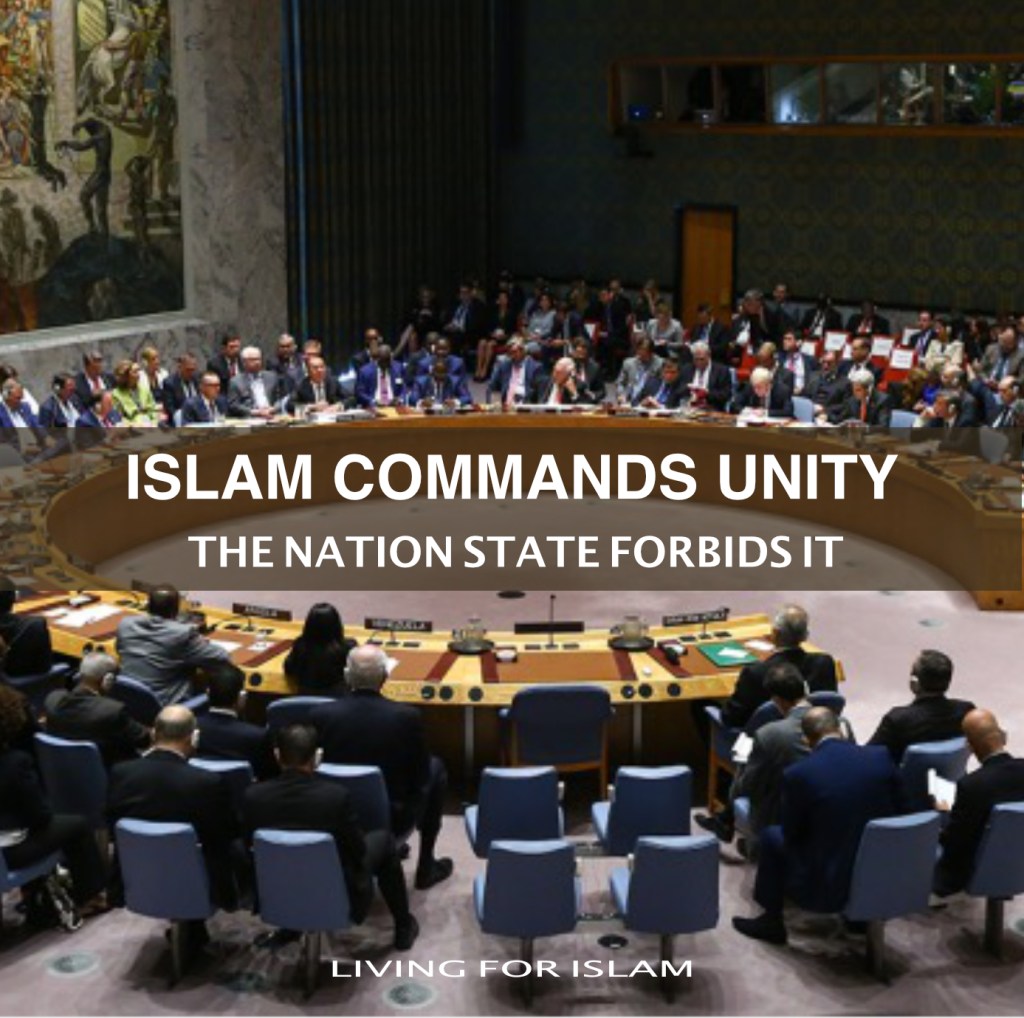
RECENT DISCUSSIONS ABOUT a proposed International Stabilisation Force for Gaza have left many Muslims profoundly betrayed. Muslim-majority countries can coordinate when the framework is “regional security.” They can act when the language is diplomatic management. They can unite when told to by a superpower. But invoke the Qur’anic obligation to defend the ummah? Invoke Islamic authority? Suddenly, the same unity becomes impossible.
This is not an accident. It is the designed outcome of a political order that has replaced Islamic obligation with national interest, and traded the unity commanded by Allah for the borders drawn by colonial powers.
The Ummah in Islam: A Divine Command, Not a Sentiment
Islam does not treat unity as optional or merely emotional. It is a direct divine command:
وَٱعْتَصِمُوا۟ بِحَبْلِ ٱللَّهِ جَمِيعًۭا وَلَا تَفَرَّقُوا۟
And hold firmly to the rope of Allah all together and do not become divided. (ale Imran 103)
Classical scholars interpreted “the rope of Allah” as the Qur’an itself, and by extension, what emanates from it, Islam as a complete way of life.
Furthermore, several ahadith talk about the unity of Muslims being a political unity under one Amir and the grave sin of trying to disrupt or break away from that. For example, the Messenger ﷺ said: “When your affairs are all united upon one man, and someone comes desiring to split you or break your unity, kill him.” (Muslim)
Division destroys the ummah’s ability to uphold Islam, implement Shari’ah, and defend itself. The Khilafah was the institutional expression of this obligation, the structure through which the ummah fulfilled its collective duties. When it fell in 1924, what collapsed was the mechanism by which Muslims could act as one body under Islamic authority.
Gaza as Proof of Betrayal
Gaza is not a humanitarian crisis that Muslim states are struggling to address. Gaza is proof that Muslim rulers have chosen a different system entirely, one that makes Islamic obligation impossible by design.
Egypt maintains a blockade of Gaza while proposing to participate in international stabilisation efforts. Gulf states normalised relations with Israel while Gaza was under siege. Turkey positions itself as a champion of Palestine while maintaining trade relationships that fund the occupation. Pakistan possesses nuclear weapons but will not invoke the Islamic obligation to defend Palestinians, because its doctrine of deterrence is national, not ummatic.
These are not failures of capacity. These are choices to preserve the nation-state system, to prioritise regime survival over ummah obligation, to derive legitimacy from the international order rather than from Islam.
This is betrayal in the precise Islamic sense: rulers entrusted with authority over Muslims have abandoned the fundamental obligation of that authority, to protect, implement and unite the ummah under Islam.
Why the Nation-State Cannot Serve the Ummah
The problem is structural: the nation-state system is fundamentally incompatible with Islamic political obligation.
Sovereignty is territorial. In the Westphalian system, sovereignty is defined by borders. Egypt’s obligations extend to Egyptian territory. The suffering of Palestinians is not Egypt’s problem. This contradicts Islamic political theory, where the ummah is a single body.
The nation-state says: you are Egyptian, then Muslim. Islam says: you are Muslim, and Egypt is merely where you reside.
Legitimacy comes from the international order, not the ummah. Muslim rulers derive legitimacy from recognition by other states, membership in international institutions, and economic relationships with global powers. Islamic legitimacy, which would demand they act on Gaza regardless of international pressure, threatens their standing in the system that keeps them in power.
This is why rulers can participate in a “stabilisation force” but cannot act under Islamic obligation. The stabilisation force is blessed by the international order. Islamic obligation threatens it.
National interest is systematically opposed to ummah obligation. When Saudi Arabia calculates its national interest, it considers relations with Israel and the United States, internal stability, and economic concerns. Fulfilling the Islamic obligation to support Gaza threatens all of these. The nation-state system requires this calculation.
The nation-state model cannot serve the ummah because it was designed to fragment the ummah. Sykes-Picot ensured that Muslim political power would be permanently divided, that Muslims would fight each other over artificial distinctions, and that Islamic unity would become structurally impossible.
Muslim rulers have spent a century maintaining this fragmentation, because their power depends on it.
What Classical Islamic Authority Actually Means
When we speak of returning to classical Islamic political authority, we mean:
1. Ultimate sovereignty belongs to Allah, expressed through Shari’ah, not through territorial borders or national constitutions.
2. Political authority exists to implement Shari’ah and protect the ummah, not to rule for its own sake or to serve the interests of others.
3. The ummah is a single political community with no lines drawn on maps to divide it.
4. When Muslims are attacked anywhere, it is the collective obligation of the ummah to respond, not as charity or foreign policy, but as a religious obligation.
Historically, the Khilafah had its problems, but it operated under a fundamentally different mindset: it existed to serve Islamic obligations, not to preserve itself within a system designed to prevent those obligations from being fulfilled.
Gaza has become a definitive test, and Muslim rulers have failed every time. Their participation in internationally-sanctioned stabilisation efforts, without acting on Islamic obligation, proves where their legitimacy comes from: the nation-state system, not Islam.
The Way Forward: Reclaiming Islamic Political Imagination
For decades, Muslims were told that working within the nation-state system would eventually serve the ummah. Gaza proves this false.
The ummah’s political consciousness must transcend borders
Ordinary Muslims already feel this. They weep for Gaza regardless of nationality. This is the Islamic political consciousness that nation-states have tried to suppress. It must translate into rejecting the artificial primacy of national identity over Islamic identity, and refusing to grant Islamic legitimacy to rulers who prioritise national interest over ummah obligation.
Muslims must regain the imagination to recreate Islamic structures, not merely rename Western ones.
The collapse of the Khilafah left a vacuum filled by institutions that mimic Western forms with Islamic labels. “Islamic” banks operating on capitalist logic, “Islamic” political parties functioning within secular frameworks, organisations like the OIC replicating the UN’s impotence.
Muslims have lost the ability to imagine politics and our institutions in Islamic terms. We have been so intellectually colonised that “Islamic governance” means constitutions beginning with Bismillah only, parliaments with Muslim members, and nation-states with Islamic rhetoric.
This is an imitation with Islamic branding, not a recreation.
Regaining imagination means asking different questions:
Not: “How do we create an Islamic democracy?”
But: “What does authority deriving legitimacy from implementing Shari’ah actually look like?”
Not: “How do we establish Islamic political parties within existing systems?”
But: “How did Muslims historically organise collective action under oppressive authority?”
Not: “How do we get Muslim-majority states to cooperate better?”
But: “What structures can bypass, transcend, or ultimately replace the nation-state system?”
This requires studying classical Islamic structures not as museum pieces but as models that operated on different premises. These structures were Islamic in their basis, not Western forms with Islamic decoration.
The Muslim world needs a robust debate about the road back to the Khilafah structure. Not superficial conferences, but serious intellectual and practical work on what Islamic political authority means, how it can be legitimately established, how it can function across artificial borders, and how it can fulfil the obligations the current system prevents.
This debate must happen among scholars, Islamic groups and ordinary Muslims, in mosques and universities, online and in communities. It must grapple with real questions of Shari’ah, legitimacy, implementation, and obstacles to reconstituting Islamic political unity.
Western modernity convinced Muslims that its categories are universal: state, sovereignty, democracy, capitalism, and separation of church and state. These are presented as natural, inevitable, and the only way to organise modern life.
They are not. They are particular developments from a particular civilisation. Islam has its own categories, reasoning, and structures.
Gaza demands structures that can actually fulfil the Islamic obligations. Such structures cannot be borrowed from the civilisation that benefits from preventing those obligations from being fulfilled.
Conclusion: Islam Did Not Fail
Islam did not fail the ummah. Allah’s command to be united remains clear. The obligation to defend fellow Muslims remains binding.
What failed was that we allowed (some willfully, some ignorantly, some through coersion) the colonisers to systematically dismantle the structures that would allow Muslims to fulfil these obligations. In it’s place, Muslim rulers chose to preserve the borders drawn by colonisers, maintain the nation-state system that keeps them in power, and derive legitimacy from the international order rather than Islam and the ummah. That choice has been reinforced for a century through education systems teaching national identity before Islamic identity, through economic dependence on powers hostile to Islamic unity, and through security apparatuses suppressing Islamic organising.
Gaza is not an exception. Gaza is the inevitable result of these choices, repeated across the Muslim world.
Recognising this is not despair. Rather, it is the beginning of rebuilding what was destroyed. The path back will not be easy or quick. But it begins with Muslims recovering the ability to imagine Islamic political authority on its own terms, and committing to the difficult work of making that imagination real.
 Living For Islam