
THIS IS AN ayah that every time I come back to it, I find it has more room inside than I remembered.
وَإِذْ تَأَذَّنَ رَبُّكُمْ لَئِن شَكَرْتُمْ لَأَزِيدَنَّكُمْ ۖ وَلَئِن كَفَرْتُمْ إِنَّ عَذَابِى لَشَدِيدٌ
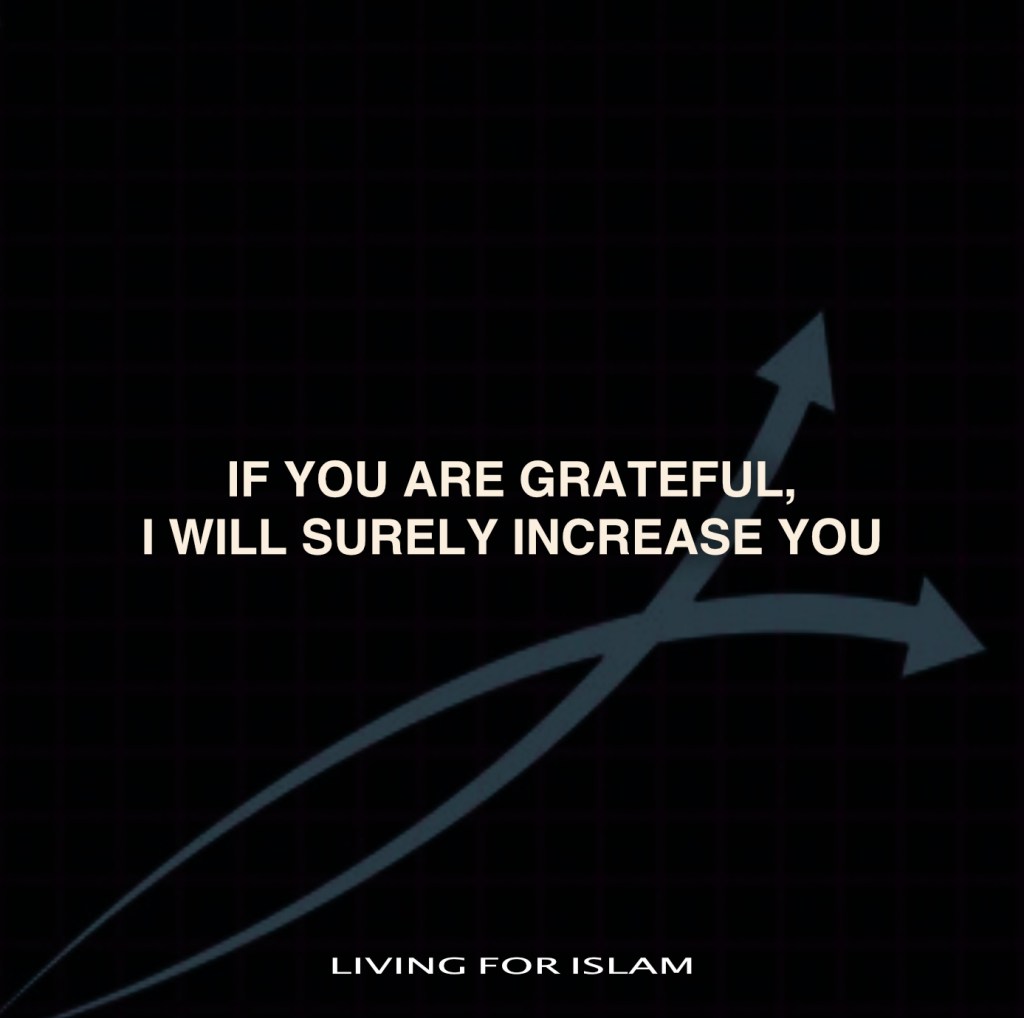
And when your Lord proclaimed: If you are grateful, I will surely increase you; but if you are ungrateful, My punishment is severe.
(Sūrah Ibrāhīm 7)
It begins with ta’adhdhana. Not simply “said.” Not “declared”. But a proclamation, something announced so it would be heard, remembered, carried forward. It is a statement about how existence works, broadcast into the open.
Notice too what Allah calls Himself in this moment, not “Lord” in the abstract, but Rabbukum. Your Rabb. The One who nurtures. The One who takes something fragile and tends to it patiently until it reaches its fullness. This promise does not come from a distant sovereign issuing terms. It comes from the One already invested in your growth. So what He is offering next is in complete harmony with Him being your Lord.
We live in a world obsessed with increase. Part of that is human nature, just like the Prophet ﷺ said that the son of Adam, if given a valley of gold, would want another one.
But there is often confusion about what increase actually means, and more importantly, about what actually produces it. We want the fruit while quietly bypassing the process that produces it.
The process this āyah describes is shukr. But shukr is not merely a feeling, and not merely a phrase. It is three things held together: noticing the blessing that Allah has given you, naming it as such, and then using it in obedience to the One who gave it. All three together constitute real gratitude. Any one of them alone falls short.
That last part is the one we most easily forget.
The ni‘mah of Allah, our health, our time, our intellect, our wealth, our children, is not given to be held. It is given to be deployed. Shukr for a gift means using that gift for the sake of the Giver. A person who says shukr Allah for their wealth but withholds it from what Allah loves; a person who says shukr Allah for their knowledge but keeps it from those who need it; a person who says shukr Allah for their energy but spends none of it in His path, each of them has named the blessing but not yet lived it. And so the increase remains locked behind a door they are, unknowingly holding shut with their own hands.
What Allah will actually increase is left undefined. He does not say wealth. He does not say status. He says only: la’azīdannakum, I will surely increase you. The certainty is absolute. The content is open. It is in line with Allah’s generosity.
The increase might be outward and tangible. But it may well be something that is intangible. A heart made more spacious, a mind sharpened for His service, a life whose ordinary moments begin to feel weighted with meaning. Often, the greatest increase is not more things, it is becoming the kind of person Allah can entrust with more.
Now listen to what the Arabic itself is doing, because the verse teaches twice, once through its meaning, and once through its sound.
The verse holds two words against each other in perfect balance: shakartum and kafartum. Gratitude and its opposite. They share the same pattern, the same rhythm. They are mirrors, and the mirroring is deliberate. These are the two paths, equally available, and the language refuses to let you forget it.
After shakartum comes la’azīdannakum, I will surely increase you. Say it aloud and feel what happens. The word opens outward. The sounds flow forward, the lām, the zā, the nūn, carrying a sense of movement, as if the very syllables are expanding as you speak them. The promise of increase sounds like increase.
Then comes the other side: inna ‘adhābī la-shadīd. The sounds change entirely. The ‘ayn draws deep in the throat. The dhāl settles with its weight. And shadīd ends on a firm, closed dāl, a hard stop, like a door closing. Where the first half moves and opens, the second half closes and holds. The Qur’an is doing what only the Qur’an does: making the sound carry the same truth as the meaning.
The word for ingratitude, kafartum, shares its root with concealment, with covering over. To be ungrateful is not merely to feel dissatisfied. It is to live as though the blessings were never there. To act as if the gifts keep failing to arrive, when in truth they have been arriving all along, quietly and steadily, unacknowledged.
This is true for an individual. It is also true for a society.
Ibn ‘Āshūr in his tafsīr asks: why does this statement appear here, in Sūrah Ibrāhīm specifically?
His answer is profound. Sūrah Ibrāhīm is a sūrah about the rise and fall of nations. It moves through the histories of prophets and their peoples, communities that were given everything, and communities that lost everything. And so this āyah, sitting within that sweep of history, is not only a personal promise. It is a civilisational law.
Nations that orient themselves around shukr, that use what they have been given in obedience to Allah, that deploy His ni‘mah for His sake, rise. Nations that fall into kufr al-ni‘mah, the concealment and misuse of blessing, decline. They organise around scarcity, and that shapes everything: what it considers success, how it spends, what it prioritises, what it is willing to sacrifice for. The pattern holds across human timelines. This verse is not only about the individual heart. It is also an explanation of history.
The question of whether we, as a Muslim community, will flourish is not answered by our ambitions or our strategies alone. It is answered by what we do with what we have already been given. Whether we are truly using the ni‘mah of Allah, our institutions, our education, our wealth, our presence in this society, for His sake and in His obedience. Or whether we are holding it, consuming it, polishing it for appearances, while the door to increase remains closed.
The promise is real. It has always been real.
La’azīdannakum, I will surely increase you.
The One making it is your Rabb, the One already invested in your becoming. But the path to it runs through something more demanding than gratitude as a feeling. It runs through gratitude as a way of life, returning what He gave you back to Him through how you live.
 Living For Islam