
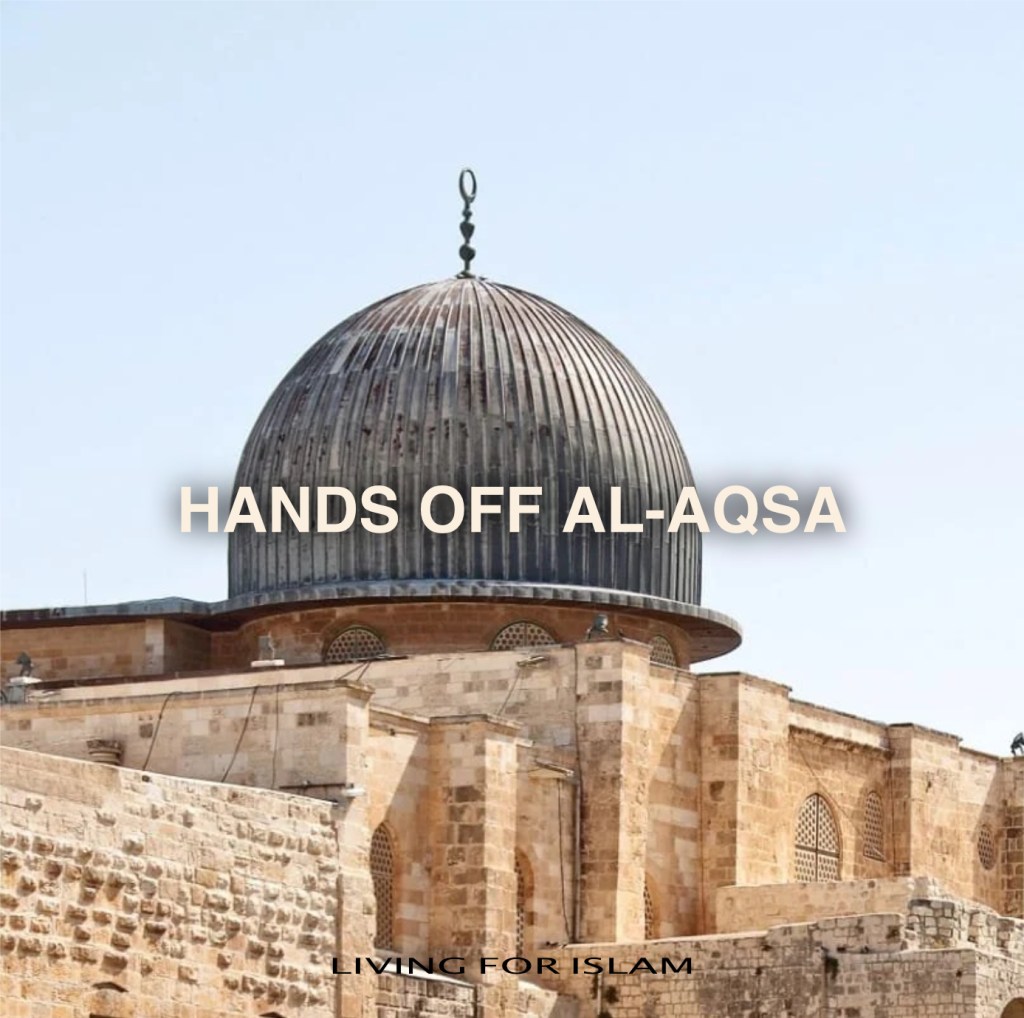
I AM NO stranger to demonstrations. I have stood in the rain and snow, marched through city centres, and raised my voice at embassies more times than I can count. Yesterday I headed to the Jordanian Embassy in London to join the Hands Off Al-Aqsa protest. I knew why I was going. I cared. I was ready.
And the fact that Allah has allowed me to keep showing up, year after year, is itself something to be grateful to Allah for.
The Situation I Was Standing Against
For those who may not be following closely, here is where things stand. Since 28th February 2026, Al-Aqsa Masjid has been closed to worshippers, the longest closure of the blessed site since the Crusades. This happened through Ramadan. Through Laylat al-Qadr. Through Eid. For five consecutive weeks now, Israeli occupation forces have kept Al-Aqsa Mosque closed, preventing Muslims from performing Friday prayers, under the pretext of a security emergency.
There are already growing fears that what is presented as a temporary measure could gradually become permanent, and Al-Aqsa could be lost.
This closure does not exist in isolation. It is one front in a much broader assault on the people of occupied Palestine. In the West Bank, settler attacks have become more severe, with a 54 per cent increase in injuries and a more than fourfold increase in displacement compared to last year. Between October 2023 and March 2026, 1,071 Palestinians, including 233 children, have been killed in the occupied West Bank and Jerusalem. Muslim homes are being seized. Families are being driven from the land their grandparents farmed. And it is happening while the world’s attention is elsewhere.
This is the oppression and injustice I am witnessing. And this is why I keep showing up.
I stood outside the Jordanian Embassy because Jordan holds a recognised custodial role over Al-Aqsa through the Hashemite custodianship, administered through the Jerusalem Waqf. That role is not symbolic. It carries real responsibility, legal, historical, and moral. My presence there was to say, clearly and publicly, that such responsibility is not something the ummah sees as optional or ceremonial.
Keeping the Call Alive
My message, as it has always been, is not merely “stop the closure.” It is deeper than that. Allah Himself puts the question directly to the believers:
وَمَا لَكُمْ لَا تُقَـٰتِلُونَ فِى سَبِيلِ ٱللَّهِ وَٱلْمُسْتَضْعَفِينَ مِنَ ٱلرِّجَالِ وَٱلنِّسَآءِ وَٱلْوِلْدَٰنِ ٱلَّذِينَ يَقُولُونَ رَبَّنَآ أَخْرِجْنَا مِنْ هَـٰذِهِ ٱلْقَرْيَةِ ٱلظَّالِمِ أَهْلُهَا وَٱجْعَل لَّنَا مِن لَّدُنكَ وَلِيًّۭا وَٱجْعَل لَّنَا مِن لَّدُنكَ نَصِيرًا
“And what is it with you? You do not fight in the cause of Allah and for oppressed men, women, and children who cry out: ‘Our Lord! Deliver us from this land of oppressors! Appoint for us a saviour; appoint for us a helper — all by Your grace.'” (an-Nisa 75)
Notice who is in this ayah. It is not abstract. It is the men, the women, and the children. The mustadh’afeen, the oppressed, whose cry demands a response from those who have the ability. They have already done their part, they have turned to Allah, made their du’a, asked for a wali and a naseer. The question is no longer directed at them. It is directed at everyone else.
This is the question I was carrying outside that embassy. Not just as a political statement but as a deeply Quranic one. Those with authority, the rulers of Muslim lands, those who command armies, those who hold real political weight, are the ones this ayah is addressing. Islam is clear: the solution to occupation is liberation by those who have the power to deliver it. A ceasefire is not liberation. A two-state arrangement is not justice. A statement of condemnation issued from a comfortable capital is not the wali and naseer these people are crying out for.
I stood outside that embassy in my own small way answering the call of the oppressed in this ayah. The oppressed of Palestine cry out for a protector. I protest so that those who could be that protector cannot claim they never heard.
I call on those with the ability to act. And if they will not, or claim they cannot, then at the very least, they must not stand in the way of the ummah uniting behind those who will. That is the call. It was the call last time I protested. It will be the call next time. I will not soften it. I will not make it more palatable. I carry it forward, clearly and without apology, because the alternative is to be among those Allah is questioning in that ayah, and that is not somewhere any of us wants to stand on the Day of Judgement.
The Tongue Has a Target
Our Prophet ﷺ guides us: “Whoever among you sees evil, let him change it with his hand. If he is unable, then with his tongue. If he is unable, then with his heart. And that is the weakest level of faith.” (Muslim)
So I use my tongue. Again and again and again.
But there is something important to understand about what “using the tongue” actually means. It is not simply making noise. It is not releasing frustration into the air and going home. The tongue, in this hadith, has a purpose, it is directed at those in the first category, those who have the hand, the power and the authority to act, in order to move them to fulfil their obligation. My voice at that embassy was not aimed at the sky. It was aimed squarely at those who have the ability to protect Al-Aqsa and the Muslims, reminding them that the ummah is watching, that their obligation has not expired, and that silence and inaction on their part is itself a choice they will be accountable for before Allah.
That is what keeps my call focused. I am not just protesting, I am addressing someone. I am not just angry, I am making an argument to those who hold power. And I will keep making it, clearly and consistently, until those with the hand use it.
“But What’s the Point of Protesting in London?”
It is a question I hear often, sometimes from well-meaning Muslims. You are in London. Al-Aqsa is in Jerusalem. The rulers who need to act are in Amman, Cairo, Riyadh. What does standing outside an embassy in a Western city actually achieve?
The answer lies in understanding the world we live in. We are not in an era where a demonstration stays on the street where it happened. A chant outside the Jordanian Embassy in London can be filmed, clipped, and on the screens of people in Amman, Karachi, Cairo, and Jakarta within minutes. The crowd, the energy, the message, it travels. And when ordinary Muslims in those countries see it, something happens. They see that the correct response is not silence. They see what solidarity looks like. They see people naming the obligation clearly, that those with authority must act, and that message gets harder to ignore.
This is precisely why governments across the world work so hard to suppress, restrict, and delegitimise protests. They are not afraid of a crowd standing in the rain. They are afraid of an idea spreading. They are afraid of public opinion shifting. They are afraid of ordinary people, in London, and then in Amman, and then everywhere, refusing to accept the narrative that nothing can be done.
The tongue, used well and aimed correctly, carries further than it ever has in human history. That is not a reason to be careless with it, it is a reason to be more deliberate. To make sure what travels around the world is the right message, the clear message, the Islamic message: that those with the power to act must act, and that the ummah will not stop saying so until they do.
One Tool, Not the Whole Toolbox
There is one more thing that needs to be said honestly. A protest is a style. It is one colour on a much larger palette. The Prophet ﷺ made private dawah, one heart at a time. He made public dawah, standing on Mount Safa and calling the people openly. There were letters sent to the rulers and kings of surrounding nations, calling them to Islam. And there was an organised march, two columns of Muslims led by Umar (ra) and Hamza (ra), walking boldly and publicly to the Ka’bah. Each style had its place.
What held it all together was not the individual styles. It was the clarity of purpose. Every action was oriented toward the same goal, establishing truth and justice, calling people to account, and working toward a world governed by what Allah has revealed.
I have to think the same way. A demonstration outside an embassy is valuable, but only as part of something bigger. Alongside it must be education, so our communities understand the issue deeply and correctly. There must be private conversations, with family, with neighbours, with those who have influence. There must be written work, content, khutbas, videos, debates, etc that carry the correct narrative into spaces a protest cannot reach. There must be engagement with Islamic scholars and thinkers who can give the ummah the intellectual and spiritual framework to understand what is happening and what Islam demands in response. There must be du’a, boycott, and charity. None of it is either-or.
And underpinning all of it must be a unified, clear aim. Not a vague call for peace. Not a demand for a ceasefire that leaves the occupation intact. But the full, unapologetic Islamic position: that Al-Aqsa belongs to the Muslims, that occupation must end through liberation, and that those with the authority and ability to bring that about are obligated by Allah to do so.
We Will Keep Going
When my actions are anchored to that understanding, then every protest, every article, every conversation, every du’a, every act of giving or withholding, becomes part of one coherent effort. Not parallel activities that exhaust without direction, but a single, purposeful dawah, carried forward in the way of the Prophet ﷺ, with the same patience, the same consistency, and the same unshakeable trust in Allah.
The demonstration outside the Jordanian Embassy yesterday was a link in a chain. A reaffirmation. A reminder that the ummah is real, that Al-Aqsa matters, that my voice is not nothing, and that Allah sees every step taken for His sake.
I leave the results with Him. Mine is simply to keep moving in the right direction.
وَلْتَكُن مِّنكُمْ أُمَّةٌ يَدْعُونَ إِلَى ٱلْخَيْرِ وَيَأْمُرُونَ بِٱلْمَعْرُوفِ وَيَنْهَوْنَ عَنِ ٱلْمُنكَرِ ۚ وَأُو۟لَـٰٓئِكَ هُمُ ٱلْمُفْلِحُونَ
“Let there arise out of you a group of people inviting to all that is good, enjoining good and forbidding evil. And it is they who are the successful.” (Aale-Imrān 104)
May Allah accept it from us all. Ameen.
 Living For Islam