
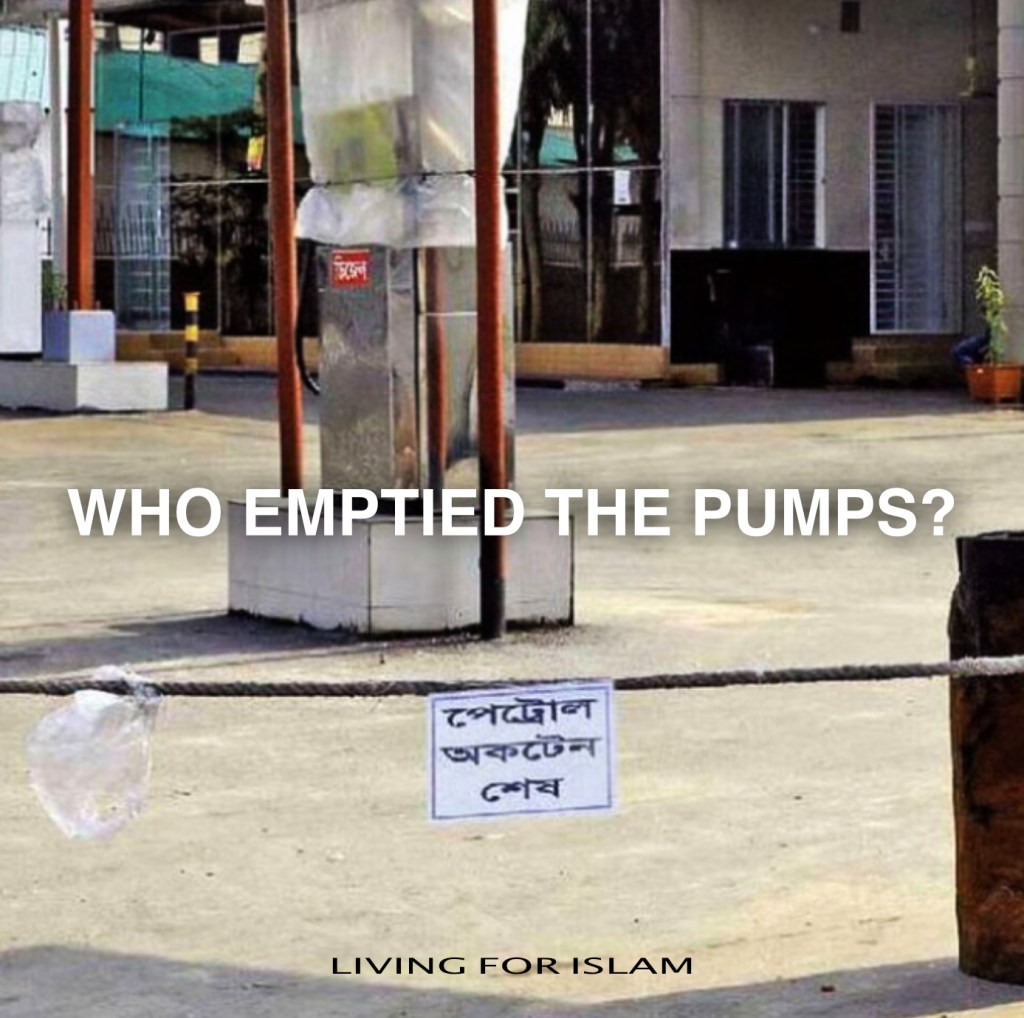
LONG QUEUES AT petrol stations. Pump attendants shaking their heads. No octane.
The global disruption is real, the war in Iran has sent shockwaves through energy markets, crude oil has risen sharply, and Bangladesh, which imports diesel and gas, has felt that shock. But here is the detail that demands attention: Bangladesh produces most of its own octane domestically.
The octane shortage was not caused by events in the Strait of Hormuz. It was caused by us.
Normal daily octane demand runs at around 1,100 tonnes. In early March, panic-buying nearly doubled that figure. Bangladesh Petroleum Corporation confirmed it held roughly four weeks of supply in reserve. Pump workers said openly there was no shortage. The shortage was manufactured by fear, and then locked in when BPC cut distributions to prevent hoarders from draining those reserves, leaving ordinary consumers with empty pumps.
When a crisis is of our own making, the question is no longer: what went wrong with supply? It becomes: what does this reveal about us?
The Failures Within
Every crisis of this kind has two faces. One belongs to those who exploit it. The other belongs to those who, in fear, deepen it.
There are strong indications that some traders withheld stock, anticipating higher prices and greater profit. Islam is unambiguous about this.
Allah’s Messenger ﷺ said: “No one hoards but the khaatii (sinner).” (Muslim)
The Arabic word, khaatii, does not mean ‘mistaken.’ It means actively guilty and sinning. Hoarding turns public hardship into private gain. It violates ʿadl and amānah, justice and trust, and the purpose for which trade exists in Islam, which is to circulate benefit, not concentrate it.
But the second failure is harder to speak about, because it implicates all of us. When rumours spread, on WhatsApp, in conversation at the corner shop, that fuel is running out, the instinct is to fill up now. Every individual making that rational choice produces an irrational collective outcome: supplies vanish, and the rumour becomes true because everyone believed it.
Islam calls the antidote tabayyun, verify before you act. And tawakkul. trust in Allah rather than panic. A community that responds to stress with discipline can absorb shocks. One that responds with fear amplifies them.
And Then There Is Government
Between the hoarder and the panicking public stands the institution of government, and it cannot be absolved here.
BPC held four weeks of supply in reserve while ordinary people queued at empty pumps. When it cut distributions by 25% to protect those reserves from hoarders, the policy response, however understandable, punished the honest consumer for the crime of the speculator. That is a failure of sequencing. The enforcement against hoarding should have come first. It did not, because the monitoring systems to catch and penalise it in real time were not in place.
This is not a new gap. The absence of transparent, real-time oversight of the distribution chain, from depot release to pump availability, is a systemic weakness that predates this crisis. The question is why, after previous shortages, it has not been resolved. A government that cannot see where its fuel is, cannot prevent it from being withheld.
The situation deteriorated further. Reports came in of tankers being threatened during transit. At least one supply operation was disrupted by looting. When the distribution of a basic commodity requires a security escort, and when Eid returnees are stranded on major highways with no fuel, the failure is no longer merely administrative. It is a breakdown of the state’s most basic obligation to the people it governs.
In Islam, leadership is not a position. It is a trust, amānah. The Prophet ﷺ said that every leader is a shepherd, and every shepherd is responsible for his flock. The standard is not whether difficult decisions were made. The standard is whether the people were protected. On that measure, this crisis reveals that the mechanisms of protection, market monitoring, distribution transparency, and enforcement were not ready when they were needed. This is a form of negligence and corruption.
The Real Crisis and the Deeper One
The octane crisis is, at its heart, a crisis of behaviour. The fuel was there. The problem was exploitation and panic, both fixable through governance and taqwa.
The wider picture is more structurally serious. Bangladesh depends on imports for diesel and gas. When global prices surge, the national budget absorbs that shock. Vital industries that depend on these products falter. For example, four fertiliser factories were shut as available gas was redirected to power plants. This is not a panic-induced problem. It is import dependency meeting global volatility.
Which raises an honest question: how long can a nation of this size and potential remain this exposed to decisions made elsewhere?
The Deeper Question
Policy can address the immediate failures: stronger enforcement against hoarding, better distribution coordination, strategic reserves, diversified energy sources. These are necessary steps.
But Islam asks something more. It asks us to understand why these crises keep recurring, and to hold before us a vision of what ought to be.
The Muslim world is not energy-poor. The lands of Arabia and Central Asia sit upon vast reserves. Bangladesh has a young population, industrial capacity, and an extraordinary workforce. Yet a disruption half a world away can bring our motorcycles to a halt.
This is not how Islam envisions the ummah to operate. We are not supposed to be divided into 57 nation states with their own interests, borders, and trade arrangements that stops the oil of a Muslim country serving the needs of another Muslim country.
Instead, Islam obligates a unified Ummah under Islamic khilafah governance, where resources, movement, and trade are unified. This is not a slogan. It is the institutional answer to a structural problem that this crisis has made visible once more.
A Test of Character
This crisis has shown us traders willing to exploit public fear, individuals willing to take more than they need when they believed others would do the same, and a government not competent (or too corrupt) to step in.
The octane crisis is a mirror. It reflects the fragility of systems under the current world view and the distance between the Islamic framework our tradition provides and what our society currently demonstrates.
The Ummah does not lack resources. It does not lack intelligence or capacity. What it lacks is alignment of values, systems, and purpose.
What we face today is not just a shortage. It is an opportunity. An invitation to have a greater vision and solve our problems through the system of Islam.
 Living For Islam