
I WAS FLYING back to London from Istanbul some years ago on a British Airways flight. The back of the plane was full of families returning from holiday, the clamour of children, the negotiating of small needs, the particular exhaustion of parents at the end of a journey.
A flight attendant was speaking to a couple near the front. I caught her remark, “I don’t understand why people have children. It’s such hard work.”
The couple smiled. It was that kind of remark: casual, companionable, spoken as common sense between adults who believed their choice was the more intelligent.
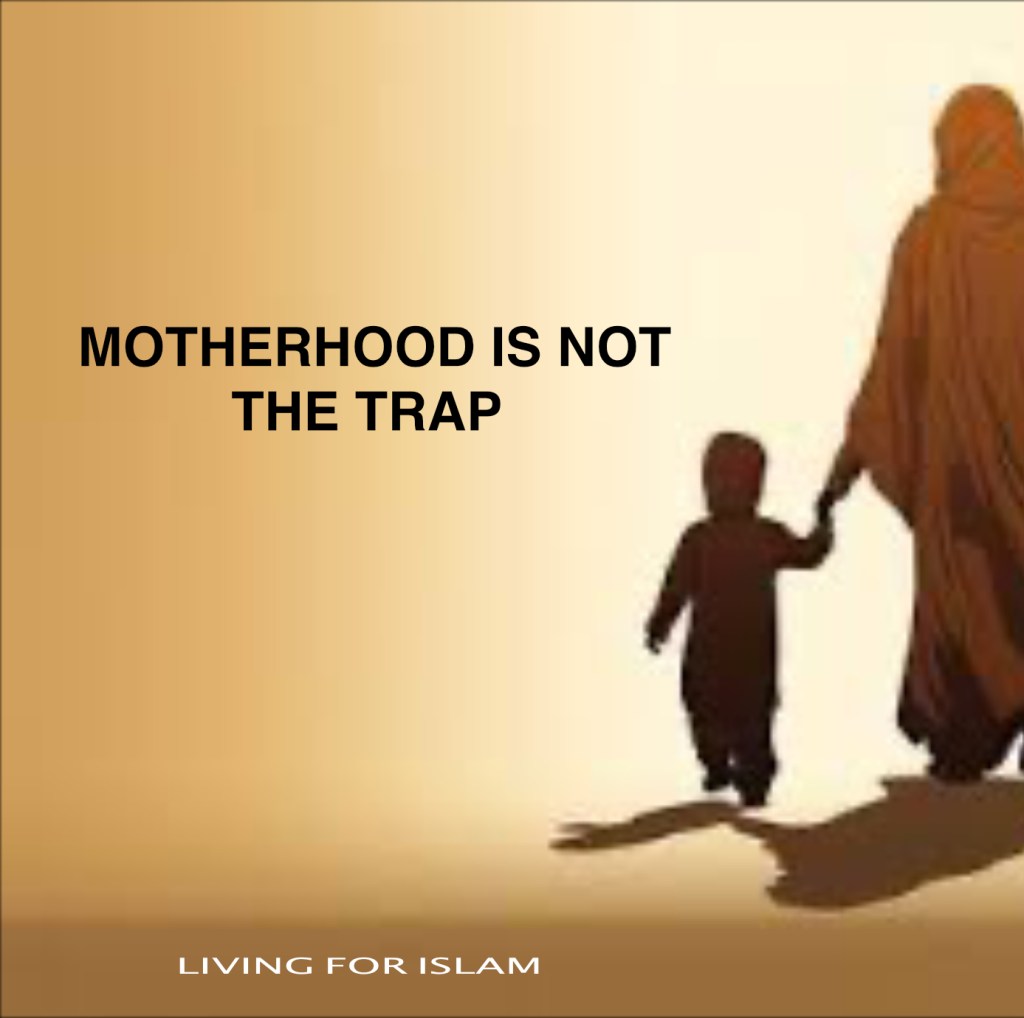
A recent BBC article has given that mood a name. ‘Like a trap you can’t escape’: it speaks about women who regret being mothers.
A trap is not a natural condition. A trap is something constructed. And if we are willing to look honestly at what has been constructed around motherhood in modern Western society then the word trap is remarkably apt.
The researchers are careful to draw the distinction. It is not the child that women regret. It is the condition of motherhood. The relentlessness. The invisibility. The slow erasure of whoever they were before. The lack of support.
What Islam Named
Islam has a great deal to say here. Not as distant theory, but as a tradition that named this maternal need fourteen centuries ago and built obligations around it accordingly.
Allah captures the weight of motherhood in Surah al-Ahqaf.
حَمَلَتْهُ أُمُّهُ كُرْهًا وَوَضَعَتْهُ كُرْهًا
His mother bore him with hardship and delivered him with hardship (al-Ahqaf 15).
The word is kurhan: suffering carried under difficulty, borne sometimes against one’s own inclination. This is not a romantic view of pregnancy and birth. It is a true one. Allah describes this clearly. He states what the mother experiences, plainly, in His own Book.
The respect given to mothers in Islam arrives because of that honesty. And the cost to her creates obligation, not only in the child, but in the entire community surrounding her.
Surah Luqman frames this in communal terms:
وَوَصَّيْنَا الْإِنسَانَ بِوَالِدَيْهِ
We have enjoined upon the human being regarding his parents. (Luqman 14)
The command is addressed to al-insan, the human being in the broadest sense. The ummah’s obligations run toward her.
A Floor, Not a Ceiling
The family is the foundation. In Islamic law, the husband is required to provide for his wife and children financially, this is nafaqah, regardless of what the wife earns or owns. This obligation is not optional. It is a strict legal duty.
It creates a floor.
A mother in an Islamic framework is never compelled to enter the labour market in order to feed her children or keep a roof over their heads. That security is her right, not a gift dependent on her husband’s goodwill. This also means that should she participate in work, community life, or public affairs it is truly her choice and one made from security rather than a necessity driven by financial pressure.
The Islamic position on motherhood is sometimes misread as a ceiling, as though women are confined to the domestic sphere. But the historical record refutes that: scholars, traders, teachers, advisors, women who shaped the tradition from within it. The Islamic model is one of cooperation between the genders, where certain obligations are fixed and others are left open to abilities and circumstances.
Culture, State, and the Economic Order
The legal framework, though, does not stand alone. It requires a surrounding culture that actually values what it protects.
Western culture treats motherhood the way the flight attendant treated it: as a lifestyle choice made by people who had not thought it through.
A society shaped by Islamic values regards the raising of children as among the most significant contributions a person can make, carrying social recognition and spiritual weight that secular liberalism has largely stripped away.
The Prophet ﷺ, when asked who most deserved devoted companionship and care, named the mother three times before the father. That’s not sentimentality. It is a statement about where a society’s attention and resources should flow.
And then there is the state. The second khalifah, ʿUmar ibn al-Khaţţab (ra), established stipends for mothers and children from the bayt al-mal, the public treasury. The principle was explicit: the community as a whole bears a share of the burden that motherhood carries. This is not charity. It is a recognition that a society which benefits from the raising of the next generation has an obligation to materially support those doing the raising.
That state support is only sustainable within a broader economic order oriented toward stability for the many rather than the concentration of wealth for the few. The prohibition of riba, charging interest on loans, prevents the cycle of debt that keeps families permanently financially exposed, always paying back more than they borrowed with no way out. Zakah is an obligation for the wealthy to redistribute a portion of their wealth every year, so that resources flow toward those who need them.
Together these principles describe an economic environment in which the pressures the BBC’s interviewees name, the financial stress, the compulsion to return to work before a mother is ready, the impossibility of asking for help, are addressed at the societal level. Not managed. Prevented.
A Civilisational Answer
The Western paradigm has led to the atomisation of the family. The stripping of social honour from the domestic. The reduction of human life to economic participation, so that a woman’s value is measured by her productivity in the market rather than by the civilisation she raises at home. It reduces motherhood to a private transaction between a woman and her biology, a personal choice whose consequences belong to her alone. The regret these women feel is not a personal failing. It is the honest response of a human being to a system that was never built with her flourishing in mind.
Others have diagnosed this problem. Secular feminists, communitarians, social conservatives, many have named the isolation, the devaluing of care work, the impossible pressures on mothers. But naming a problem is not the same as having a framework to solve it. What the secular liberal order cannot offer is a complete structure, one in which the bearing and raising of children is understood as a communal and sacred act, where the mother is held rather than isolated, where her role carries genuine social weight, and where the economic order is structured to support rather than exploit the family.
Islam is not one policy option among many. It is a civilisational alternative. It offers a complete account of what the human being is, what the family is for, what society owes its members, and what governance must look like if it is to serve the flourishing of real people rather than the smooth functioning of markets.
The Islamic response to the mothers in that BBC article is not a poster on a mosque wall about Jannah. It is a question turned back on every Muslim community: what are we doing for the mothers in our midst? Not just with praise. But with our presence, with resources, with husbands who understand nafaqah as an obligation, with communities that actually share the load, and as an ummah with a vision of governance and economic life serious enough to reestablish the state in which motherhood is genuinely supported.
Jannah lies beneath a mother’s feet. That means we should be paying very careful attention to the ground she is standing on.
 Living For Islam