
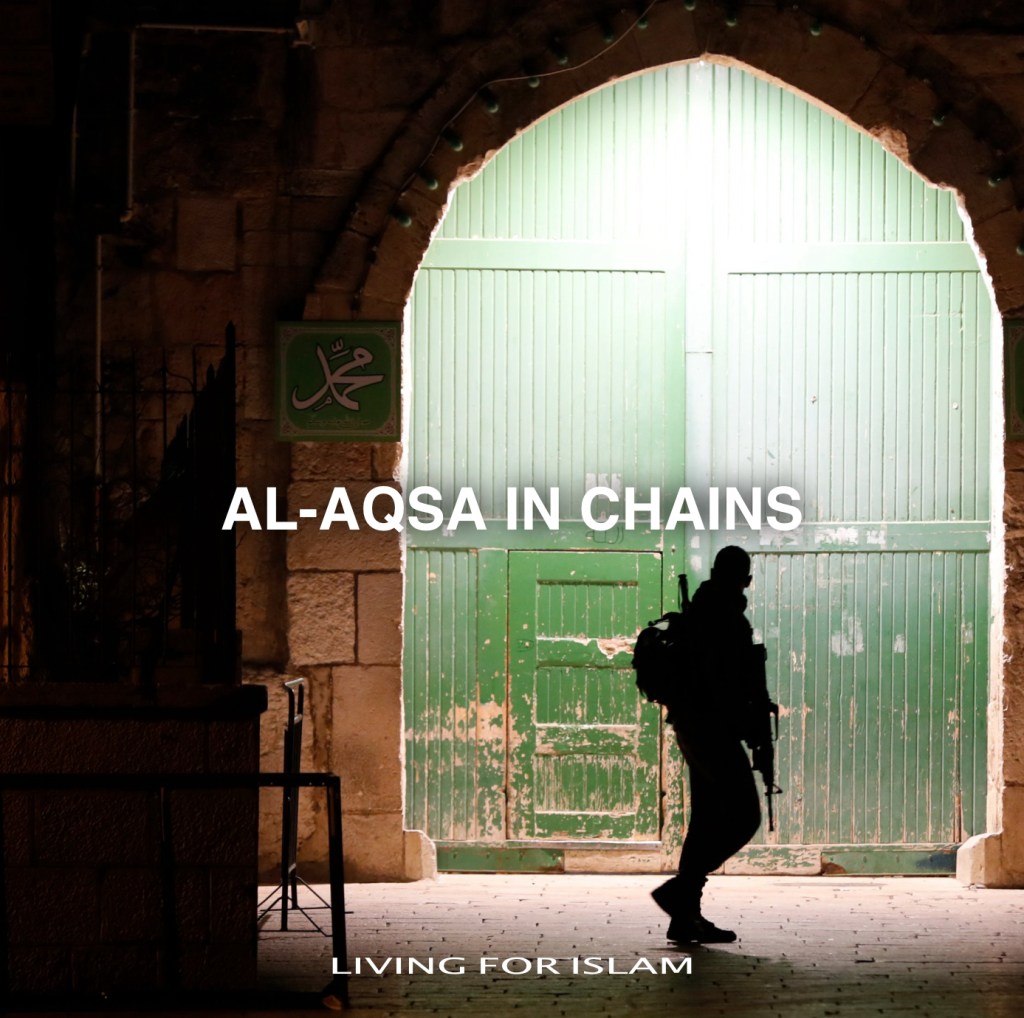
THERE ARE MOMENTS in history that expose the true condition of a nation. What we are witnessing today at Masjid al-Aqsa is one such moment.
For the first time since the occupation of Jerusalem in 1967, and possibly since the liberation by Salahuddin from the Crusaders in 1187CE, the blessed mosque has been closed during the last ten nights of Ramadhan. The occupiers have stated that the closure will extend beyond Eid.
This is not just a political development. It is a spiritual wound.
A Silent Bleeding Wound
Al-Aqsa today is not merely occupied; it is being systematically restricted, reshaped, and tested.
Under the pretext of “emergency law,” worshippers have been barred from entering the mosque during the most sacred nights, severing a connection stretching back to the time of the Prophet ﷺ himself.
Incursions into the mosque compound have increased. Many Palestinians have been arrested or forcibly barred from entry. There are also growing concerns about attempts to carry out the so-called “animal sacrifice” ritual during the Jewish Passover (April 2026) inside the courtyards of al-Aqsa, a move widely seen as efforts to impose a new reality in al-Aqsa.
This is not a distant issue. It is unfolding now.
How Did We Get Here?
The Messenger of Allah ﷺ warned of a time when nations would gather against the Ummah like diners around a dish. When asked whether Muslims would be few in number, he replied that they would be many, but like the foam of a flood: present, yet weightless. He ﷺ identified the cause: love of the dunya and hatred of death.
This diagnosis resonates deeply today. The fragmentation of the Muslim world, divided by politics, nationalism, and internal conflict, has left the Ummah unable to respond with unity and strength. Instead of standing as one body, we have become scattered voices.
The Cost of Silence
Silence is not neutral. To do so is to allow the gradual erosion of Al-Aqsa’s status, where access is restricted, identity is altered, and sacred space is divided.
The Prophet ﷺ reminded us that the believers are like one body: when one part suffers, the whole body responds with fever and sleeplessness.
If Al-Aqsa is bleeding, what does our silence say about us?
We need more than awareness
Many call on us to act: du’ā’, charity, boycotts, and lobbying our local politicians. All play a part in keeping this issue alive in the public consciousness. But awareness alone does not change realities on the ground.
As the decades have shown, and particularly since October 2023, these efforts have not been able to halt the violations or alter the trajectory of events. This is not a failure of intention. It is a reflection of structural limitations.
This problem is one of political disunity and Muslim rulers who put their personal and national interests before the Islamic interest to save Palestine. As long as we remain divided and have such rulers, we will not be able to solve this problem.
Responsibility and the Path Forward
The Ummah cannot afford to see Al-Aqsa as someone else’s problem.
Our history shows that when the Ummah was united under sincere and principled leadership, it was able to protect its sanctities. We saw this in the time of Umar al Khattab (ra), who first liberated Jerusalem from the Byzantines, Salahuddin Ayyubi, who liberated it again from the Crusaders, and Sultan Abdul Hamid II in the late Ottoman period, who took a stance not to sell Jerusalem at any price to the Zionists, declaring it not his to give.
Unity, however, is not declared. It is built. It begins with reevaluating the thoughts within ourselves and our communities, to build Islamic convictions and a shared vision that rises above division.
A Moment of Truth
Al-Aqsa is an amānah, a trust, upon the entire Ummah.
If we were not moved in the last ten nights of Ramadhan, then when will we be?
 Living For Islam