

THERE ARE MOMENTS when you look at the world and realise you have run out of reactions. The grief has been grieved too many times. The anger has nowhere left to go. The shock of one week becomes the ordinary of the next, and somewhere in that process something in you goes numb, not because you have stopped caring, but because caring this much, for this long, with this little power to change anything, has its own kind of cost.
You have seen the images. You have read the words. You have watched children pulled from rubble, families erased, entire neighbourhoods reduced to dust. You have watched leaders look away. You have watched the mechanisms of the world grind on as though none of it is happening. And somewhere beneath the grief, beneath the anger, a question has formed, not always spoken, sometimes just felt in the chest like a weight:
Where is the promise of Allah?
If you have felt that, this is for you.
The Qur’an answers that question. In many different ways. But one of its most complete answers is not an argument. It is a story.
Surah Yusuf is described by Allah Himself as ahsan al-qasas, the most beautiful of stories. It was revealed in its entirety at one of the most difficult moments of the Prophet’s ﷺ mission, a year so heavy it has come to be known as the Year of Grief, in which he had lost both his wife and his protector. There is a reason Allah chose that moment to tell this particular story. It was not a coincidence. It was a mercy.
The story of Yusuf (as) begins with a dream. As a young boy, he tells his father Ya’qub (as) that he saw eleven stars, the sun, and the moon all prostrating to him. Ya’qub immediately recognises what it means and warns his son to say nothing to his brothers.
Then the dream is buried under years of events that seem to contradict it entirely.
Betrayal. A well. Slavery. A foreign land. A false accusation. A prison.
Every single development looks like the end of the story. And it is at one of those moments, when Yusuf has been sold as a slave for a low price in a foreign market, when he is at perhaps his most alone and most forgotten, that the Qur’an pauses the narrative and says something extraordinary.
وَاللَّهُ غَالِبٌ عَلَىٰ أَمْرِهِ وَلَٰكِنَّ أَكْثَرَ النَّاسِ لَا يَعْلَمُونَ
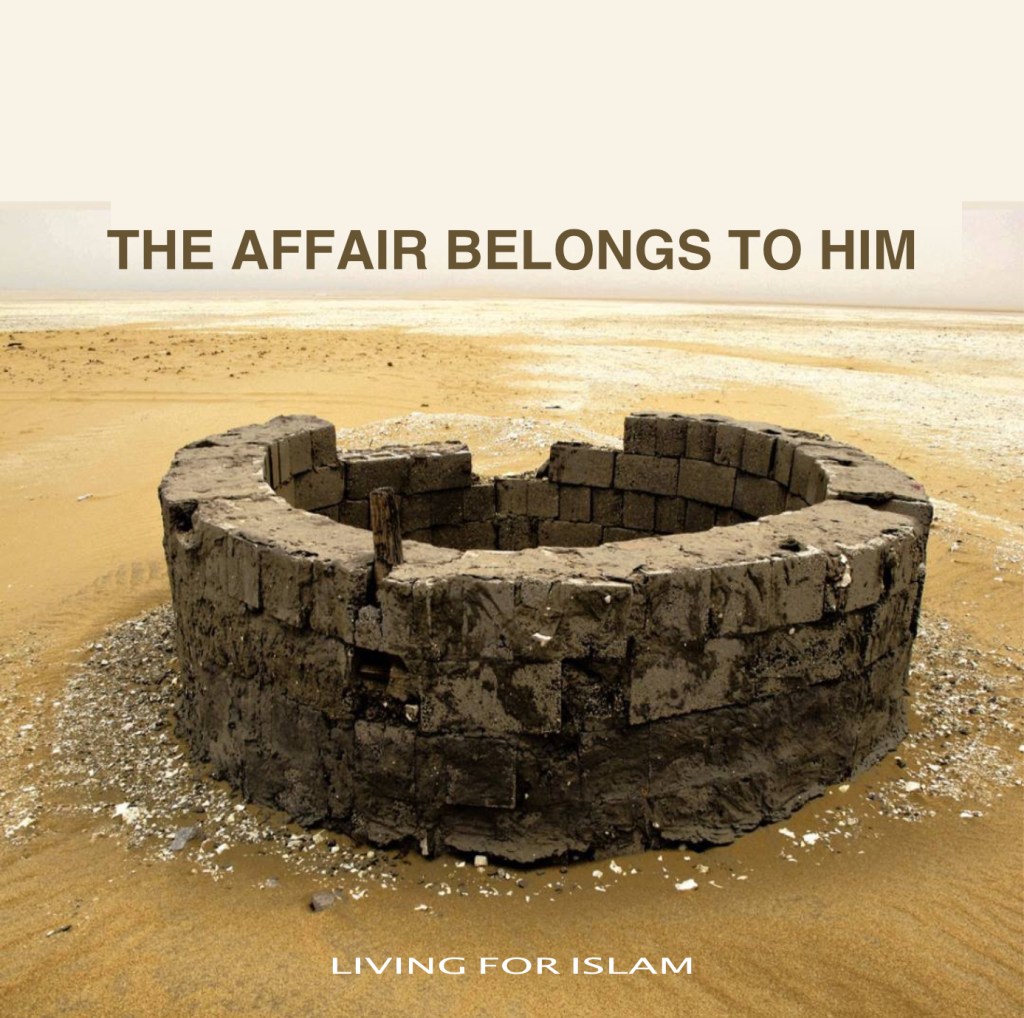
And Allah is dominant over His affair, but most people do not know. (Yusuf 21)
To feel the weight of it, we need to slow down.
The word ghālib (غَالِب) comes from the root gh-l-b. It does not simply mean to control. It carries the meaning of prevailing after resistance, dominating despite opposing forces, despite competing intentions, despite every effort to produce a different outcome.
That distinction matters.
The verse is not saying that Allah oversees events from above while humans go about their business. It is saying that despite every human plan, every act of scheming, every confident exercise of worldly power, the divine will ultimately prevail over all of it.
Yusuf’s brothers planned carefully. The traders had their commercial calculations. The Egyptian official made what seemed to him an ordinary purchase. Each of them was acting on their own intentions, pursuing their own goals.
None of them knew what they were participating in.
Notice also the phrase: not ghālib ‘alā kulli shay, dominant over everything in general, but ghālib alā amrihi: dominant over His affair.
The word amr (أَمْر) carries layered meaning: an affair, a command, a decree, the unfolding of a plan already in motion. Here, it refers to the divine purpose already set in motion within this story. Allah is not reacting to events as they unfold. He is not adjusting. The affair is His, and His dominance over it is already a settled matter.
The brothers think they are closing a chapter by removing Yusuf from their father. In reality, they are opening one.
There is also something precise in how the sentence is structured in Arabic.
The phrase Allāhu ghālibun is a nominal sentence, a jumlah ismiyyah. In Arabic rhetoric, nominal sentences carry the meaning of permanence and continuity rather than a single completed action. A verbal sentence would say: Allah prevailed. The nominal sentence says: Allah is, always, continuously, prevailing. It is not a statement about one episode. It is a statement about the nature of reality.
And the preposition ʿalā, over, places the divine plan above the plane of human action entirely. Every scheme, every alliance, every act of power operates within the story. Allah’s decree stands above it.
The verse ends with a phrase that is easy to pass over.
وَلَٰكِنَّ أَكْثَرَ النَّاسِ لَا يَعْلَمُونَ
…but most people do not know.
This is not a dismissal. It is an explanation of why history so consistently misreads itself in the moment.
The brothers cannot foresee the famine. The traders cannot foresee the palace. No one standing at that point of sale could imagine the throne. They see their own intentions and their own slice of events. They do not have access to the whole picture.
Most people do not know, so most people read the present moment as the final word.
We are living through events that is testing us on what it means to be a believer.
The suffering is real. The scale of it is real. The silence of those with power is real. The sense that the machinery of this world is designed to protect some lives and discard others, that is real too. It is not weakness to feel the weight of it. It is not lack of iman to grieve. The Prophet ﷺ himself wept. The Qur’an itself describes the cry of the oppressed reaching Allah.
That feeling is not new. Every generation of believers has known some version of it.
But beneath the grief, there is something the oppressors of every age have consistently failed to understand.
They believe they are writing the story.
They are not.
What the Qur’an offers in response is not an instruction to look away. The story of Yusuf (as) is full of action, he works, he advises, he refuses, he perseveres, he governs. The surah does not teach passivity. But running beneath all of that human effort is a current of trust that does not depend on how things look. The outcome is not in the hands of those who appear to hold the power. The amr belongs to Allah. And He is ghālib over it.
When Yusuf was thrown into the well, his brothers believed they had ended his story.
They had no idea they were beginning it.
The well led to the caravan. The caravan led to the palace. The palace led to the prison. The prison opened the door to the throne. Every moment that looked like a closing was in fact a passage. Every act intended to bury him became the mechanism of his elevation.
The people involved could not see what they were participating in. They were not meant to. The knowledge of how it would unfold belonged only to Allah. And to the reader of the surah, whom Allah invites to watch the full arc, so they might learn this lesson.
This is what Allah is offering you now.
Not a removal of pain. Not an instruction to look away. Not a promise that things will resolve quickly or easily or in the way you have imagined. But something more solid than any of that: the knowledge that the present moment is one scene in a much larger story, and that the One who decreed it knows its end from its beginning.
Empires have believed their power to be permanent. Oppressors have believed they controlled the future. History has not been kind to such beliefs.
The believer looks at the turbulence of the present not with denial, and not with indifference to the suffering within it, but with the orientation of someone who knows that the final chapter has not yet been written, and that the One who carried Yusuf from the bottom of a well to the authority of a kingdom is still, today, ghālib.
وَاللَّهُ غَالِبٌ عَلَىٰ أَمْرِهِ
The ending already belongs to Him.
 Living For Islam