
ALLAH ASKS IN Surah At-Tawbah:
أَمْ حَسِبْتُمْ أَن تُتْرَكُوا وَلَمَّا يَعْلَمِ اللَّهُ الَّذِينَ جَاهَدُوا مِنكُمْ وَلَمْ يَتَّخِذُوا مِن دُونِ اللَّهِ وَلَا رَسُولِهِ وَلَا الْمُؤْمِنِينَ وَلِيجَةً ۚ وَاللَّهُ خَبِيرٌ بِمَا تَعْمَلُونَ
Do you think that you will be left while Allah has not yet made evident those among you who strive and not taken any intimate associate other than Allah and His Messenger and the believers? And Allah is aware of what you do. (at-Tawbah 9:16)
The word at the heart of this ayah is walijah, an intimate ally, the one you truly turn to, the inner circle of your trust. Allah is not simply asking whether we believe in Him. He is asking something sharper: when danger arrives, and choices must be made, whose shelter do we actually seek? Who is our walijah in actions, not merely in words?
This question has never been more urgent for the Ummah than it is today.
A Manufactured Division
When the Ottoman Khilafah fell, and the colonial powers convened to divide its inheritance, they did something more consequential than drawing borders; they implanted an idea. That Muslims were not one people with one set of obligations to one another, but many separate nations with separate interests and separate fates. The Sykes-Picot agreement, the mandates, and the artificially constructed states that followed were not peoples finding natural self-expression. They were the deliberate division of a community that had understood itself, for over a millennium, as a single body.
We have been living inside that division ever since, often without questioning it. Today, there are over fifty Muslim-majority nation-states with armies, constitutions, foreign ministries and seats at the United Nations. And yet when Gaza burns, when Muslim cities are besieged, when our lands are struck, these fifty-plus states offer statements, symbolic gestures, and at worst, complicit silence. The machinery of the nation-state has not protected the Ummah. It was never built to.
The Iran Illusion
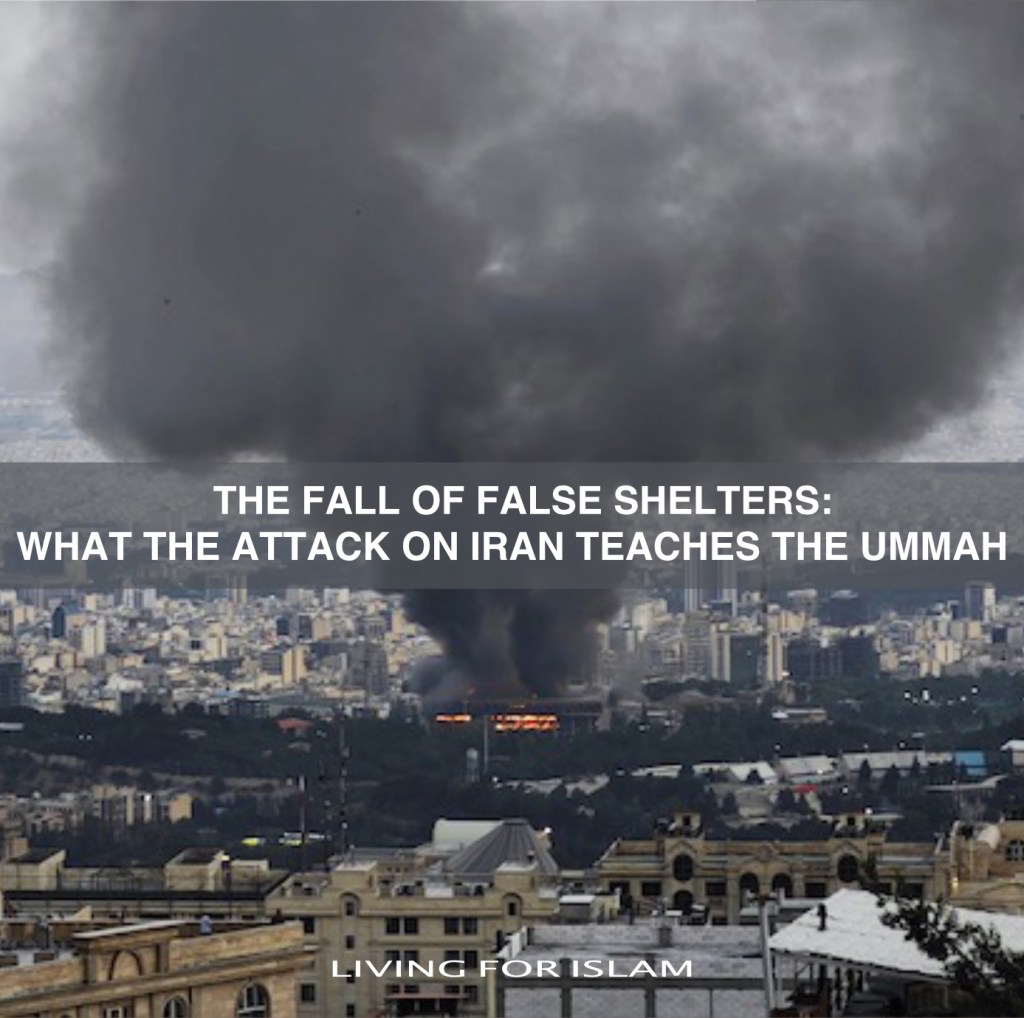
The current US-Israeli military campaign against Iran brings this lesson into sharp relief. And it also teaches us something more that the Ummah must examine honestly.
For decades, the Islamic Republic presented itself as the standard-bearer of resistance: the liberation of Al-Quds, defiance of Western arrogance, solidarity with the oppressed. Many Muslims, including Sunnis with deep theological disagreements with Tehran, were drawn to this image, seeing in Iran what they could not find in their own governments, a state that seemed willing to say no.
But the image and the reality were never the same thing.
When the US invaded Afghanistan in 2001, Iran quietly cooperated with American intelligence against the Taliban, not from principle, but because the Taliban were Sunni rivals on its eastern border. In Iraq from 2003, Iranian-backed forces moved in not to resist the occupation but to reshape the country’s sectarian landscape in Tehran’s favour, with devastating consequences for ordinary Sunnis. When the Syrian people rose against Assad, Iran deployed the IRGC, mobilised Hezbollah, and brought in foreign fighters to crush the uprising, because Assad’s survival served Iranian strategy, whatever the cost in Muslim lives. And then Gaza. As Israel’s destruction unfolded before the world, Iran restrained Hezbollah to the point that they were eventually taken out by the Israelis without having made any difference.
At every moment of truth, the calculus was the same: national interest, sectarian positioning, strategic calculation. The speeches were performances. The policy was something else entirely.
This is not an indictment of the Iranian people, who have suffered greatly. It is an honest reckoning with what the nation-state model produces, even when, perhaps especially when, it wraps itself in the symbols of Islam.
The Lesson of Compliance
Here is the deeper and most sobering lesson. Iran complied. Not openly, but in the ways that matter to the superpowers, cooperating on intelligence, managing its proxies carefully, calibrating its confrontations, stopping well short of genuinely threatening the regional order. It made itself useful. And still, when the architects of the “new Middle East” decided their vision required a different Iran, when the project of establishing Israeli dominance demanded it, none of that compliance bought a single day’s protection. The answer was regime change.
Every Muslim-majority government should learn from this. The nation state that trades its Islamic obligations for security guarantees has not bought safety; it has bought time, on terms set by others, revocable at will. The Gulf states, for all their alignment with Washington, are one strategic recalculation away from the same fate. The protection offered to the compliant is not protection. It is a leash.
This is the structural flaw of the nation-state model for the Muslim world. It does not give us power. It gives us the appearance of power, flags, anthems, embassies, seats at tables where decisions have already been made, while keeping us divided, unable to act collectively, and permanently dependent on the goodwill of those whose interests are not ours.
Rejecting the Narrative
We should expect the Western liberal narrative to draw its own conclusions from all of this, and we should be clear about what that narrative is and what it is designed to do.
Images of Iranians celebrating will be amplified. They will be offered as proof that the people themselves have rejected Islamic governance, that Islam and freedom are incompatible, that what we are witnessing is liberalism’s triumph and Islam’s defeat. This is not analysis. It is a propaganda effort with a specific goal: to convince the Ummah that an alternative rooted in Islam is neither desirable nor possible.
We should not be moved by it. The grievances of Iranians are real. A population that has lived under authoritarian rule, seen its young people imprisoned for dissent, and been ground down economically has every reason for frustration. But two things must be said plainly.
Iran was never a state built wholly on Islam. Like the Saudi state in recent decades, the Islamic Republic practised the deen selectively, deploying Islamic symbolism to serve the interests of a ruling class while setting aside the principles of justice and accountability whenever they became inconvenient. What Iranians experienced was not Islam in governance. It was a regime that used Islam as a legitimising tool. To conclude from its failures that Islam itself fails is like concluding from a corrupt judge that justice itself is corrupt.
Nor did Iran’s economic suffering arise simply from misgovernance. Sweeping US-led sanctions were designed to make ordinary Iranian life so painful that society would fracture, a collective punishment of an entire people. Having engineered that suffering, the same powers now present it as organic evidence of Islamic failure. We should name this for what it is: a wound inflicted deliberately, then pointed to as proof of the patient’s weakness.
The Ummah has seen this playbook before. Every time a Muslim-majority state stumbles, the conclusion on offer is the same: your deen is the problem. Our answer must be equally consistent: the deen has not been the problem. It has not yet been sincerely tried.
The Ground Being Cleared
What we are living through is deeply painful. But pain, in the Islamic worldview, is not simply suffering; it is preparation. The sifting Allah describes in the ayah is not punishment; it is the process by which what is false is separated from what is true, by which misplaced loyalties are made evident.
The illusion that a nation-state, however loudly it invokes Islam, can substitute for genuine unity of the Ummah is being stripped away. The illusion that compliance will earn us the protection of the powerful is being stripped away (even the European ‘middle powers’ are realising that). The illusion that our division is natural rather than manufactured is being stripped away. Each crisis removes another layer. Each betrayal sharpens the diagnosis.
This is not the end. It is the ground being cleared.
What Must Be Built
What is needed now is not another variant of what has failed, not another nation-state with better slogans, not another regime promising to be more authentically Islamic than the last.
What is needed is a genuine recovery of the political vision Islam itself provides: one that takes the Qur’anic address to the Ummah as a single community, that draws on the model of the Seerah, and that refuses to accept our division as permanent. The Qur’an does not speak to fifty nations, it speaks to one Ummah. The Prophet ﷺ built one political community with one set of loyalties and one understanding of collective responsibility. The obligation to protect Muslim life and resist oppression does not dissolve into fifty separate national calculations. It is the obligation of one body.
The path towards this is long. It demands sincerity, sacrifice, and an honesty about how far we have drifted. But it begins, as it always has, with knowing where our walijah truly lies.
Conclusion
Do not be deceived by the apparent strength of those who have wronged us, nor discouraged by the apparent weakness of the Ummah in this moment. Allah tests those He loves. He filters and purifies before He elevates. The false shelters are falling because they were always false, and their falling is part of how the truth becomes clear.
What is asked of us is not grief, but clarity. Not despair, but the quiet, determined resolve to place our trust where it has always belonged, with Allah, His Messenger ﷺ, and the believers and to begin, from that foundation, to build.
وَاللَّهُ خَبِيرٌ بِمَا تَعْمَلُونَ
And Allah is aware of what you do. (al Mujadila 11)
 Living For Islam