
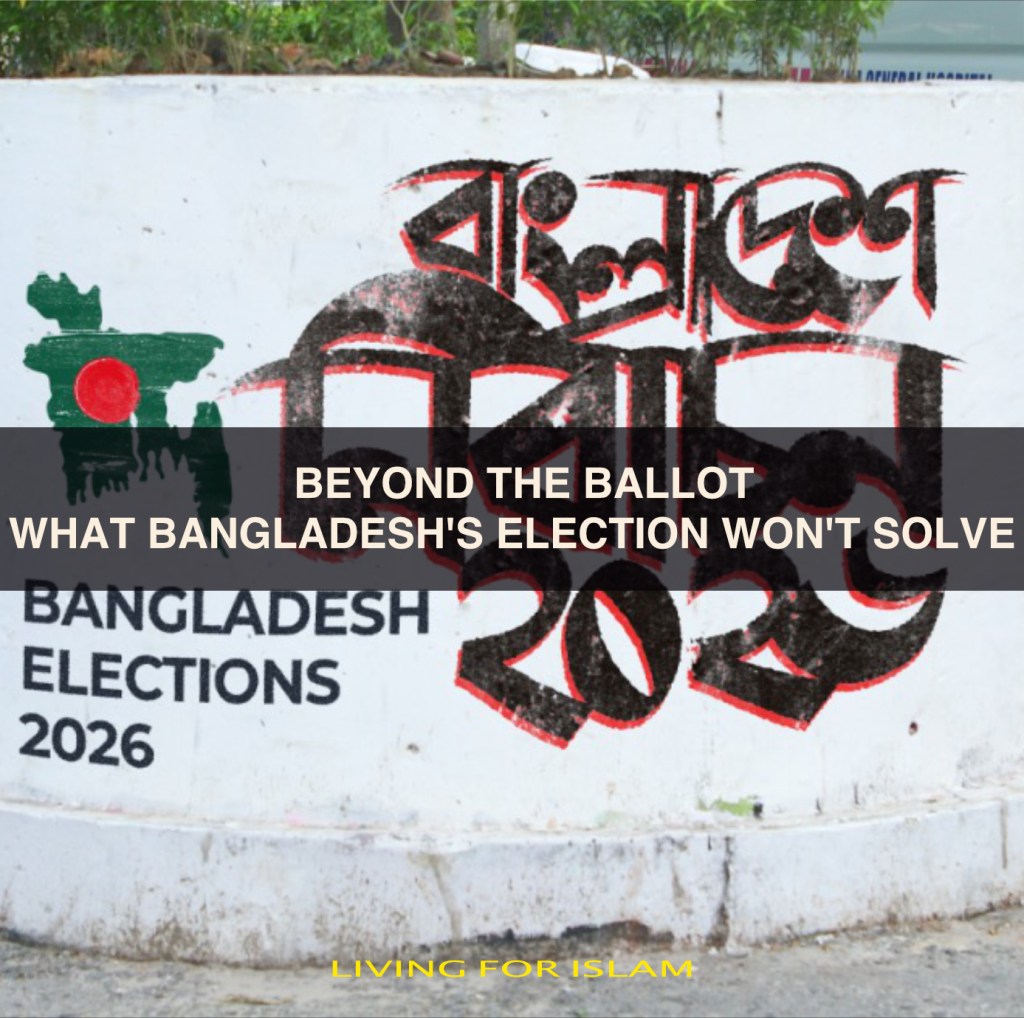
AS BANGLADESH COMES to another general election, I keep hearing the same arguments on repeat. Secularism is the only path to stability. Democracy is the only legitimate system. Islamic political aspirations? Emotional. Regressive. Dangerous.
But here’s what nobody seems willing to say out loud.
Five decades of secular governance haven’t resolved the moral and political anxieties of this Muslim-majority society. If anything, they’ve exposed a widening gap between who we are spiritually and what our political system assumes we should be.
The resurgence of Islamic politics isn’t accidental. It’s symptomatic.
The Secular Assumption
Secularism makes a straightforward claim: keep religion private. Governance should operate on neutral principles. Law comes from human deliberation alone. Sovereignty belongs to the people, expressed through shifting majorities.
For a society where the overwhelming majority professes Islam, this was always going to be a problem.
Because Islam doesn’t work like that. The Qur’an doesn’t just talk about prayer and fasting. It talks about justice, contracts, inheritance, leadership, and public trust. It addresses markets and courts as much as mosques. It frames authority as an amanah, a moral trust accountable before Allah.
To insist that such a faith remain politically silent is not neutrality. It is a philosophical imposition.
For fifty years, secular governance in Bangladesh has tried to normalise this separation. But the people haven’t followed. Islam remains the language through which millions understand justice, dignity, and accountability. That’s not going away because a constitution says so.
Democracy and Moral Drift
Secular democracy promises representation and accountability. But what most citizens actually experience is endemic corruption, patronage networks, and elections that change faces but rarely change structures.
Here’s the deeper issue, though.
Secular democracy puts sovereignty in numerical majority. Law becomes legitimate because it was voted through. Morality becomes negotiable. What was wrong yesterday can be right tomorrow if the parliamentary maths works out.
Islamic political thought starts somewhere else entirely. Ultimate sovereignty belongs to Allah. Human authority is delegated, limited, and morally bound. This isn’t a procedural difference. It’s aqeedal.
When governance is cut off from Revelation, politics becomes a contest of interests, not a pursuit of justice. And in that system, corruption isn’t an anomaly. It’s built in.
The growing appeal of Islamic political discourse? It’s disillusionment with this moral drift.
Bangladesh’s Particular Struggle
Bangladesh carries its own complications here.
During the Pakistani period, Islam was used as an unifying ideology while denying Bengali cultural and linguistic rights. The 1971 independence movement emphasised Bengali nationalism and secular ideals as a direct response.
So we ended up with a strange tension. Islam justified Pakistan. Secularism justified Bangladesh. And neither framework has fully answered the question: what does governance actually look like for a Bengali-speaking, Muslim-majority nation?
Even firmly secular leaders invoke Islamic references when they need legitimacy. That tells you something. We’re still searching for a synthesis that constitutional provisions haven’t settled.
What This Actually Looks Like
These aren’t just abstract debates. They show up in real policy. They touch everyday life.
Family law. Our current laws draw from Islamic jurisprudence but sit within a secular constitutional framework. When reforms are proposed, the questions come immediately: on what basis? Whose interpretation? Who decides?
Economic policy. Our banking system runs on interest. But millions of citizens regard riba as forbidden. Islamic banking exists as an alternative, but remains marginal while the state’s entire economic structure assumes interest-based finance as the default
Education. What should schools teach about governance and ethics? Secular curricula treat these as civic values and constitutional principles. Many parents want their children learning through an Islamic framework. The gap between state schools and madrasas reflects this unresolved tension.
Beyond Nostalgia
Here’s what concerns me, though.
Islamic political movements in Bangladesh aren’t unified. Traditional ulama, modernist reformers, and Islamist organisations have different visions. These matters need to be worked out.
Islamic political parties participate in the same democratic system they theoretically oppose. They contest elections, form alliances with secular parties, and compromise fundamental principles for expediency. This isn’t flexibility. It’s incoherence.
Most Islamic discourse is reactive, not constructive. It criticises secularism without offering detailed alternatives. It invokes the Medinan state without grappling with how those principles translate to the 21st century.
If we’re serious about Islamic governance, we need serious work. Detailed jurisprudence on constitutional structure, economic policy, minority rights, and legal frameworks. Engagement with classical thought and honest assessment of where implementations succeeded and failed.
We need clear answers to the questions that many ask about minority and women’s rights. Not answers that pander to Western acceptability but to true Islamic principles and obligations.
Until this happens, Islamic movements remain fragmented, reactive, and easily co-opted.
The Deeper Question
Tomorrow, tens of millions will vote. A government will form. The contradictions will remain.
For a Muslim-majority society, the search for coherence between its politics and its īmān will remain unresolved because the real issue is not being addressed: on what moral foundation, on what system, does governance rest?
But growing numbers see through the theatre.
The work ahead is rebuilding governance from Islamic foundations. Serious scholarship, not slogans. Intellectual courage, not expediency.
Tomorrow’s election won’t save Bangladesh.
The question is whether we’re ready to start asking what actually might.
 Living For Islam