
THEY SAY THAT there are three types of people when it comes to crime. Those who commit it, those who facilitate it and those who turn a blind eye to it.
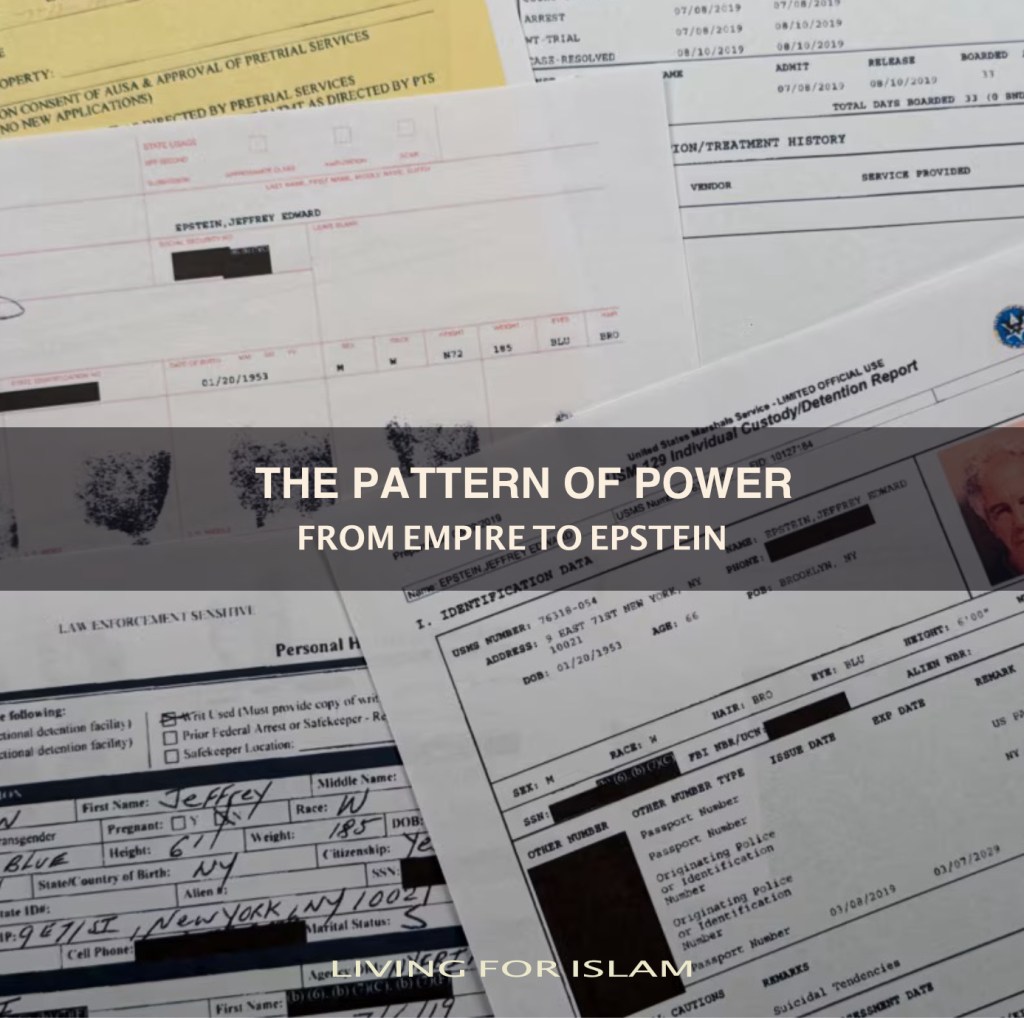
For many people, the Epstein files confirm this very point and what had long been suspected: his crimes were not the actions of a lone predator. What is more is that it is not about individuals but a system in which wealth, influence, and institutional silence protected the powerful at the expense of the vulnerable.
For ordinary Muslims, this is a familiar pattern. Publicly, societies speak the language of morality. Privately, exploitation is hidden. When elite interests are involved, accountability is delayed or denied. This was not just a scandal. It was a reminder of how power behaves when it is shielded from consequence.
The Mask of the “Civilising Mission”
When European colonial powers expanded into Muslim lands, across North Africa, the Middle East, Central Asia, and South Asia, conquest was rarely presented as conquest. It was framed as benevolence. Colonial rule was sold as a “civilising mission” that promised progress and reform to societies portrayed as backward and oppressive.
Women were placed at the centre of this narrative. Muslim societies were depicted as uniquely cruel to women, while European domination was presented as their liberation. The French in Algeria, the British in Egypt and India, and the Dutch in Indonesia all used the condition of Muslim women as justification for occupation.
This rhetoric justified the extraction of land and wealth while portraying colonial powers as moral authorities, societies that claimed to have solved the problems of justice and human dignity and were now exporting their solutions to others.
Hypocrisy at Home
Yet while claiming to rescue women abroad, colonial societies often failed to protect women and children within their own borders. Victorian Britain, at the height of its empire, was marked by widespread child labour, prostitution, and the sexual abuse of minors. Legal protections were weak, enforcement was inconsistent, and social status often determined whether justice was applied at all.
The age of consent in Britain remained twelve until 1875. Even after reforms, elite perpetrators frequently escaped consequences. Women and girls who spoke out were dismissed, discredited, or punished. Institutions that claimed to deliver justice often functioned instead as shields for the powerful.
This was not an accident. It was a structural feature of societies that relied on moral rhetoric while tolerating deep inequalities of power.
Epstein and the Modern Pattern
The Epstein case shows a similar trend today. He wasn’t just a criminal who avoided consequences; he was part of powerful financial, political, and social circles that protected him from being questioned.
Many individuals connected to him publicly promoted women’s rights, human rights, and global justice. The contrast is revealing. Moral language is used to project virtue outward while exploitation continues inward, protected by wealth, reputation, and institutional hesitation.
This is not a condemnation of entire societies. Epstein’s crimes were exposed by victims, journalists, and investigators who refused to stay silent. But his influence reveals a persistent truth: when powerful people are treated as above the law, justice becomes selective, and abuse can continue.
For Muslims aware of the history of colonialism, this pattern is not surprising. It reinforces a long standing caution toward any claim of moral superiority that is not matched by real accountability.
What Islam Teaches About Power
Islam addresses this problem directly. It does not assume human virtue. It anticipates corruption.
The Messenger of Allah ﷺ warned that societies are destroyed not simply by crime, but by selective justice. He said: “The people before you were destroyed because if a noble person committed theft, they would leave him, but if a weak person committed theft, they would carry out the punishment on him. By Allah, if Fatimah, the daughter of Muhammad, were to steal, I would cut off her hand.” (Muslim)
This establishes a principle: no one is above the law. The moment a society accepts two standards, one for the powerful and one for the powerless, it begins its moral collapse.
The relevance to modern scandals like Epstein is obvious. His crimes persisted not because laws were missing, but because they were not applied equally. Power rewrote the rules. Institutions hesitated. Silence became policy. Islam treats this not as a minor flaw, but as a fatal failure.
The Qur’an commands believers:
يَـٰٓأَيُّهَا ٱلَّذِينَ ءَامَنُوا۟ كُونُوا۟ قَوَّٰمِينَ بِٱلْقِسْطِ شُهَدَآءَ لِلَّهِ وَلَوْ عَلَىٰٓ أَنفُسِكُمْ أَوِ ٱلْوَٰلِدَيْنِ وَٱلْأَقْرَبِينَ ۚ إِن يَكُنْ غَنِيًّا أَوْ فَقِيرًۭا فَٱللَّهُ أَوْلَىٰ بِهِمَا
“O you who believe! Stand firmly for justice as witnesses for Allah, even if it is against yourselves, your parents, or your relatives — whether one is rich or poor, Allah is more worthy of both.” (an-Nisa 135)
And:
يَـٰٓأَيُّهَا ٱلَّذِينَ ءَامَنُوا۟ كُونُوا۟ قَوَّٰمِينَ لِلَّهِ شُهَدَآءَ بِٱلْقِسْطِ ۖ وَلَا يَجْرِمَنَّكُمْ شَنَـَٔانُ قَوْمٍ عَلَىٰٓ أَلَّا تَعْدِلُوا۟ ۚ ٱعْدِلُوا۟ هُوَ أَقْرَبُ لِلتَّقْوَىٰ
“O you who believe! Be persistently standing firm for Allah, witnesses in justice, and do not let hatred of a people prevent you from being just. Be just; that is closer to righteousness.” (al-Ma’idah 8)
No ruler, scholar, or benefactor is exempt from accountability before Allah. Justice is measured not by speeches or intentions, but by equal application.
Islam’s Tools for Accountability
At the foundation of Islam is the belief that every person is accountable to Allah and that all deeds will be exposed:
فَمَن يَعْمَلْ مِثْقَالَ ذَرَّةٍ خَيْرًۭا يَرَهُۥ
وَمَن يَعْمَلْ مِثْقَالَ ذَرَّةٍۢ شَرًّۭا يَرَهُۥ
So whoever does an atom’s weight of good will see it, and whoever does an atom’s weight of evil will see it. (az-Zalzalah 7–8)
Right and wrong are not decided by public opinion. They are defined and binding.
Muslims are commanded to stand for justice and moral responsibility:
كُنتُمْ خَيْرَ أُمَّةٍ أُخْرِجَتْ لِلنَّاسِ تَأْمُرُونَ بِٱلْمَعْرُوفِ وَتَنْهَوْنَ عَنِ ٱلْمُنكَرِ وَتُؤْمِنُونَ بِٱللَّهِ
You are the best nation produced for mankind: you enjoin what is right and forbid what is wrong, and believe in Allah. (ale Imran 110)
The Prophet ﷺ said: “Whoever among you sees an evil, let him change it with his hand. If he cannot, then with his tongue. If he cannot, then with his heart, and that is the weakest of faith.” (Muslim)
Silence in the face of injustice is not neutrality; it is complicity. This principle challenges cultures that protect status and reputation at the expense of truth and the vulnerable.
Consultation (shura) is also a safeguard:
وَأَمْرُهُمْ شُورَىٰ بَيْنَهُمْ
“…and whose affairs are conducted by mutual consultation…” (ash-Shuraa 38)
The community has the right to participate in public affairs and to hold leaders accountable. In Shari‘ah, the law binds everyone without exception: rulers, officials, and governing bodies alike.
Islam also recognises that good intentions are not enough. Justice requires institutions. Historically, institutions such as hisbah and the Court of Unjust Acts (Mahkamat al-Mazalim) existed to restrain abuses of power and protect the public.
Because power and wealth often reinforce one another, Islam treats wealth as a trust, not a mark of superiority:
كَىْ لَا يَكُونَ دُولَةًۢ بَيْنَ ٱلْأَغْنِيَآءِ مِنكُمْ
“…so that wealth does not circulate only among the rich from among you.” (al-Hashr 7)
Wealth is not meant to purchase silence or immunity; it increases responsibility.
When Muslims Fail Their Own Teachings
These principles do not enforce themselves. Today, the Muslim world faces these issues as well. Not due to Islam, but because secularism and man made systems have replaced it. Leaving behind Islamic governance hasn’t led to fairness; instead, it has allowed the same abuses that the teachings aimed to stop.
The Real Lesson
The Epstein files expose more than individual criminality. They show how societies decay when power is insulated from accountability and justice becomes selective.
For Muslims, the lesson is one of responsibility. Islam presents a demanding vision of justice, one that refuses elite immunity, rejects performative morality, and insists that the same rules apply to everyone.
That standard is not a slogan. It is an obligation.
 Living For Islam
One thought on “The Pattern of Power: From Empire to Epstein”