
THE UNITED KINGDOM is one of the richest countries in the world. Yet the Joseph Rowntree Foundation’s UK Poverty 2026 report shows that more than 14 million people, around one in five, live in poverty. Of these, 6.8 million live in very deep poverty, unable to meet basic needs like food, heating, and housing. Poverty has not only remained high for decades; it has become more severe.
This reality may surprise some, but it should not. Poverty on this scale is not an accident. It is the predictable outcome of the ideas this society is built on.
Poverty as a Product of Ideology
Modern Britain is governed by liberal secular ideas. At their core is the belief that society prospers by producing more wealth and allowing markets to decide how that wealth is distributed, with limited interference. The state’s role is reduced, and responsibility is placed on individuals to survive and succeed within the market.
But when wealth is left largely to market forces, those who already have power and resources take a greater share. Wealth does not “trickle down” naturally. Instead, it concentrates. The strong protect their interests, influence policy, and shape the rules to their advantage through lobbying, corporate power, and political access. The result is not shared prosperity, but widening inequality.
To justify this outcome, the system promotes a narrative that blames the poor. Poverty is explained as a failure of effort, skill, or attitude. Structural barriers, low wages, insecure work, high housing costs, poor health, weak schooling, and limited opportunities are ignored, even though these are built into the system itself and benefit those at the top.
Instead of asking why work does not provide dignity or security, the question becomes why individuals are not trying harder.
Poverty as Discipline
Within this ideology, welfare is viewed with suspicion. Support is kept deliberately low to avoid what is called “dependency.” Claimants are stigmatised, while welfare fraud is exaggerated. At the same time, large-scale corporate abuse, tax avoidance, and exploitation are treated as normal or unavoidable.
Poverty is not simply tolerated; it is used as pressure. Fear of deprivation forces people into insecure, low-paid, and degrading work. This keeps wages down and profits up. The system becomes very good at measuring poverty, producing reports and statistics, but structurally incapable of ending it.
This is not a failure of management. It is a failure of values.
The Islamic View: Responsibility, Not Blame
Islam begins from a completely different foundation.
In Islam, wealth does not belong absolutely to individuals. It belongs to Allah. Human beings are trustees, not owners. Because of this, poverty is not primarily blamed on the poor. It is understood as a failure of responsibility, especially by those with wealth and by those who rule.
The Prophet ﷺ said: “He is not a believer whose stomach is filled while his neighbour goes hungry.” (Bayhaqi)
Hunger, in Islam, is not a neutral misfortune. It is evidence that an obligation has not been fulfilled.
The Qur’an is clear that the poor have a defined right in the wealth of others:
وَٱلَّذِينَ فِىٓ أَمْوَٰلِهِمْ حَقٌّۭ مَّعْلُومٌۭ
لِّلسَّآئِلِ وَٱلْمَحْرُومِ
“And in their wealth is a known right for the needy and the deprived.” (al-Maʿārij 24–25)
This is not charity that depends on generosity or gratitude. It is a right. Withholding it is an injustice.
The Role of the State
Islam does not treat welfare as optional or secondary. Ensuring that people’s basic needs are met, food, clothing, shelter, healthcare, education, and security, is a duty of governance.
If markets fail to provide these needs, the state must intervene. If people remain hungry, responsibility does not fall on them alone. It falls on the ruler. Islamic thought holds rulers accountable before Allah for unmet basic needs. Poverty is evidence of governance failure.
This responsibility is not merely moral; it is legal. Islamic governance allows, and in cases of necessity, requires the use of public wealth, compulsory levies, and redistribution to prevent deprivation. Survival is not conditional on productivity.
The elderly, the sick, the disabled, and those without work are entitled to provision. Forcing people into exploitative labour through hunger and fear is an injustice.
Zakat and Beyond
Zakat shows the difference clearly. It is not voluntary charity. It is a mandatory transfer of wealth. The poor are entitled to it as a right, and withholding it is a grave sin.
Historically, zakat was collected and distributed by the state as part of a wider economic system. It was never meant to stand alone. Alongside zakat were other public revenues, public ownership of key resources, and emergency obligations when hardship spread.
The aim was not short-term relief, but the removal of structural poverty.
Limiting Wealth Concentration
Islam also places clear limits on wealth accumulation. Interest (ribā) is prohibited. Hoarding is condemned. Monopolies and price manipulation are restricted. Inheritance laws prevent wealth from being locked permanently within elite families.
The Qur’an states the reason plainly:
كَىْ لَا يَكُونَ دُولَةًۢ بَيْنَ ٱلْأَغْنِيَآءِ مِنكُمْ
“So that wealth does not merely circulate among the rich among you.” (al-Ḥashr 7)
This is not an economy built only around growth. It is an economy built around justice.
Accountability and Justice
Perhaps the most important difference is accountability. In Islam, authority is inseparable from responsibility. Rulers are answerable to Allah for the well-being of those under their care.
ʿUmar ibn al-Khaṭṭāb (ra) said that he feared being questioned by Allah if a sheep stumbled on the banks of the Euphrates. This was not poetry. It was a political principle: power carries responsibility for life, safety, and provision.
Justice (ʿadl) in Islam is not limited to courts and contracts. It includes material sufficiency. A society where people go hungry while wealth accumulates is not just unfortunate; it is unjust.
A Call to Reckoning and Revival
This framework is often dismissed as unrealistic. But what is called “realism” today is the acceptance of permanent poverty in rich societies. That is not realism; it is resignation.
It must be said honestly that the Muslim world today does not implement these principles. Colonial disruption, the loss of Islamic governance, and absorption into global capitalist systems have hollowed out Islamic economic responsibility. This is a failure of practice, not of Islam itself.
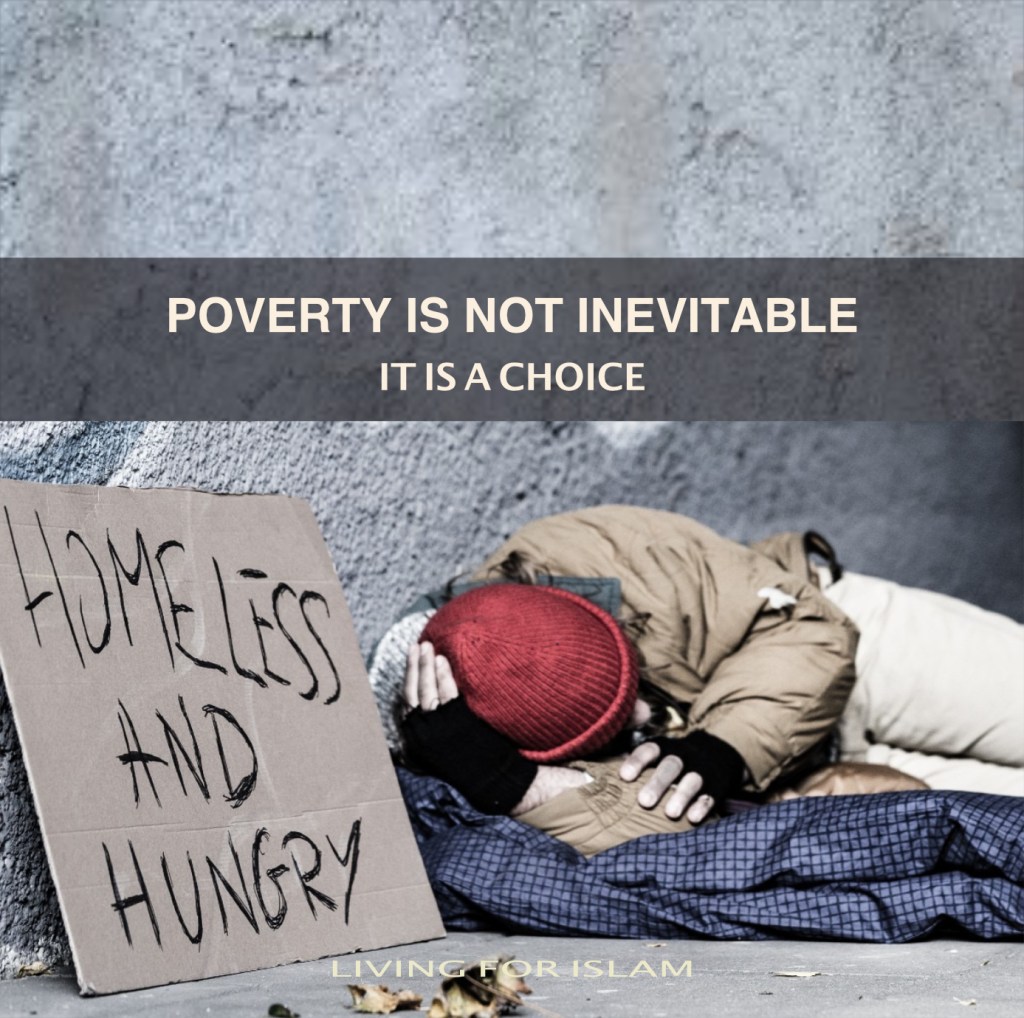
The JRF report should provoke more than concern. It should provoke a reckoning. Poverty on this scale is not inevitable. It persists because the dominant ideology does not see it as unacceptable.
Liberal secularism asks how poverty can be managed without disrupting markets. Islam asks why deprivation is allowed to exist at all.
Muslims should speak this truth clearly and confidently, in the West as a moral challenge to a system that normalises suffering, and in the Muslim world as a call to revive a comprehensive Islamic governance where poverty itself is treated as a violation of justice.
Until society is organised around responsibility before Allah, no number of reports, reforms, or promises will end poverty. Justice demands more than management. It demands a different foundation altogether.
 Living For Islam