
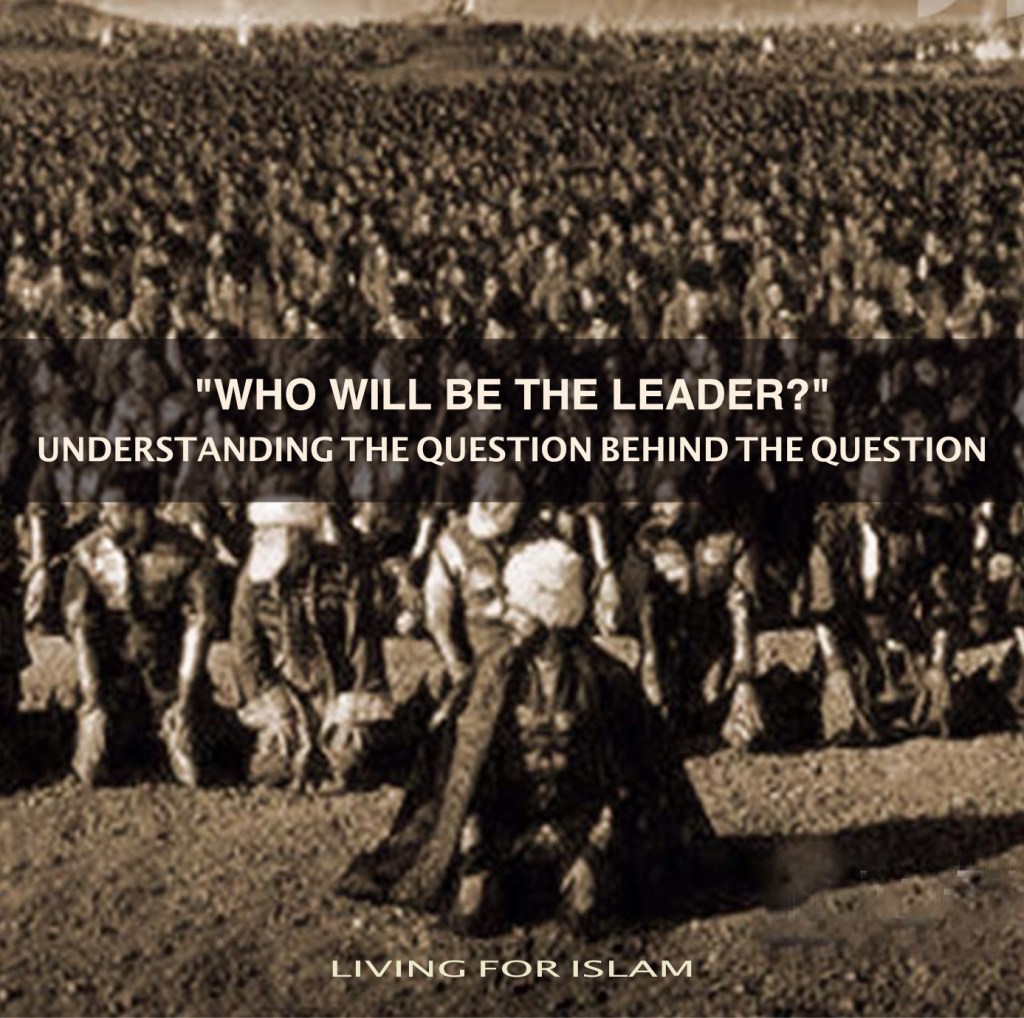
WHENEVER THE TOPIC of Islamic governance or the re-establishment of a khilafah arises, a familiar question often emerges: “But who will be the leader?”
This may be an honest and responsible question. Yet a closer examination often reveals that this question is not that, but more a way of preventing meaningful discussion.
This article aims to demonstrate that Islamic governance has a clear, systematic framework, one that does not require a specific individual to be identified before we can even discuss its principles or possibility.
What the Question Really Hides
In practice, the question “Who will be the leader?” rarely asks about process, accountability, or principles. More often, it subtly communicates:
“Unless we can identify a flawless, universally accepted individual right now, we should not even discuss governance.”
This assumption is modern in origin. It reflects a political culture conditioned to evaluate governance through personalities, charisma, and popularity rather than systems, law, and process. Implicitly, it assumes moral perfection is a prerequisite for legitimacy. Islam is seen to be pure, but politics is dirty.
Islam, however, never operated on this assumption. Islam is indeed pure, and its role is to elevate politics to something far more than we are accustomed to today.
Islamic Governance Is Realistic, Not Idealistic
Islamic governance was built on the recognition that rulers are fallible human beings who require restraint, accountability, and law. It does not demand perfect leaders or charismatic saviours. From the earliest days in Madinah, the emphasis was on establishing a constitutional and legal framework capable of functioning even under imperfect rulers.
Classical Sunni jurists such as al-Māwardī (al-Aḥkām al-Sulṭāniyyah, d. 1058) and Ibn Taymiyyah (Majmūʿ al-Fatāwā, d. 1328) consistently stressed that political legitimacy rests on objective conditions and accountability, not on charisma, popularity, or some special quality.
Islamic Governance is Practical
Classical Sunni jurisprudence outlines seven threshold conditions (shurūṭ al-inʿiqād) for a ruler:
- Muslim
- Male
- Mature (bāligh)
- Sane (ʿāqil)
- Just (ʿadl)
- Competent (kifāyah / qudrah)
- Free (ḥurr)
These conditions define minimum legal eligibility, not ideals of perfection or personal piety. They answer a limited but essential question: Who may lawfully assume authority? They say nothing about popularity, charisma, ethnicity, or universal approval.
The condition most often misunderstood is justice (ʿadl). In Islamic law, justice refers to public uprightness, the absence of open corruption, and reliability in fulfilling obligations. It does not mean sinlessness or moral infallibility. If it did, even the Rightly Guided khulafah, whose legitimacy is unanimously affirmed, would fail to qualify.
Al-Māwardī treats justice as a functional requirement for public trust, while Ibn Taymiyyah repeatedly emphasises that law restrains rulers, not personal virtue.
The Barrier of Nationalism
Notably absent from the seven conditions are ethnicity, nationality, tribe, geographic origin or modern citizenship
Yet many contemporary objections hinge precisely on these factors, often expressed as: “He must be one of us.”
Many Muslims today have been conditioned to believe that only someone from their own nation could legitimately rule them. Saudis struggle to imagine a non-Saudi ruler; Pakistanis are uneasy with the idea of a non-Pakistani one. These instincts are made to feel natural and ingrained in state constitutions, but they are not Islamic. They are the product of colonial borders and nationalist conditioning, not fiqh.
Throughout Islamic history, legitimacy flowed from law and competence, not ethnicity or geography. Scholars from Andalusia taught in Baghdad. A Berber could rule in Delhi. ʿUmar ibn al-Khaṭṭāb (ra) appointed governors outside their home regions, including Abū ʿUbaydah ibn al-Jarrāḥ (ra) over Syria. The Abbasids routinely appointed non-Arabs to govern provinces, prioritising capability over tribal affiliation.
Only with colonialism did rigid borders and rival national identities fragment the ummah. These divisions were designed to weaken Muslims politically, yet many have internalised them so deeply that Islamic governance itself now appears “unrealistic.”
Nationalism reframes the ummah as competing tribes with flags, making unity under Islam feel impossible even when its principles are clear.
Why the Leadership Question Persists
The persistence of “Who will be the leader?” may reflect real concerns, such as the fear of tyranny, chaos or of repeating past failures
Islam addresses these fears not by waiting for saints or angels, but by having a system that binds rulers to law, process and accountability. It obliges the ummah to hold its rulers to account through checks and balances to minimise negative outcomes. The solution is structural, not personal.
Islamic governance comes from the Qur’an and Sunnah, not from historical actions. The fact that past leaders failed to uphold trust, shūrā, or accountability does not negate these principles.
To argue that Islamic governance is impossible because historically the khilafah was imperfect is to confuse the system with its implementation. We do not abandon systems because of failure; we seek to implement them correctly.
In the absence of the khilafah, discussions about leadership must therefore focus on the framework that would govern authority, rather than attempting to preselect individuals in a vacuum.
Redirecting the Conversation
To engage meaningfully with Islamic governance, Muslims must shift their focus from personalities to principles. This knowledge of how the Islamic political system works has been missing and suppressed for over a hundred years following the fall of the Ottoman khilafah. It is not taught in the centres of learning across the Muslim world. The pulpits do not address these issues.
The questions that matter are:
- By what process is a ruler appointed?
- Who gives bayʿah, and what limits the ruler’s authority?
- What does a ruler do, and how is he held accountable or removed if he violates the law?
- How does the system operate, and what are its institutions that ensure justice and competence?
Until Muslims move from asking “Who will the leader be?” to asking “What system will govern him?”, leadership debates will remain stalled, not because answers are absent, but because the focus is misplaced.
Conclusion
Islamic governance is practical, not idealistic. The classical seven conditions define eligibility, not perfection. Legitimacy flows from law, process, and accountability, not from personality, charisma, or ethnic identity.
Obsessing over identifying a single “perfect leader” before even discussing governance is a modern distraction, a reflection of colonial conditioning and misplaced fear, not Islamic principle. There is a system. It is detailed, realistic, and rooted in revelation.
Understanding that Islamic system is the first step toward realising that Islamic governance is not impossible. Rather, it is the only solution for the Muslim world.
 Living For Islam