
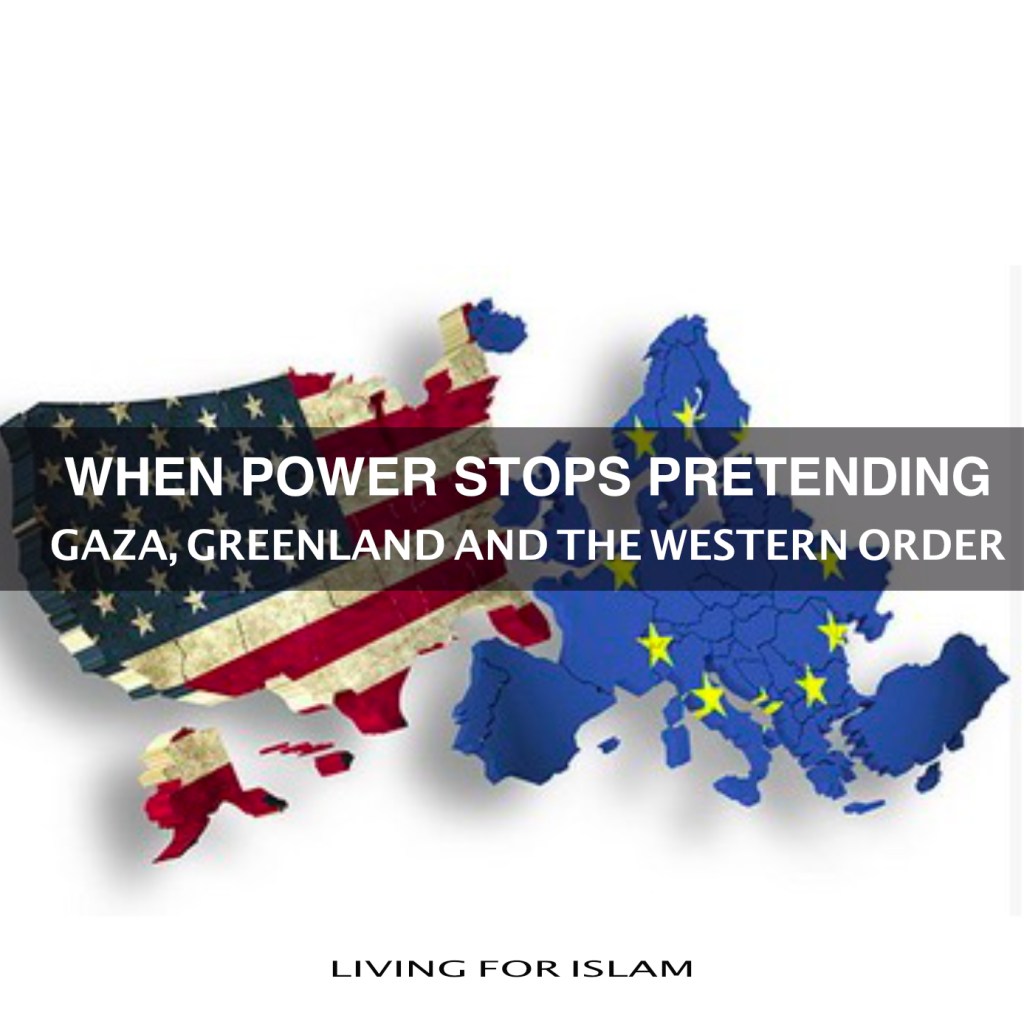
WHEN EUROPEAN LEADERS rushed to condemn Donald Trump’s remarks about “taking” Greenland, many Muslims watched with a familiar mix of clarity and disbelief. Not because Trump’s comments deserved defence, but because the sudden moral outrage exposed something long concealed: Western appeals to international law have never been rooted in principle. They have always been rooted in interest, wrapped in institutional language.
President Macron spoke of “respect over brutality.” EU officials warned of violations of sovereignty and the rule of law. The performance was polished and reassuring.
But for Muslims watching Gaza reduced to rubble while European arms factories benefit, the spectacle rang hollow. Trump, for all his vulgarity, had accidentally done something revealing. He stripped away the performance.
Trump does not excel at diplomacy, but he does excel at bluntness. When he says, “I want Greenland,” he is not invoking democracy or humanitarian concern. He is stating a raw geopolitical fact: power pursues interest.
European elites were not disturbed because Trump proposed something unprecedented. They were disturbed because he said openly what they prefer to pursue quietly. For decades, Western powers have advanced strategic interests under the banner of universal principles. Trump dispensed with the banner.
The difference is not moral. It is aesthetic.
The contrast between Europe’s response to Ukraine and its response to Gaza makes this unmistakably clear.
When Russia invaded Ukraine in February 2022, Europe reacted with speed and resolve. Sanctions followed within days. Billions in military aid were mobilised. Energy systems were restructured despite the domestic cost. Legal action was pursued. The moral language was absolute. There were no calls for “balance.” No hesitation about responsibility.
Now consider Gaza.
Since October 2023, tens of thousands of civilians have been killed. Entire neighbourhoods erased. Starvation, mass displacement, and the systematic destruction of civilian infrastructure are well-documented. Legal bodies issue warnings. Humanitarian organisations cry out.
And yet Europe hesitates. Accountability is delayed. Arms sales continue.
The difference is not the scale of suffering. It is not the clarity of the law. It is whose interests are at stake.
This is often described as hypocrisy. That is too generous. What we are witnessing is not inconsistency, but design.
International law, as it currently operates, is not a neutral moral order occasionally betrayed. It is a hierarchical system. It binds the weak. It disciplines adversaries. It remains negotiable for the powerful. Trump’s Greenland remarks matter because they abandon the ritual. European powers prefer the ritual, but both pursue interests first.
Even Western leaders now admit this openly.
At yesterday’s World Economic Forum in Davos, Canadian Prime Minister Mark Carney acknowledged that the so-called “rules-based international order” was unravelling, and had always relied on a shared fiction. Western states, he explained, joined its institutions, praised its principles, and benefited from its stability, even as powerful actors exempted themselves when convenient. What once served their interests no longer constrains them. The bargain no longer works.
This admission matters. It confirms that the moral language of the order was performance, not enforcement.
Europe’s politics reflect this reality. Leaders present a show of unity, but beneath it lies fragmentation driven by self-interest. They spoke together against Trump’s Greenland comments because their interests aligned. When Gaza demanded action that risked strategic loss, unity collapsed.
What appears as consensus is often factional alignment in disguise. As the Qur’an observes:
تَحْسَبُهُمْ جَمِيعًۭا وَقُلُوبُهُمْ شَتَّىٰ
You think they are united, but their hearts are divided. (al-Hashr 14)
Words can unite. Deeds expose division.
Muslims are often accused of cynicism for seeing this clearly. In truth, this clarity comes from experience. Bosnia, Afghanistan, Iraq, Syria, Libya, Palestine, we’ve seen it all before.
The pattern is consistent. Western powers act in the Muslim world to forward their interests, and they structure that engagement to neutralise Muslim political agency.
Islam offers a different moral logic.
Justice in Islam is not contingent on power or alliance.
يَـٰٓأَيُّهَا ٱلَّذِينَ ءَامَنُوا۟ كُونُوا۟ قَوَّٰمِينَ بِٱلْقِسْطِ شُهَدَآءَ لِلَّهِ وَلَوْ عَلَىٰٓ أَنفُسِكُمْ
Be persistently standing firm in justice, witnesses for Allah, even if it be against yourselves. (an-Nur 135)
Rights flow from human creation, not state permission. Rulers are subject to law, not above it.
These are not abstractions. They are governing principles.
But principles that demand justice beyond borders cannot survive within a political order built on fragmentation and competitive self-interest. If justice is genuinely transnational, political authority cannot remain artificially partitioned by the nation-state model.
This is where the Islamic political system of khilafah enters, not as nostalgia for empire, and not as a policy manual, but as a structural necessity. Principles that transcend the nation-state require political structures capable of doing the same.
Muslims lack such a structure today, not because it is unworkable, but because it was dismantled and consistently obstructed. From Sykes-Picot onward, fragmentation has been strategic. The global order can accommodate Muslim-majority states that play by its rules. It cannot tolerate a unified Muslim polity operating on a different worldview altogether.
Trump has done Muslims an unintended service. By abandoning the performance, he made the mechanism visible. The so-called rules-based international order was never about rules. It was about order, Western order, maintained by Western power and justified by Western institutions.
European outrage is not moral. It is professional.
Muslims possess actual principles, grounded in revelation rather than convenience. The fact that they are not currently implemented does not negate their truth. It clarifies the task ahead.
The blueprint exists. The need is urgent. And no one else will build a just order on our behalf.
 Living For Islam