
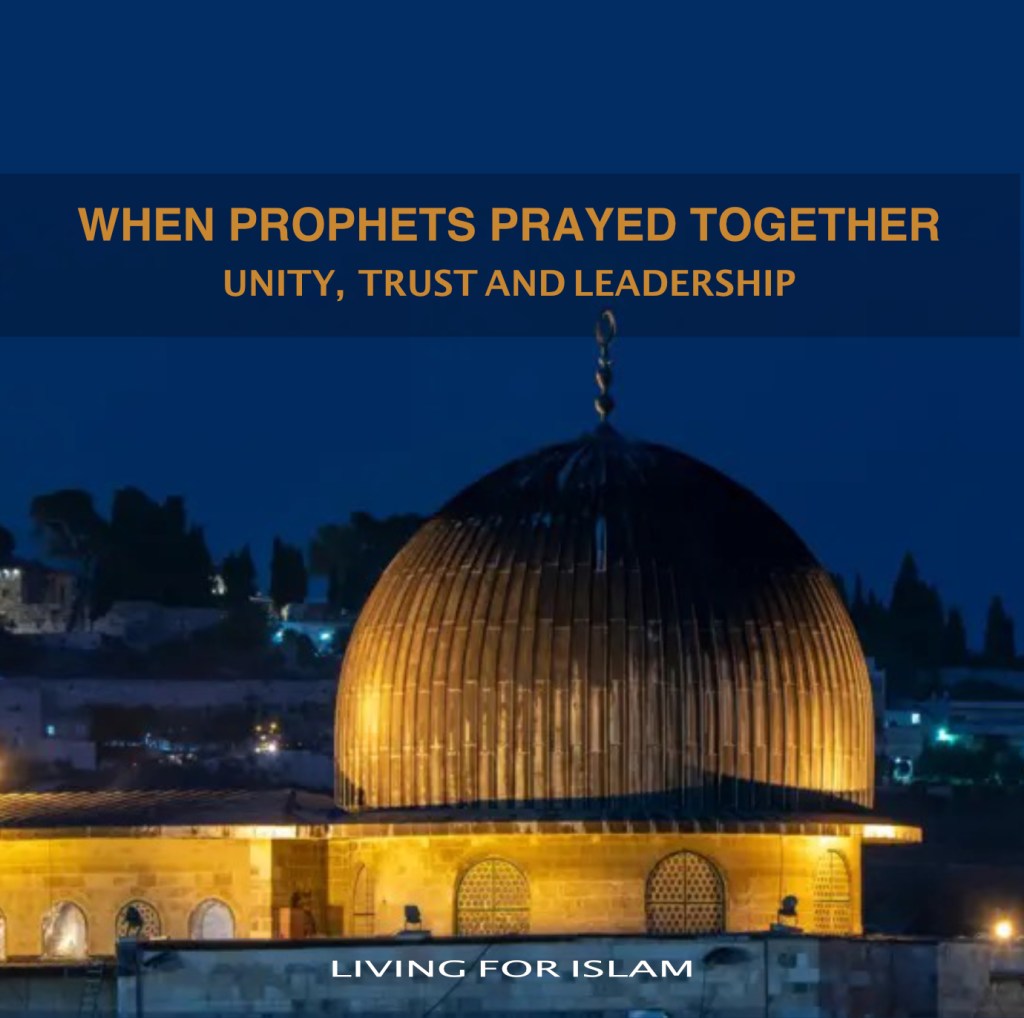
AMONG THE MOST profound moments in the life of the Prophet Muhammad ﷺ is the Night Journey (al-Isrāʾ wa al-Miʿrāj), and within it, a scene of immense theological and civilizational significance: the Prophet ﷺ leading all the prophets in prayer at al-Masjid al-Aqsa.
This moment is not merely an honour bestowed upon the final Messenger of Allah ﷺ, the Seal of the Prophets. It is a declaration of Islam’s relationship to all previous revelations, a statement of continuity rather than rupture, and a concluding model for how sacred space is to be understood and governed.
Prophetic Leadership Without Erasure
When the Messenger ﷺ stood at al-Aqsa and led the prophets, among them Ibrahim, Musa, and ʿIsa (peace be upon them all), he did not negate them. Rather, he affirmed them. His leadership was not ethnic, tribal, or exclusive; it was bound in the same purpose and mission that unites all prophets, tawhid, laa ilaha illallah.
Islam presents itself not as a new religion severed from the past, but as the culmination and preservation of a single divine message:
قُولُوٓا۟ ءَامَنَّا بِٱللَّهِ وَمَآ أُنزِلَ إِلَيْنَا وَمَآ أُنزِلَ إِلَىٰٓ إِبْرَٰهِـۧمَ وَإِسْمَـٰعِيلَ وَإِسْحَـٰقَ وَيَعْقُوبَ وَٱلْأَسْبَاطِ وَمَآ أُوتِىَ مُوسَىٰ وَعِيسَىٰ وَمَآ أُوتِىَ ٱلنَّبِيُّونَ مِن رَّبِّهِمْ لَا نُفَرِّقُ بَيْنَ أَحَدٍۢ مِّنْهُمْ وَنَحْنُ لَهُۥ مُسْلِمُونَ
Say, (O believers) “We believe in Allah and what has been revealed to us; and what was revealed to Ibrahim, Ismael, Ishaq, Yaqub, and his descendants; and what was given to Musa , Isa, and other prophets from their Lord. We make no distinction between any of them. And to Allah we all submit.” (al Baqarah 136)
The image of all the prophets praying together in Jerusalem establishes al-Aqsa not as the property of one people in one era, but as a sacred trust rooted in tawḥīd. The final Prophet ﷺ leads, yet all are honoured. And just as the imam of the congregation is responsible for those behind him, Islam is responsible for this Blessed land.
Jerusalem Under Islamic Rule: A Historical Reflection of This Ethos
This prophetic vision did not remain abstract. It found expression in history.
When ʿUmar ibn al-Khaṭṭāb (ra) entered Jerusalem in 637 CE, he did so not as a conqueror seeking domination, but as a custodian seeking to restore justice. The Covenant of ʿUmar guaranteed security for Christian lives, churches, and property. Jews, who had been barred from Jerusalem under Byzantine Christian rule, were permitted to return and live there once again.
For centuries under Islamic governance, Umayyad, Abbasid, Ayyubid, Mamluk, and Ottoman, Jerusalem remained a city of plural worship. Mosques, churches, and synagogues existed within walking distance of one another. Disputes existed, as they do in all societies, but the organising principle was coexistence under divine accountability, not exclusivist supremacy.
This reality was not accidental. It flowed directly from Islam’s understanding of custodianship (khilafah) and the protection of sacred space.
وَلَوْلَا دَفْعُ ٱللَّهِ ٱلنَّاسَ بَعْضَهُم بِبَعْضٍۢ لَّهُدِّمَتْ صَوَٰمِعُ وَبِيَعٌۭ وَصَلَوَٰتٌۭ وَمَسَـٰجِدُ يُذْكَرُ فِيهَا ٱسْمُ ٱللَّهِ كَثِيرًۭا
Had Allah not repelled (the aggression of) some people by means of others, destruction would have surely claimed monasteries, churches, synagogues, and mosques in which Allah’s Name is often mentioned. (al Hajj 40)
A community that believes Musa and ʿIsa (peace be upon them) are prophets of Allah cannot justify their eradication or exclusion.
The Crusades: Sacred Space Through the Lens of Exclusion
This Islamic model stands in stark contrast to the Crusader occupation of Jerusalem in 1099 CE. The Crusaders did not see Jerusalem as a shared trust. They saw it as an exclusive possession.
Historical accounts, including those from Christian chroniclers, record the mass slaughter of Muslims and Jews alike. Synagogues were burned with worshippers inside. Mosques were desecrated. Bloodshed was framed as sanctification.
Where Islam sought to protect faith and life, the Crusaders sought purity through domination. Sacredness was redefined as the absence of the “other.”
Salahuddin and the Restoration of Prophetic Ethics
The difference between these two visions became unmistakably clear less than a century later with the liberation of Jerusalem by Salahuddin al-Ayyubi (may Allah have mercy on him) in 1187 CE.
When Salahuddin entered the city after defeating the Crusader forces, he did not mirror their crimes, despite having every political and emotional justification to do so. Instead, he consciously reversed them. Civilians were spared. Churches were protected. Ransoms were set at humane levels, and many who could not pay were freed regardless. Jewish families, massacred or expelled during Crusader rule, were once again allowed to return and resettle in Jerusalem.
Salahuddin’s conduct was not an act of personal generosity alone. It was a deliberate application of Islamic principles of justice, mercy, and restraint. He understood Jerusalem not as a trophy of war, but as an amanah. His actions echoed the precedent of ʿUmar ibn al-Khaṭṭāb (ra) and, more fundamentally, the prophetic ethos embodied by the Messenger ﷺ at al-Aqsa.
Under Salahuddin and subsequent Muslim rule, Jerusalem returned to being a city where Muslims, Christians, and Jews lived and worshipped in relative security. Sacred space was restored to its proper meaning, not domination through exclusion, but dignity through justice.
Justice as The Crux of Authority
Salahuddin’s legacy illustrates a central Islamic principle: legitimacy is not derived from power alone, but from restraint. Where the Crusades sought to sanctify violence, Salahuddin disciplined power with accountability to Allah. Where others erased communities, he protected them. Where others claimed divine entitlement, he demonstrated divine responsibility.
This is why Salahuddin remains respected not only in Muslim memory but even in Western historical tradition. His rule exposed the ethical emptiness of exclusivist claims to Jerusalem and reaffirmed Islam’s civilizational vision, one in which leadership serves all who revere Allah, not only those who rule in His name.
From Ottoman Stewardship to Zionist Exclusivity
Following the fall of the Ottoman Khilafah in the early 20th century, Jerusalem entered a new and destabilising phase. British colonial administration, followed by the Zionist occupation, transformed the blessed land from a sacred trust open to all into a site of ideological exclusivity.
Zionism, unlike Judaism as a faith, is premised on ethno-religious nationalism. Its logic is not coexistence, but replacement. Palestinians, Muslim and Christian alike, have been displaced, dispossessed, and subjected to legal and physical marginalisation. The genocide in Gaza and the continued settlement of the West Bank is open for all to see.
This framework is fundamentally incompatible with the scene at al-Aqsa during al-Isrāʾ. A project that denies the legitimacy, presence, and rights of others in Jerusalem stands in opposition to the very moment when all prophets stood shoulder to shoulder in prayer.
Al-Aqsa as an Amanah Awaiting to be Reclaimed
The Night Journey teaches Muslims that leadership over sacred space is not about dominance, but responsibility. The Messenger ﷺ did not lead the prophets to claim ownership over them, but to affirm a trust.
Jerusalem flourished when it was governed according to this trust, when rulers saw themselves as guardians, not owners of rivieras and real estate; when faith was protected, not weaponised.
For Muslims today, al-Aqsa is more than a political issue; it is a moral guide. It reminds us of an Islam that is confident, inclusive, principled, and respectful of others.
The prayer at al-Aqsa was a glimpse of a divinely ordered world. One where revelation unites people rather than fragments. Reclaiming al-Aqsa, therefore, is not only about land. It is about reclaiming that prophetic vision of leadership and trust.
 Living For Islam