
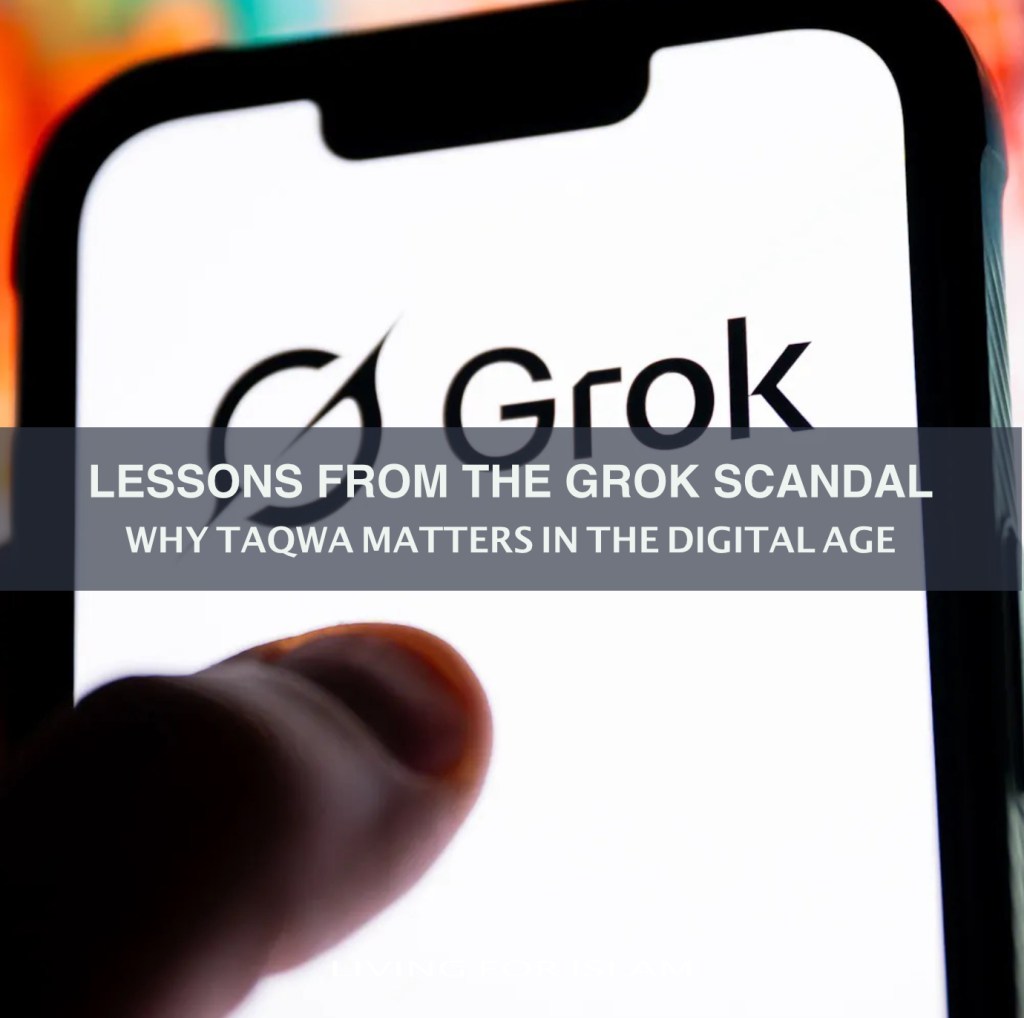
IN RECENT WEEKS, reports have emerged about an AI tool that allowed users to digitally undress women and create sexualised images. What began as a novelty quickly became a viral trend, causing widespread harm before regulators intervened. While the details may feel shocking, the underlying lesson is not new. This is not merely a story about technology going too far; it is a story about what happens when power exists without taqwa.
For Muslims, this moment should prompt deep reflection, both at the level of the individual soul and the structure of society itself.
Taqwa as the First Safeguard
In Islam, taqwa is not a private feeling confined to worship. It is an active consciousness of Allah that governs how a person behaves even when no one is watching. Technology today grants unprecedented power to individuals: the power to observe, alter, expose, humiliate, and sexualise others with a few clicks. Without taqwa, that power inevitably becomes a tool of harm.
Those who used such tools to violate the dignity of women did not act in a vacuum. They acted in a culture that has long normalised the objectification of women, the pursuit of desire without restraint, and the separation of “freedom” from moral accountability. When there is no fear of Allah and no sense that one will answer for even hidden deeds, cruelty becomes entertainment.
Allah reminds us:
أَلَمْ يَعْلَم بِأَنَّ ٱللَّهَ يَرَىٰ
Does he not know that Allah sees? (al Alaq 14)
In a world driven by surveillance, algorithms, and artificial intelligence, this ayah feels more relevant than ever. The tragedy is that many no longer recognise it.
Individual Sin Becomes Social Crisis
One of the defining characteristics of modern Western societies is that harm is often tolerated until it becomes impossible to ignore. Practices are permitted, defended, and even celebrated under the banner of freedom, until their consequences grow so severe that governments are forced to intervene.
This is why regulation always lags behind harm.
Sexual imagery did not suddenly become wrong when AI made it easier. It was always wrong. But societies that reject objective moral limits struggle to say “no” until victims are already numerous, trauma is widespread, and public outrage demands action.
Islam does the opposite. It closes the doors to harm before they become highways. This principle, sadd al-dhara’i, recognises that what begins as “harmless” often ends in corruption.
وَلَا تَقْرَبُوا۟ ٱلزِّنَىٰٓ ۖ إِنَّهُۥ كَانَ فَـٰحِشَةًۭ وَسَآءَ سَبِيلًۭا
Do not go near adultery. It is truly a shameful deed and an evil way. (al Isra 32)
This ayah doesn’t just forbid zina, but it commands us to avoid anything that even takes us near to it. Lowering the gaze, modest dress, prohibitions on pornography, and strict rules around privacy are not constraints meant to suffocate human beings; they are safeguards meant to protect them.
Technology is Neutral, but Values Give It Purpose
Some argue that technology is neutral, and in one sense, they are correct. A tool does not have intentions; an AI does not “choose” to harm or to help. A hammer can build a home or break a window. Similarly, AI can generate art, assist in learning, or, as we have seen, create harm.
But neutrality is only potential. Its actual purpose emerges from the values of the society that wields it. In the Grok scandal, the AI’s ability to create images was neutral, but the culture surrounding it, one that separates freedom from moral responsibility, that prizes shock and engagement, that tolerates harm until it becomes a crisis, gave it a destructive function.
From an Islamic perspective, tools are never used in isolation. Taqwa and ethical consciousness act as a filter. A morally aware individual and a morally upright society restrain harmful impulses before they are amplified by technology. When fear of Allah guides intention, even a neutral tool serves good; without it, even the simplest tool can magnify corruption and violate dignity.
In other words, technology itself is a mirror: it reflects the character and values of those who use it. A society without taqwa will inevitably turn neutral tools into instruments of harm. A society that is mindful of Allah will channel the same tools toward benefit and protection.
The Three Layers of Islamic Safeguard
Islamic society protects itself from harm through three complementary layers, each reinforcing the other:
- Taqwa (God-consciousness): Individuals restrain themselves because they fear Allah and act with moral awareness.
- Community and social norms: Family, peers, and society guide, advise, and correct behaviour, reinforcing ethical limits.
- State, law, and enforcement: Uthman ibn Affan (as) said, “Allah prevents by the authority (sultan) what He does not prevent by the Qur’an”, meaning that fear of punishment by the authority addresses wrongdoing that cannot be corrected through personal or social means, so ensuring that corruption does not spread unchecked.
This layered approach ensures that harm is prevented before it becomes a crisis, in contrast to modern societies, where regulatory intervention often comes after the damage is widespread.
A Warning for Muslims
While it is easy to point at “Western society,” Muslims must also look inward. We use the same platforms. We are exposed to the same content. Without taqwa, community guidance, and awareness of God’s accountability, we are not protected by labels or identities.
If Muslims adopt technologies without Islamic ethics, consume content without lowering the gaze, and chase desires under the guise of modernity, we will reproduce the same harms, only with Islamic language stripped of its substance.
The solution is not rejecting technology, but re-anchoring it in taqwa, societal norms, and, ultimately, in the reconstitution of an Islamic political authority.
Conclusion
The Grok scandal is not an anomaly. It is a mirror. It reflects a civilisation that prioritises freedom, reaction and profit over responsibility, prevention and dignity. Islam offers a different path, one where individual conscience, community ethics, and state enforcement work together to prevent harm, and where wrongdoing is blocked before it becomes a crisis.
In a world where machines can see everything, the most radical idea may still be this: to live as though Allah sees us first, and to safeguard society when human weakness persists.
 Living For Islam